In most cases, you cannot deduct a house remodel on your taxes in the year you complete the work, but the costs are rarely lost. The IRS treats most home improvements as capital expenses, which adjust your home’s cost basis and reduce taxable gains when you sell. Specific situations, such as medical modifications, rental property upgrades, or home office improvements, may unlock partial or full deductions in different ways.
Are House Remodels Tax Deductible? The Direct Answer
A standard house remodel on your primary residence is not directly tax deductible. The IRS classifies most remodeling work as a capital improvement, meaning the cost is added to your home’s basis rather than written off in the current tax year. You recover the tax benefit later, when you sell, by reducing your taxable capital gain. Specific exceptions apply for rental units, home offices, energy-efficient upgrades, and medically necessary modifications.
When Remodels Are NOT Deductible (Personal Use)
Remodels on a home used purely as a personal residence cannot be deducted as a yearly expense. This includes kitchen renovations, bathroom upgrades, flooring replacement, painting, and similar improvements. The IRS views these as personal expenses tied to your lifestyle, not income-producing activities. Even large projects like full remodeling services or room additions follow the same rule. Keep every receipt, contract, and invoice, because these costs still matter when calculating your cost basis at sale.
When Remodels ARE Deductible (Specific Scenarios)
Certain remodels qualify for tax treatment in the year of the work. Medically necessary modifications, such as wheelchair ramps, walk-in tubs, or stairlifts, may be deducted as medical expenses if they exceed the IRS threshold. Energy-efficient improvements like qualifying windows, insulation, or heat pumps may earn federal tax credits. Remodels tied to rental units or a dedicated home office follow separate depreciation and deduction rules that can produce meaningful annual tax savings.
The deductibility question opens directly into the larger issue of tracking qualified capital improvements, which determines how much of your remodel returns to you at sale.
How Capital Improvements Reduce Your Tax Bill Later
When a remodel qualifies as a capital improvement, the cost increases your home’s adjusted cost basis. A higher basis means a smaller taxable gain when you sell, which can save thousands in capital gains tax. Qualifying work must add value, extend useful life, or adapt the home to new uses. Examples include room additions, new roofing, HVAC system replacements, finished basements, and major plumbing or electrical upgrades. Routine repairs like patching drywall or fixing a leaky faucet do not qualify.
Tracking Costs and Adjusted Cost Basis
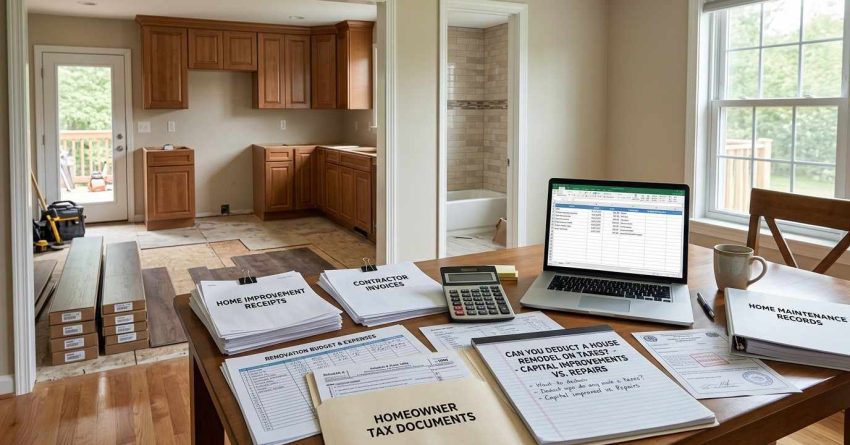
Accurate records are the foundation of any future tax benefit. Save itemized invoices, contractor agreements, permits, and proof of payment for every qualifying project. Organize them by year and project type, since the IRS may request documentation decades later when you sell. Digital folders, labeled receipts, and a simple spreadsheet that tracks running totals will protect your basis calculation and ensure no eligible improvement is overlooked.
Remodel Deductions for Rental and Home Office Use
If you remodel a rental unit, the rules change significantly. Improvements must generally be depreciated over 27.5 years for residential rentals, while certain repairs can be deducted immediately. Investors should review remodel costs on rental property closely to separate deductible repairs from capital improvements.
For homeowners running a qualified business from home, a portion of remodel costs tied to that space may follow home office improvement rules, which allow partial depreciation based on square footage.
Conclusion
Most house remodels are not deductible in the current year, but they protect your future tax position by raising your cost basis. Rental, home office, energy, and medical-related remodels offer additional pathways to real tax savings when documented correctly.
For homeowners and property managers planning their next renovation, Mr. Local Services connects you with trusted remodeling professionals and detailed records that support every tax-smart decision you make.
Frequently Asked Questions
Can I deduct a kitchen remodel on my primary home?
No, a kitchen remodel on a personal residence is not deductible. The cost is added to your home’s basis and reduces capital gains tax when you sell.
Are energy-efficient remodels tax deductible?
Qualifying energy-efficient upgrades like heat pumps, insulation, and ENERGY STAR windows may earn federal tax credits, reducing your tax bill directly in the year installed.
Can landlords deduct remodel costs on a rental property?
Yes, but most improvements must be depreciated over 27.5 years. Routine repairs that maintain the property may be deducted in full the same tax year.
Do medically necessary home modifications qualify for deductions?
Yes, modifications like ramps, grab bars, or accessibility upgrades may be deducted as medical expenses if total qualifying costs exceed the IRS adjusted gross income threshold.
How do I prove remodel costs to the IRS years later?
Keep itemized invoices, signed contracts, permits, and payment records. Store everything digitally and by project to support cost basis adjustments at sale.