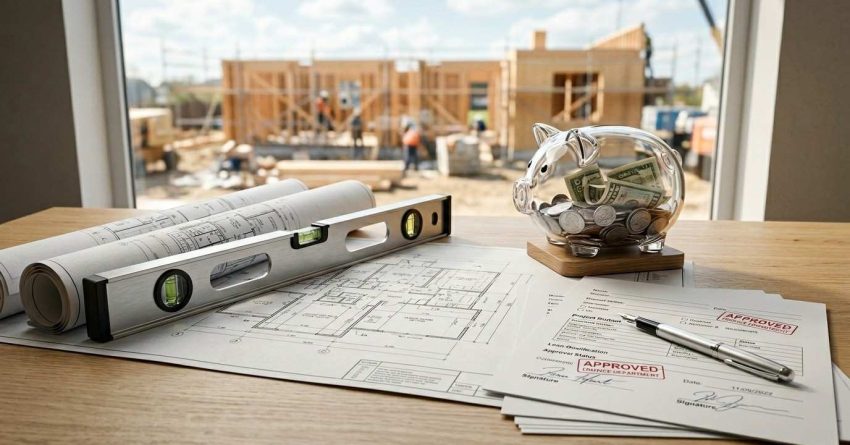
Qualifying for a construction loan requires meeting stricter standards than a traditional mortgage — lenders typically require a credit score of 680 or higher, a down payment of 20–25%, and a fully approved builder and project plan before they will commit funds.
Understanding these requirements upfront saves time, prevents costly surprises, and puts you in the strongest possible position when you sit down with a lender. This guide covers every qualification factor — from credit and income standards to documentation, project approval, and what to do if your first application is denied.
What Is a Construction Loan and How Does It Work?
A construction loan is a short-term financing product that covers the cost of building a new home or completing a major renovation. Unlike a traditional mortgage, which releases the full loan amount at closing, a construction loan releases funds in stages — called draws — as each phase of the project is completed and verified by the lender.
Most construction loans carry a term of 12 to 18 months, covering the active building period. During this time, borrowers typically pay interest only on the funds drawn, not the full loan amount. Once construction is complete, the loan either converts to a permanent mortgage or is paid off through a separate refinance.
How Construction Loans Differ from Traditional Mortgages
Traditional mortgages are secured by an existing property with a known market value. Construction loans are secured by a property that does not yet exist, which is why lenders apply stricter qualification standards. The lender is taking on more risk — the home must be built correctly, on time, and within budget before the collateral has real value.
Types of Construction Loans Available in the USA
The three most common construction loan types are construction-only loans, construction-to-permanent loans, and owner-builder loans. Construction-only loans cover the build period and require a separate mortgage at completion. One of the most popular paths is construction-to-permanent loans, which roll your building financing and long-term mortgage into a single closing — a dedicated guide to this loan type walks through how the conversion works and when it makes sense.
Construction loans are one of several home financing options available to buyers and builders — our complete home financing guide covers every loan type, eligibility path, and lender comparison you need to make a confident decision.
Basic Eligibility Requirements for a Construction Loan
Lenders evaluate construction loan applicants across four core areas: credit history, income stability, debt levels, and the viability of the construction project itself. Meeting the threshold in all four areas is required — a strong score in one area does not compensate for a weakness in another.
Most conventional lenders require a minimum credit score of 680, though some programs accept scores as low as 620 with compensating factors. Income must be verifiable and consistent, typically documented through two years of tax returns and recent pay stubs. Self-employed borrowers face additional scrutiny and must demonstrate stable business income over the same period.
Credit Score Requirements for Construction Financing
Credit score requirements for construction loans are higher than for standard purchase mortgages because of the elevated risk involved. Conventional lenders generally require a score of 680 or above. FHA construction loan programs may accept scores as low as 620, but these programs carry additional requirements and mortgage insurance costs.
A detailed breakdown of credit score requirements for home loans explains exactly where lenders draw the line and how to improve your standing before applying.
Debt-to-Income Ratio and Financial Health Standards
Your debt-to-income ratio, or DTI, measures how much of your gross monthly income goes toward existing debt payments. Most construction lenders cap DTI at 43–45%, though some conventional programs allow up to 50% with strong compensating factors such as significant cash reserves or a high credit score.
To calculate your DTI, add all monthly debt obligations — including car payments, student loans, credit card minimums, and any existing mortgage — and divide by your gross monthly income. If your DTI exceeds the lender’s threshold, paying down existing debt before applying is the most direct path to improving your eligibility.
Down Payment and Equity Requirements
Construction loans require a larger down payment than most traditional mortgages. Most lenders require between 20% and 25% of the total project cost, which includes land, materials, labor, permits, and contingency reserves. Some lenders calculate the down payment against the appraised value of the completed home rather than the total project cost.
The higher down payment requirement reflects the lender’s need to protect against cost overruns, project delays, and the possibility that the completed home appraises below the projected value. Borrowers who own their land outright may be able to use that equity as part or all of their down payment, depending on the lender’s policies.
How Much Do You Need to Put Down?
For a $400,000 construction project, a 20% down payment equals $80,000 and a 25% requirement equals $100,000. These figures represent the minimum — lenders may require more if the project is complex, the borrower’s credit profile is borderline, or the builder has limited experience. Having additional cash reserves beyond the down payment also strengthens your application, as lenders want to see that you can absorb unexpected costs without defaulting.
Documentation You Need to Qualify
Construction loan applications require significantly more documentation than standard mortgage applications. Lenders need to verify your financial health and the viability of the project before committing funds to a home that does not yet exist.
Gathering all required documents before you begin the application process reduces delays and demonstrates organizational readiness to the lender. A complete loan application checklist outlines every financial and project document lenders typically require so nothing is missed. Financial Documents Lenders Require
Personal financial documentation typically includes two years of federal tax returns, two months of bank statements, recent pay stubs covering the last 30 days, W-2s or 1099s for the past two years, a list of all current debts and monthly obligations, and documentation of any assets used toward the down payment. Self-employed borrowers must also provide a year-to-date profit and loss statement and may need a CPA letter confirming business stability.
Project and Builder Documentation
Project documentation is equally important and often the area where applications stall. Lenders require a signed contract with a licensed general contractor, a detailed construction timeline, a complete itemized budget covering all project phases, architectural plans and specifications, proof of permits or permit applications, and evidence of builder’s risk insurance. Some lenders also require a construction management plan outlining how draws will be requested and verified.
How Lenders Evaluate Your Construction Project
Beyond your personal financial profile, lenders conduct a thorough evaluation of the construction project itself. This evaluation determines whether the project is financially sound, whether the builder is qualified, and whether the completed home will be worth enough to justify the loan amount.
Appraised Value of the Completed Home
Before approving a construction loan, lenders order an appraisal of the home based on the architectural plans, specifications, and comparable sales in the area. This is called an “as-completed” or “subject-to” appraisal. The loan amount is typically capped at a percentage of this appraised value — usually 80–90% — which means if the appraised value comes in lower than your project cost, you may need to increase your down payment or reduce the project scope.
Builder Approval and Contractor Credentials
Lenders do not simply approve the borrower — they also approve the builder. Most lenders require the general contractor to be licensed, insured, and bonded in the state where the project is located. They may also review the builder’s financial statements, references from previous projects, and track record of completing projects on time and within budget.
A practical guide to vetting a home builder covers the credentials, licenses, and track record lenders look for before approving your project.
The Construction Loan Application Process Step by Step
The construction loan application process follows a defined sequence that differs from a standard mortgage application. Understanding each step in advance helps you prepare the right materials and avoid delays.
A clear construction planning steps guide strengthens every part of your loan application before you submit.
The process typically begins with pre-qualification, where the lender reviews your credit, income, and general project scope to determine whether you are likely to qualify. Pre-qualification is followed by formal application, during which you submit all financial and project documentation. The lender then orders the as-completed appraisal and conducts a full underwriting review of both your financial profile and the construction project.
Once underwriting is complete, the lender issues a commitment letter outlining the loan terms, draw schedule, and conditions of approval. Closing follows, at which point the loan is funded and construction can begin. Draws are released at each project milestone after a lender-ordered inspection confirms the work has been completed as planned.
What Happens After You Submit Your Application?
After submission, the lender’s underwriting team reviews your file, which typically takes 30 to 60 days for a construction loan — longer than a standard mortgage due to the additional project documentation involved. During this period, the lender may request additional documentation or clarification. Responding promptly to these requests keeps the process moving and demonstrates your readiness to the lender.
Common Reasons Construction Loan Applications Are Denied
Understanding why applications are denied helps you address weaknesses before submitting. The most common denial reasons include a credit score below the lender’s minimum threshold, a DTI ratio that exceeds program limits, an insufficient down payment or lack of verifiable assets, an unapproved or underqualified builder, an as-completed appraisal that comes in below the project cost, incomplete or inconsistent project documentation, and a construction budget that lacks adequate contingency reserves.
In many cases, denial is not permanent. Lenders who decline an application are required to provide a written explanation, which gives you a clear roadmap for what to address before reapplying.
Tips to Strengthen Your Construction Loan Application
Preparation is the most effective tool for improving your qualification odds. Start by pulling your credit report at least six months before applying and addressing any errors, late payments, or high utilization rates. Pay down revolving debt to reduce your DTI, and avoid opening new credit accounts in the months leading up to your application.
Choose your builder carefully and verify their licensing, insurance, and project history before presenting them to the lender. A builder with a strong track record and clean financial standing significantly improves your file. Prepare a detailed, realistic construction budget with a contingency reserve of at least 10–15% of the total project cost — lenders view this as evidence of financial planning and risk awareness.
Our home financing guide provides a broader look at how lenders assess borrowers across all loan types, giving you a complete picture of what to work toward as you prepare your application.
Conclusion
Qualifying for a construction loan requires meeting clear standards across credit, income, down payment, documentation, and project viability — each factor carries real weight in the lender’s decision.
Addressing weaknesses in your financial profile before applying, selecting a qualified builder, and preparing thorough project documentation are the three actions that most directly improve your approval odds.
At Mr. Local Services, our network of skilled professionals can help you prepare your property and project for lender review — connect with a trusted expert today and take the next step toward building with confidence.
Frequently Asked Questions About Construction Loan Qualification
What credit score do I need to qualify for a construction loan?
Most conventional lenders require a minimum credit score of 680 for a construction loan. FHA construction programs may accept scores as low as 620, but these typically require mortgage insurance and additional documentation to offset the higher risk.
How much of a down payment is required for a construction loan?
Construction loans typically require a down payment of 20–25% of the total project cost. Borrowers who own land outright may be able to apply that equity toward the down payment requirement, depending on the lender’s specific policies.
Can I use a construction loan to renovate an existing home?
Yes. Renovation construction loans, sometimes called construction-to-permanent renovation loans or FHA 203(k) loans, are designed to finance major home improvements. Eligibility requirements are similar to new construction loans, including credit, income, and contractor approval standards.
How long does it take to get approved for a construction loan?
Construction loan approval typically takes 30 to 60 days from the time a complete application is submitted. The extended timeline reflects the additional underwriting required to evaluate both the borrower’s financial profile and the construction project itself.
Do I need a licensed contractor to get a construction loan?
Yes. Most lenders require the general contractor to be licensed, bonded, and insured in the state where the project is located. Owner-builder loans exist for borrowers who want to act as their own contractor, but these programs carry stricter requirements and are offered by fewer lenders.
What is an as-completed appraisal and why does it matter?
An as-completed appraisal estimates the market value of the home once construction is finished, based on the architectural plans and local comparable sales. Lenders use this figure to determine the maximum loan amount — if the appraisal comes in below the project cost, you may need to increase your down payment or reduce the project scope.
What happens if my construction project goes over budget?
Cost overruns are not automatically covered by the construction loan. If the project exceeds the approved budget, you are responsible for covering the difference out of pocket. This is why lenders require a contingency reserve — typically 10–15% of the total project cost — and why accurate budgeting before application is essential.