
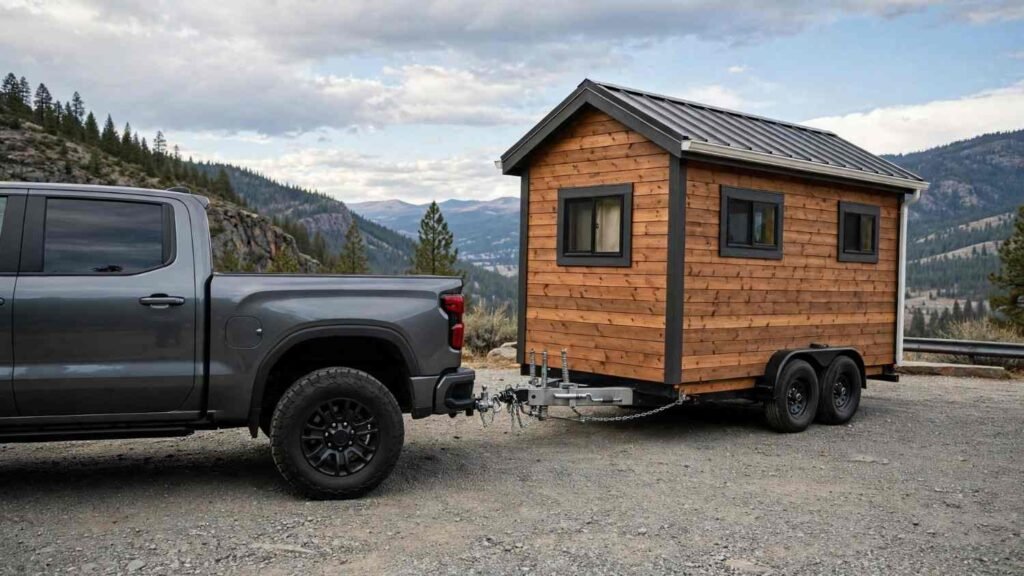
Towing a tiny house safely comes down to one number most people never check: tongue weight. Get it wrong and the trailer sways at highway speed no matter how good the truck is. I’ve watched this topic trip up new tiny house owners more than any other part of the build.
This guide exists because towing mistakes cause real accidents, and most of them are preventable with the right setup and knowledge. A tiny house on wheels behaves nothing like a standard camper once weight gets distributed poorly.
I walk through the weight fundamentals that determine whether your rig tows straight, the equipment and vehicle setup that makes towing safe, the sway prevention and inspection habits that catch problems early, and the legal rules and driving techniques that keep you compliant and in control on the road.
Understanding Tiny House Weight Classifications and GVWR
Gross Vehicle Weight Rating is the maximum total weight a trailer and its cargo can safely reach. GVWR is a manufacturer-assigned limit that accounts for the trailer’s frame strength, axle capacity, and tire rating combined.
I always start here because everything else in this guide depends on knowing this number first. A tiny house trailer typically carries a GVWR between 10,000 and 22,000 pounds, and building beyond that limit compromises the entire structure.
Dry Weight vs. Loaded Weight
Dry weight is the trailer’s weight with no furniture, water, propane, or belongings loaded in. Loaded weight adds all of that back, and it climbs fast once appliances, water tanks, and furniture go in.
I tell every tiny house owner to weigh the finished house at a certified scale before the first tow. Guessing at loaded weight is how people end up exceeding GVWR without realizing it.
How GVWR Is Calculated for Trailers
Manufacturers calculate GVWR by adding the trailer’s unloaded weight to its maximum rated cargo capacity. The Federal Motor Carrier Safety Administration sets structural standards that inform how axle and frame capacity translate into a safe GVWR figure.
That number sits on a metal plate near the trailer’s tongue or axle. I check it every time I inspect a tiny house build, because it’s the single fastest way to catch an overloaded trailer before it hits the road.
Tongue Weight and Why It Determines Towing Stability

Tongue weight is the downward force the trailer’s hitch applies to the tow vehicle. It’s the single biggest factor in whether a tiny house tows straight or starts swaying at speed.
I’ve seen well-built tiny houses become dangerous simply because the water tank sat too far back. Weight distribution inside the trailer matters just as much as the total weight.
Ideal Tongue Weight Percentage
Tongue weight should sit between 10% and 15% of the total loaded trailer weight for stable towing. Too little weight up front invites sway, and too much overloads the tow vehicle’s rear axle.
I measure this with a tongue weight scale before every long tow, not just once during the build. Weight shifts as propane tanks empty and water gets used, so the percentage moves during a trip.
Signs of Improper Tongue Weight
A trailer that sways noticeably at highway speed usually has too little tongue weight. A tow vehicle whose rear end squats down heavily signals the opposite problem, too much weight up front.
I pull over and redistribute cargo the moment I feel either symptom. Continuing to drive with bad tongue weight is one of the fastest ways to lose control of a trailer.
Choosing the Right Tow Vehicle for Your Tiny House
The tow vehicle needs a payload and towing capacity that comfortably exceeds the tiny house’s fully loaded weight. I never recommend towing at the edge of a truck’s rated capacity, because wind, grades, and cargo shifts all eat into that margin fast.
A half-ton truck struggles with most tiny houses over 10,000 pounds. Heavy tiny houses need a three-quarter-ton or one-ton truck with the right axle and cooling package.
Matching Truck Payload to Trailer Weight
Payload capacity covers passengers, cargo, and tongue weight combined inside the truck itself. I add up everything riding in the cab and bed before I even look at the trailer’s weight, because payload gets exceeded faster than towing capacity does.
A truck rated for 12,000 pounds of towing can still be payload-limited if its bed carries tools and gear. Both numbers need headroom, not just one.
Engine, Transmission, and Axle Considerations
Diesel engines generally handle sustained towing loads better than gas engines on long grades. Transmission cooling and axle gearing matter as much as raw horsepower once a tiny house adds real weight behind the truck.
I look at the truck’s tow package rear axle ratio before recommending any vehicle for tiny house use. A 3.73 or higher axle ratio gives noticeably better control on hills with a loaded trailer.
Hitch Types and Weight Distribution Systems
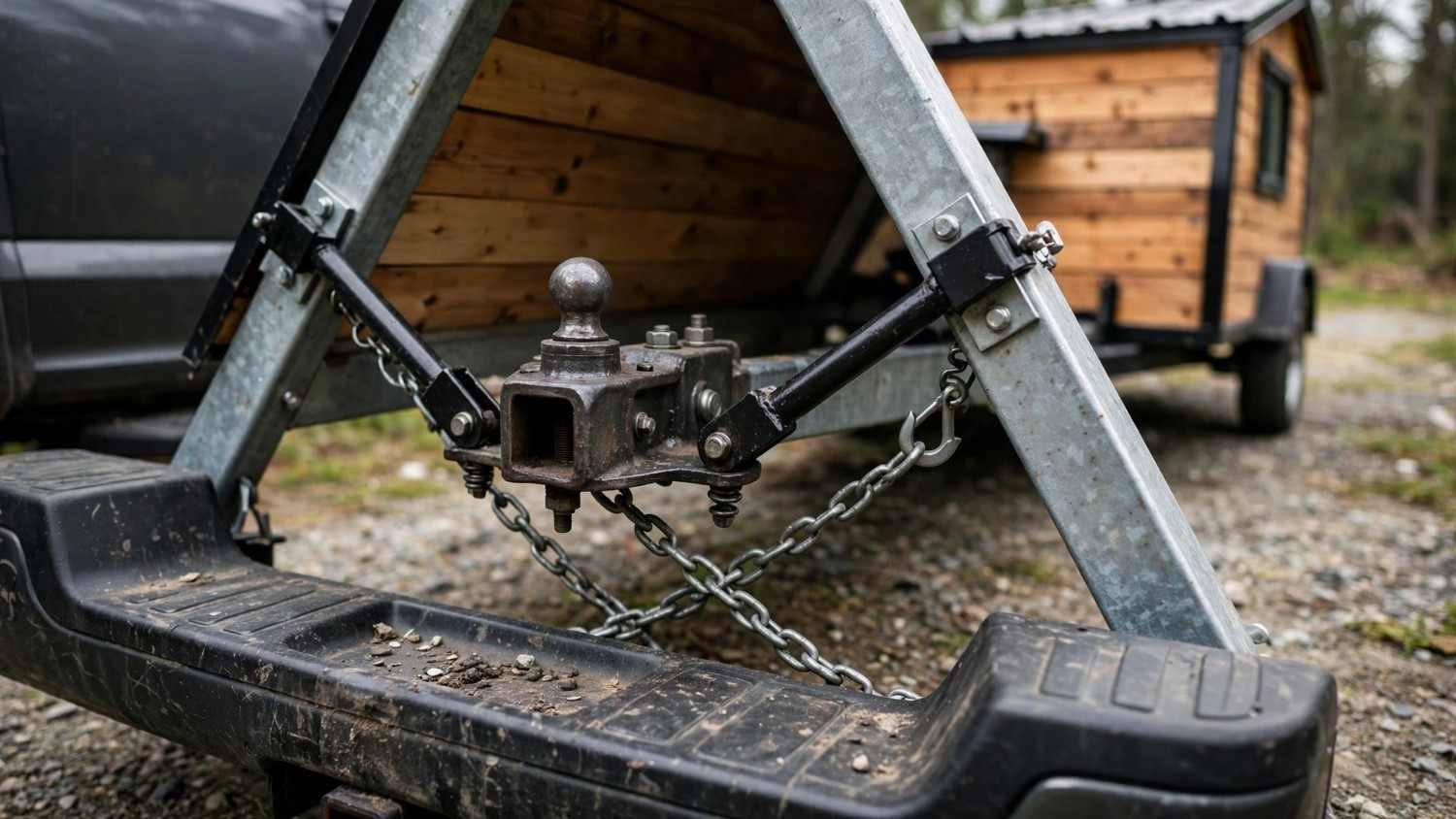
Hitch selection changes based on trailer weight, tongue weight, and whether the tiny house sits on a bumper-pull or gooseneck frame. I match the hitch to the trailer’s specific weight profile, not just its size.
Getting this wrong undermines every other safety measure in this guide. The hitch is the single connection point holding the whole trailer to the truck.
Weight Distribution Hitches Explained
A weight distribution hitch uses spring bars to transfer tongue weight across all axles of the tow vehicle and trailer. This keeps the truck’s front end from lifting and restores steering and braking control that sags under a heavy tongue load.
I recommend these for any bumper-pull tiny house over 6,000 pounds. Below that weight, a standard hitch usually performs fine without added distribution hardware.
Gooseneck and Fifth-Wheel Setups
Gooseneck hitches mount inside the truck bed and connect over the rear axle, handling significantly more weight than bumper-pull setups. Heavier tiny houses, generally those above 14,000 pounds, benefit from this configuration because it shifts pivot point weight directly over the truck’s strongest structural point.
I steer heavier builds toward gooseneck hitches specifically for this reason. The stability difference on the highway is noticeable within the first few miles.
Brake Systems and Braking Requirements by Weight
Trailer brakes become mandatory in most states once a trailer crosses a specific weight threshold. I check the state’s exact cutoff before finalizing a braking system, because the requirement varies by a few thousand pounds depending on jurisdiction.
Braking is not optional safety equipment on anything approaching a tiny house’s typical weight range. Stopping a loaded trailer without trailer brakes puts enormous strain on the tow vehicle’s brakes alone.
Electric vs. Hydraulic Surge Brakes
Electric brakes activate through a controller synced to the tow vehicle’s brake pedal, giving the driver adjustable braking force. Hydraulic surge brakes activate automatically from trailer momentum pushing against the hitch, requiring no in-cab controller at all.
I favor electric brakes for tiny houses because the controller lets the driver fine-tune braking force for the trailer’s actual loaded weight. Surge brakes work fine too, but they offer less control over stopping behavior.
State Brake Requirement Thresholds
Most states require trailer brakes somewhere between 3,000 and 5,000 pounds of gross trailer weight. A handful of states set that threshold lower, closer to 1,500 pounds, which catches smaller tiny house trailers by surprise.
I check the exact figure for the state of registration and every state on the planned route. Crossing a state line with brakes that meet one state’s law but not another’s creates a real legal problem.
Preventing and Correcting Trailer Sway
Trailer sway develops when lateral forces from wind, passing trucks, or road camber overcome the trailer’s directional stability. I treat sway prevention as a combination of correct weight distribution, the right hitch, and disciplined driving habits working together.
No single fix solves sway on its own. It’s the interaction between tongue weight, hitch type, and speed that keeps a trailer tracking straight.
Common Causes of Sway
Insufficient tongue weight is the most frequent cause of trailer sway on tiny houses. Crosswinds, sudden lane changes, and a following truck’s wake also trigger sway even on a properly loaded trailer.
I’ve traced almost every sway complaint back to cargo sitting too far toward the rear axle. Moving heavy items forward, closer to the axle centerline, fixes the majority of cases immediately.
Anti-Sway Bars and Corrective Driving Techniques
Anti-sway bars use friction or hydraulic resistance to dampen side-to-side trailer movement before it escalates. Easing off the accelerator, rather than braking hard, is the correct response the moment sway begins.
Braking hard during a sway event makes the problem dramatically worse. I keep steering inputs minimal and let the trailer’s own resistance settle the movement, because overcorrecting the wheel amplifies sway rather than stopping it.
Pre-Tow Safety Inspection Checklist
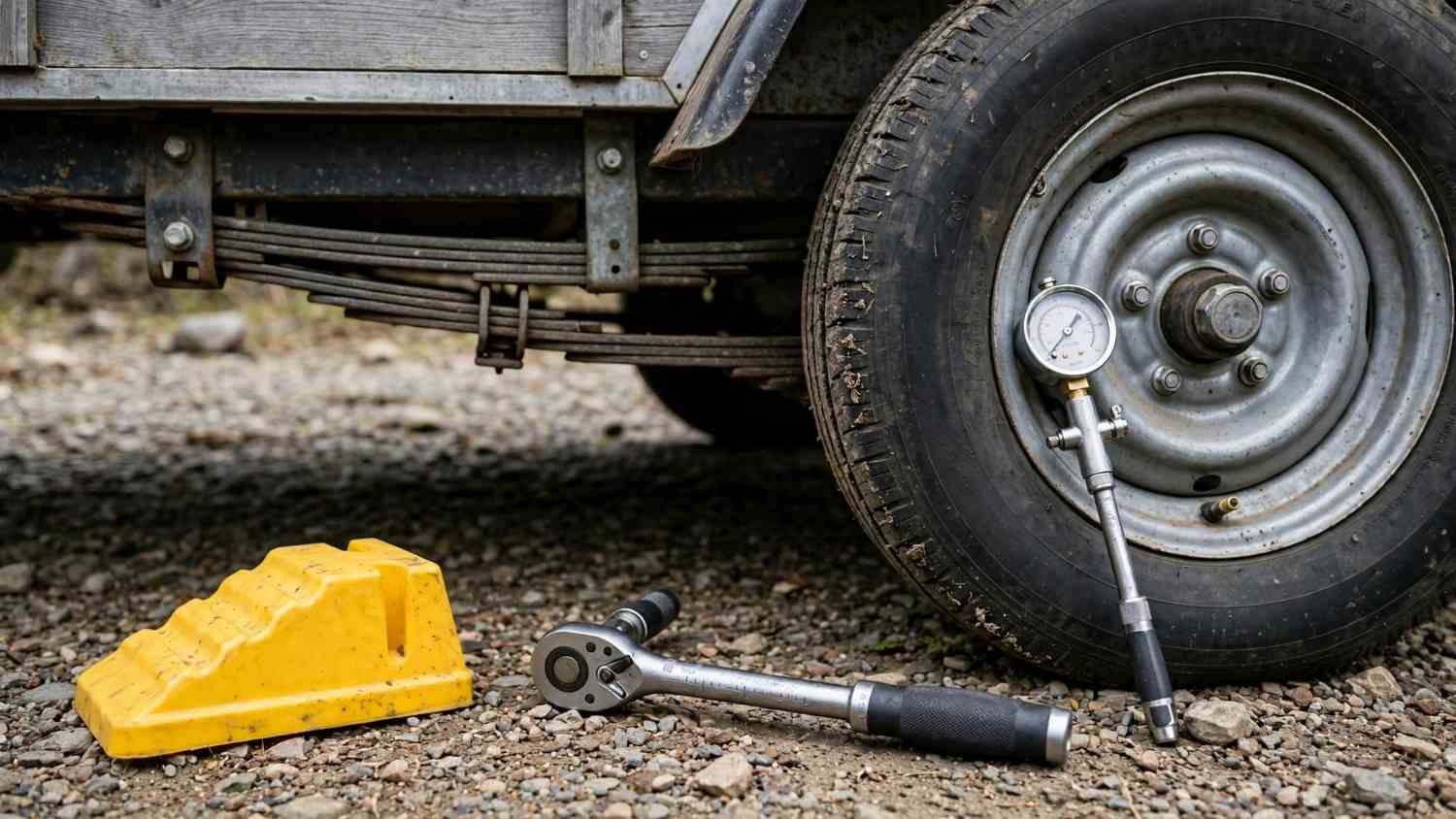
A pre-tow inspection catches the mechanical failures that cause roadside breakdowns and accidents. I run through the same checklist before every tow, regardless of how short the trip is.
Skipping this step is where most preventable towing accidents originate. Five minutes of inspection consistently prevents hours of roadside trouble.
Tire, Wheel, and Suspension Checks
Trailer tire pressure needs checking cold, before driving, against the rating printed on the tire’s sidewall. Wheel lug nuts loosen over time and need a torque check, especially after the first fifty miles on a new trailer.
I inspect the suspension’s leaf springs and equalizers for cracking or excessive wear before any long haul. A failed spring at highway speed causes sudden, severe handling problems.
Coupling and Chain Verification
The coupler needs to latch fully and lock, with the safety pin or clip seated properly through the mechanism. Safety chains cross underneath the hitch in an X pattern, which catches the tongue if the coupler ever fails.
I test the coupler by hand before every trip, pulling upward to confirm it’s locked, not just closed. This single check prevents the rare but catastrophic event of full trailer separation.
Legal Weight Limits, Permits, and State Regulations
Weight limits and permit requirements shift from state to state, and towing a tiny house across multiple states means checking every jurisdiction on the route. I treat this as a pre-trip planning task, not something to sort out at a weigh station.
Getting stopped without the right permit creates delays, fines, and sometimes an impound situation. Planning ahead avoids all three.
Oversize/Overweight Permit Triggers
Width over 8.5 feet or height over 13.5 feet typically triggers oversize permit requirements in most states. The Federal Highway Administration outlines how individual states set their own permit thresholds and escort vehicle requirements above federal baseline dimensions.
I measure the tiny house’s exact width and height before any interstate trip and pull permits in advance where required. Escort vehicles become mandatory in some states once a trailer exceeds certain width thresholds.
State-by-State Towing Law Variance
Speed limits for towed trailers run lower than standard speed limits in several states, sometimes by 10 to 15 miles per hour. Some states also cap the total combined length of tow vehicle and trailer, which catches longer tiny house builds off guard.
I map the full route before departure and note any state with unusual towing restrictions. A five-minute check prevents an unexpected citation hundreds of miles from home.
Driving Techniques for Safely Towing a Tiny House
Towing a tiny house demands slower speeds, longer following distances, and earlier braking than driving unloaded. I adjust every habit behind the wheel the moment a trailer this heavy gets hitched up.
The extra weight changes stopping distance, cornering behavior, and how the vehicle responds to sudden inputs. Driving technique has to change to match.
Highway Speed and Following Distance
Staying five to ten miles per hour under the posted limit gives more reaction time and reduces sway risk substantially. Following distance needs to double compared to unloaded driving, since stopping a loaded tiny house takes considerably longer.
I treat 65 miles per hour as a practical ceiling regardless of the posted limit. Most sway incidents I’ve reviewed happened above that speed.
Navigating Grades, Curves, and Wind
Downhill grades need lower gears engaged before the descent starts, not partway down. Curves take wider, slower entries than usual because the trailer’s momentum carries through the turn independently of the truck.
Wind gusts hit a tiny house’s tall, flat sides harder than a standard camper. I grip the wheel firmly and expect a push whenever passing trucks or open crossings appear on the route.
Common Towing Mistakes That Cause Accidents
Most tiny house towing accidents trace back to a handful of repeated, preventable mistakes. I see the same errors across different builds and different owners, which makes them worth listing plainly.
Recognizing these mistakes in advance prevents them from becoming a roadside emergency. Every one of them is avoidable with basic preparation.
Overloading and Uneven Load Distribution
Loading a tiny house beyond its GVWR compromises axles, tires, and brakes simultaneously, not just one component. Uneven distribution, particularly water and propane sitting too far back, creates tongue weight problems even when total weight sits within limits.
I weigh the finished house and check axle-by-axle distribution, not just the total. A trailer can pass the total GVWR check and still be dangerously imbalanced side to side or front to back.
Ignoring Maintenance Warning Signs
Cupped or unevenly worn tires signal alignment or suspension problems that worsen under load. Bearings that run hot after a short drive indicate a failure that gets worse, not better, the longer it’s ignored.
I stop and address any unusual noise, smell, or handling change immediately rather than finishing the trip first. A small mechanical warning sign today becomes a roadside breakdown, or worse, next week.
Conclusion
Towing a tiny house safely comes down to weight distribution, the right equipment, and disciplined driving habits working together. Every section of this guide connects back to that same core principle.
We’ve covered the mechanics, the legal requirements, and the daily habits that keep a tiny house tracking straight on the highway. None of it replaces careful, honest weight checks before every trip.
We help homeowners plan safe, well-built tiny house projects from the ground up. Reach out to Mr. Local Services for guidance on your tiny house build and the systems that keep it road-ready.
Frequently Asked Questions
What is the ideal tongue weight percentage for towing a tiny house?
Tongue weight should sit between 10% and 15% of the trailer’s total loaded weight. Going outside that range invites sway or overloads the tow vehicle’s rear axle.
Do I need trailer brakes for a tiny house?
Most states require trailer brakes once gross trailer weight crosses a threshold between 1,500 and 5,000 pounds. I check the exact figure for every state along the planned route before towing.
What size truck do I need to tow a tiny house?
A three-quarter-ton or one-ton truck comfortably handles most tiny houses once weight passes 10,000 pounds. Payload capacity and towing capacity both need real headroom above the trailer’s loaded weight.
How do I stop trailer sway while driving?
Ease off the accelerator gradually and keep steering inputs minimal until the trailer settles. Braking hard during a sway event makes the problem noticeably worse.
What permits do I need to tow a tiny house across state lines?
Width over 8.5 feet or height over 13.5 feet typically triggers oversize permit requirements in most states. I check every state on the route in advance, since thresholds and escort requirements vary.
Should I choose a gooseneck or bumper-pull hitch for my tiny house?
Gooseneck hitches handle heavier loads better, generally recommended above 14,000 pounds of trailer weight. Lighter tiny houses tow comfortably on a bumper-pull setup with a weight distribution hitch added.
How often should I check tongue weight during a long trip?
I check tongue weight before departure and again after any major cargo change, like using up water or propane. Weight shifts during a trip change the tongue weight percentage even when total weight stays similar.
What’s the biggest towing mistake tiny house owners make?
Uneven weight distribution inside the trailer causes more towing problems than total overweight does. Water tanks and propane sitting too far back create sway risk even within a legal total weight.