A park model home with the wrong insulation loses heat through the floor before it loses it anywhere else. The underbelly and skirting are where most park models fail first, long before the walls or roof become the problem.
I’ve seen park model owners spend money on a new furnace when the real issue sat six inches below their feet. Cold floors, spiking energy bills, and frozen pipes almost always trace back to gaps in the underbelly, weak skirting, or an HVAC system sized for a house twice the square footage.
I’ll walk through how insulation and climate control actually work in a park model, covering the insulation fundamentals and R-values you need to know, the weak points where air escapes and how skirting fixes that, the HVAC systems and four-season packages that keep temperatures stable, the warning signs that mean it’s time to upgrade, and the seasonal maintenance that keeps all of it working.
What Insulation and Climate Control Really Mean for a Park Model
A park model home is a factory-built structure under 400 square feet, designed for semi-permanent placement on a fixed lot. It sits closer to an RV in construction than a site-built house, which changes how heat and cold move through it entirely.
How Park Models Differ From Site-Built Homes and RVs
A site-built house sits on a poured foundation with a sealed crawl space or basement. A park model sits on piers or blocks with open air underneath, much like a travel trailer.
That open underbelly is the single biggest difference. Heat escapes downward in winter and rises up from the ground in summer, and neither problem exists in a house with a real foundation.
The Core Components of a Climate-Controlled Park Model
Four systems work together to hold temperature: wall and roof insulation, underbelly insulation, skirting around the base, and the HVAC unit itself. Miss one and the other three work harder to compensate.
I think of it as a chain. The weakest link decides how comfortable the home actually feels, not the average of all four systems combined.
R-Values and Insulation Ratings Explained for Park Models
R-value measures how well a material resists heat flow the higher the number, the better the insulation performs. It’s the standard homeowners and manufacturers both use to compare materials.
What R-Value Actually Measures
R-value is a rating that indicates a material’s resistance to conductive heat transfer, expressed as a single number per inch of thickness. A higher R-value means less heat moves through that material in a given time period.
Fiberglass batt insulation typically runs R-3 to R-4 per inch, while closed-cell spray foam reaches R-6 to R-7 per inch. That gap matters more in a park model’s thin wall cavities than it would in a standard 2×6 stud wall.
Recommended R-Values by Climate Zone
The U.S. Department of Energy recommends wall insulation of R-13 to R-23 and floor insulation of R-25 to R-30 depending on climate zone, with colder northern zones requiring the higher end of each range. Park models built for four-season use typically target the upper half of those ranges in the floor and underbelly.
I always tell owners in colder states to prioritize floor R-value over wall R-value. The ground stays cold longer than the outside air ever does.
Types of Insulation Used in Park Model Homes
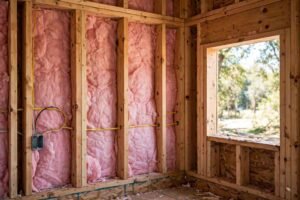
Manufacturers use three main insulation types in park models, and each one fits a different part of the structure better than the others.
Fiberglass Batt Insulation
Fiberglass batt is a woven glass-fiber material that insulates wall cavities and ceilings at a lower cost than foam alternatives. It’s the most common choice for standard-climate park models because it balances price and performance well.
It does lose effectiveness when compressed or exposed to moisture. That makes it a poor fit for the underbelly, where humidity and settling are constant risks.
Spray Foam Insulation
Spray foam expands on application and fills gaps that batt insulation physically can’t reach. Closed-cell spray foam also acts as a vapor barrier, which matters in humid climates or damp underbellies.
I recommend it for the underbelly and skirting cavity almost every time. The higher upfront cost pays for itself in fewer moisture problems down the line.
Rigid Foam Board Insulation
Rigid foam board is a dense, panel-form insulation used under flooring and behind skirting for consistent, moisture-resistant coverage. It holds its R-value better than batt insulation over time because it doesn’t compress or sag.
Installers often layer rigid board against the underbelly before adding skirting on top. That combination handles both insulation and a physical moisture barrier in one step.
Where Heat and Cold Escape in a Park Model
Air doesn’t leave a park model evenly. It escapes through specific weak points, and knowing where those are changes how you prioritize repairs.
Underbelly and Floor Insulation Gaps
The underbelly is the single largest source of heat loss in most park models, mainly because factory insulation often settles or gets damaged during transport. A gap the size of a dinner plate can drop floor temperature across an entire room.
I’ve pulled back underbelly material on “well-insulated” units and found batt insulation sagging a full foot from where it should sit. Transport vibration does that more often than owners expect.
Wall Cavity and Skirting Weak Points
Wall cavities in park models run thinner than standard residential framing, which limits how much insulation fits inside them. Skirting gaps at the base compound the problem by letting cold air wash directly against that thin wall from outside.
A loose skirting panel isn’t just a cosmetic issue. It’s a direct pipeline for outside air reaching the coldest part of the structure.
Roof, Windows, and Door Seals
Roof insulation matters, but window and door seals fail faster and cause more noticeable drafts. Weatherstripping around doors and window frames degrades within a few years in units that see heavy sun exposure.
That’s usually the cheapest fix on this whole list. A $20 tube of caulk and new weatherstripping solves what feels like a much bigger problem.
Skirting as a Climate Control Strategy
Skirting is the enclosure installed around a park model’s base that seals the underbelly space from outside air, wind, and moisture. It functions as both an insulation layer and a physical barrier against pests and freezing temperatures.
How Skirting Protects the Underbelly
Skirting blocks wind from moving directly across the underbelly insulation, which stops the “wind-washing” effect that strips heat away faster than still air would. It also keeps the space above freezing in most climates, protecting exposed plumbing lines.
Without skirting, even perfect underbelly insulation underperforms. Moving air pulls heat away far faster than static air ever does.
Skirting Materials Compared
Vinyl skirting costs the least and installs fastest, but it offers minimal insulation value on its own. Insulated foam-core skirting panels cost more upfront and provide meaningfully better thermal performance in cold climates.
I steer four-season owners toward insulated panels every time. The price difference is small compared to what a single frozen pipe repair costs.
HVAC Systems Built for Park Model Living

Park models need HVAC systems sized for their actual footprint, not scaled-down versions of residential units. Getting this wrong causes as many comfort problems as bad insulation does.
Mini-Split Heat Pumps
A mini-split heat pump is a ductless system that heats and cools by transferring heat between indoor and outdoor units rather than generating it directly. These systems dominate park model installations because they need no ductwork and run efficiently at small square footages.
Modern mini-splits also handle both heating and cooling from one unit. That eliminates the need for a separate furnace and AC setup entirely.
Ductless vs Ducted Systems
Ductless systems mount directly on interior walls and skip ductwork altogether, which suits a park model’s tight framing. Ducted systems technically fit larger park models but require space inside walls or ceilings that most units simply don’t have.
I recommend ductless for nearly every park model I’ve reviewed. The install is faster and the efficiency loss from missing ductwork isn’t a factor to begin with.
Sizing an HVAC Unit for a Park Model’s Square Footage
HVAC sizing runs on BTUs per square foot, and oversizing a unit wastes energy through short-cycling just as much as undersizing leaves rooms cold. A typical 400-square-foot park model needs roughly 9,000 to 12,000 BTUs, adjusted for climate zone and insulation quality.
A poorly insulated unit needs more BTUs to hit the same comfort level as a well-insulated one. That’s the direct financial link between the insulation chapters above and the HVAC decision here.
Four-Season Package Upgrades for Year-Round Comfort
Manufacturers offer four-season packages as factory or dealer upgrades that combine heavier insulation, upgraded skirting, and climate-rated components into one order. These packages exist specifically because standard park models aren’t built for extreme cold or heat by default.
What a Four-Season Package Includes
A four-season package typically bundles higher R-value wall and floor insulation, heat-taped plumbing lines, insulated skirting, and a dual-zone HVAC system rated for extreme temperatures. Some packages also add double-pane windows as a standard inclusion rather than an option.
Buying these upgrades separately after the fact almost always costs more. Ordering the package at purchase time bundles labor and materials at a lower combined rate.
Signing Up for Cold-Climate or Hot-Climate Packages
Cold-climate packages emphasize heat retention thicker insulation, heat tape, and sealed skirting. Hot-climate packages instead prioritize higher-capacity cooling and reflective roofing to reduce solar heat gain.
Match the package to where the unit actually sits, not where you bought it. A cold-climate package wastes money on a unit permanently parked in Arizona.
Signs Your Park Model Has Poor Insulation or Climate Control
Most insulation failures show up gradually, and owners often adjust to the discomfort before recognizing the underlying cause.
Cold Floors and Drafts
A floor that feels noticeably colder than the surrounding air points directly to underbelly insulation failure. Drafts near baseboards or window frames signal seal failure rather than insulation failure, which changes the fix entirely.
I always ask owners to feel the floor near exterior walls first. That single test narrows down whether the problem is underbelly, skirting, or wall insulation.
High Energy Bills and Frozen Pipes
A sudden jump in heating or cooling costs without a matching change in usage habits usually means the HVAC system is compensating for lost insulation somewhere in the structure. Frozen pipes specifically point to underbelly and skirting failure, since that’s the only space cold enough to freeze standing water.
A frozen pipe in a park model almost never happens with intact skirting and underbelly insulation. That single fact tells you where to look first.
Upgrading Insulation and Climate Control in an Existing Park Model
Older park models built before four-season standards became common can still be retrofitted without a full rebuild.
Retrofitting Skirting and Underbelly Insulation
Retrofitting means removing existing skirting, inspecting and replacing sagging underbelly insulation, and installing insulated skirting panels in its place. This single upgrade often produces the largest comfort improvement of any retrofit option available.
It’s also the most disruptive to do correctly. Full underbelly access takes longer than most owners expect, since sagging insulation has to come out before new material goes in.
Replacing or Upgrading an HVAC System
An HVAC replacement makes sense when the existing unit is undersized, over 10 years old, or was never matched to the home’s actual insulation level. Upgrading insulation first and HVAC second is the more cost-effective order, since better insulation often allows a smaller, cheaper replacement unit.
Doing it backward wastes money. A bigger HVAC unit compensates for bad insulation, but it never fixes the underlying problem.
Seasonal Maintenance for Insulation and Climate Systems

Insulation and HVAC systems both degrade faster without seasonal attention, even when nothing appears visibly wrong.
Pre-Winter Checklist
Before cold weather hits, inspect skirting for gaps, heat-tape exposed plumbing lines, and test the HVAC heating cycle before the first freeze. Catching a failed heat strip in October beats discovering it during a January cold snap.
Pre-Summer Checklist
Before summer heat arrives, check skirting vents for proper airflow, clean HVAC filters and outdoor condenser coils, and inspect roof seals for sun damage. A dirty condenser coil can cut cooling efficiency by a meaningful margin before anyone notices the AC working harder than it should.
Conclusion
Insulation and climate control in a park model come down to four connected systems insulation type, skirting, HVAC sizing, and seasonal upkeep. Weakness in any one system forces the others to work harder and cost more.
Cold floors, high bills, and frozen pipes are signals worth acting on early rather than living with. Catching these issues before peak season saves both comfort and money.
We at Mr. Local Services connect park model owners with skilled professionals who handle insulation retrofits, skirting upgrades, and HVAC sizing correctly the first time. Reach out and we’ll get your park model ready for whatever season comes next.
Frequently Asked Questions
What R-value do I need for a park model in a cold climate?
Cold-climate park models generally need R-25 to R-30 in the floor and R-19 to R-23 in the walls. Four-season packages typically meet or exceed these numbers by default.
Does skirting actually make a difference in temperature?
Yes, skirting blocks wind from stripping heat away from underbelly insulation and keeps exposed plumbing above freezing. Removing skirting in winter causes a noticeable temperature drop within hours.
What size HVAC unit does a typical park model need?
Most 400-square-foot park models need 9,000 to 12,000 BTUs, adjusted for insulation quality and climate zone. Poorly insulated units often need more BTUs than well-insulated ones of the same size.
How do I know if my underbelly insulation has failed?
Cold floors near exterior walls and rising energy bills without a change in usage are the two clearest signs. Physical inspection usually reveals sagging or missing insulation material.
Is spray foam better than fiberglass for park models?
Spray foam handles moisture and gap-filling better, making it a stronger choice for the underbelly and skirting cavity. Fiberglass batt still works well in wall cavities where moisture exposure is lower.
What’s included in a four-season package upgrade?
A four-season package typically includes upgraded wall and floor insulation, heat-taped plumbing, insulated skirting, and a dual-zone HVAC system. Some packages also add double-pane windows.
Can I retrofit insulation into an older park model?
Yes, retrofitting existing skirting and underbelly insulation is common and often produces a significant comfort improvement. It requires full underbelly access, which takes more time than a surface-level repair.