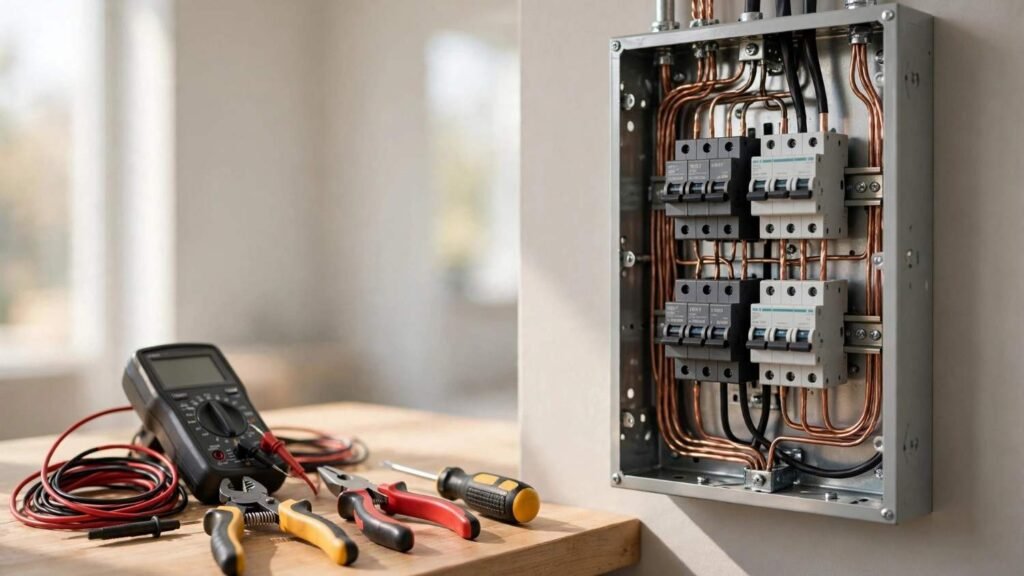
Electrical terms like voltage, amperage, and circuit breakers describe how power moves safely through your home’s wiring system. I’ve found that most homeowners hear these words constantly but never get a plain-language explanation. That’s what we’re covering here. By the end, you’ll recognize these terms on an inspection report or a contractor’s invoice without feeling lost.
The 10 Most Common Electrical Terms Explained
Here’s the short version. Voltage measures electrical pressure, amperage measures current flow, and wattage measures total power used. A circuit breaker shuts off power during an overload, grounding redirects stray electricity safely, and a GFCI outlet prevents shock near water. These five terms cover most of what you’ll see on a panel or permit.
Terms 1–5: Voltage, Amperage, Circuit Breaker, Wattage, Grounding
Voltage is the force pushing electricity through a wire, usually 120 or 240 volts in US homes. Amperage is the volume of electricity flowing, which determines how thick your wiring needs to be. Wattage combines the two to measure actual energy use.
Circuit breakers trip when amperage exceeds safe limits, protecting wires from overheating. Grounding gives excess electricity a safe path into the earth. Without it, a fault could travel through you instead.
Terms 6–10: GFCI, Short Circuit, Fuse, Circuit, Breaker Box
A GFCI outlet detects tiny current imbalances and shuts off power in milliseconds, which is why they’re required near sinks and tubs. A short circuit happens when electricity takes an unintended path, often causing sparks or tripped breakers.
Fuses are the older cousin of circuit breakers. They burn out once and need replacing. A circuit is simply the full loop electricity travels, and the breaker box is where all those circuits connect and get monitored.
Once you understand the basics, the next logical step is knowing when wiring issues need more than a glance. That’s usually when a licensed electrician can diagnose the issue safely, especially with anything involving the panel itself.
Why Knowing These Terms Helps Homeowners

I think this knowledge pays off the moment something goes wrong. You’ll describe the problem accurately on the phone instead of saying “it just stopped working.” That alone speeds up diagnosis and often lowers the cost of the visit.
Spotting Warning Signs Before Calling a Professional
Flickering lights, warm outlets, or a breaker that trips repeatedly all point to specific issues. A tripping breaker suggests overloaded amperage. A warm outlet often means loose wiring or a short. Knowing the terms helps you describe these symptoms clearly.
When to Call an Electrician vs. Handle It Yourself
Replacing a lightbulb or resetting a GFCI outlet is safe territory for most homeowners. Anything involving the breaker box, grounding, or repeated tripping needs a professional. These issues can signal deeper wiring problems that aren’t visible from the surface.
We always recommend starting with a home electrical safety inspection if you’re unsure whether a symptom is minor or serious.
Conclusion
These 10 terms cover the foundation of how home electrical systems work and stay safe. Understanding them helps you catch warning signs early and communicate clearly with professionals. We want every homeowner to feel confident, not confused, about their wiring.
Reach out to Mr. Local Services today, and let our licensed electricians handle the technical details with you.
Frequently Asked Questions
What is the difference between voltage and amperage?
Voltage measures electrical pressure, while amperage measures the volume of current flowing. Together they determine total wattage, or power consumed by a device.
Why do GFCI outlets matter in bathrooms and kitchens?
GFCI outlets detect current imbalances near water sources and shut off instantly. They prevent electric shock in moisture-prone areas like sinks and tubs.
Is a circuit breaker the same as a fuse?
Both protect wiring from overload, but breakers can be reset while fuses must be replaced after they burn out. Breakers are now standard in most homes.
What causes a short circuit?
A short circuit happens when electricity takes an unplanned path, often due to damaged insulation or loose wiring. It usually trips the breaker immediately.
How do I know if my home’s grounding is working properly?
A licensed electrician can test grounding with simple equipment during an inspection. Signs of poor grounding include frequent shocks or flickering lights.