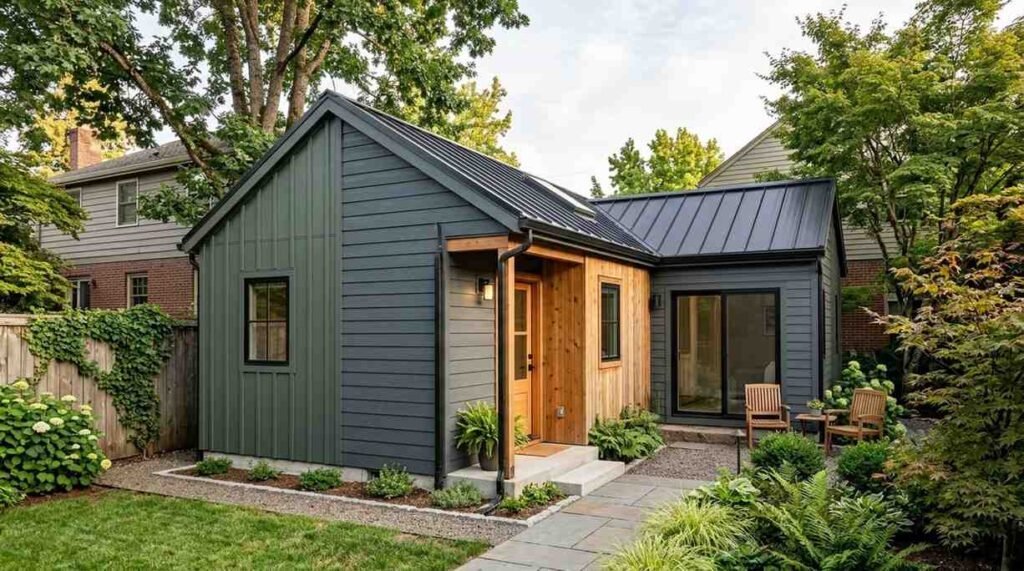
ADU siding and cladding are the exterior wall materials that protect an accessory dwelling unit from water, wind, fire, and temperature swings while defining how it looks. I treat this choice as the single biggest exterior decision on any ADU build, and it affects every owner, landlord, and property manager holding the keys.
Siding failures cause rot, mold, and structural damage that cost far more than the original install. Choosing well protects rental income and property value for decades.
I cover materials, selection criteria, fire and weather codes, weather barriers, real 2026 costs, installation, maintenance, and rental-specific choices in this guide.
What ADU Siding and Cladding Actually Are
Siding is the outermost weather-facing layer on an ADU wall. Cladding is the broader term covering that layer plus the systems behind it that manage water and air.
I use both words interchangeably in conversation with homeowners. Builders and architects draw a sharper line, and that distinction matters once you get into rainscreen assemblies and ventilated wall systems.
Siding vs. Cladding: The Practical Difference
Siding usually means the visible product: lap boards, panels, shingles, or planks. Cladding describes the full exterior envelope assembly, including the barrier, furring, and fasteners underneath.
Ask a contractor for “cladding” and you get a system conversation. Ask for “siding” and you get a material conversation.
The Four Layers Behind Every ADU Wall
Every properly built ADU wall has four working layers. Sheathing gives structure, the water-resistive barrier sheds bulk water, the drainage gap or furring lets moisture escape, and the siding takes the weather.
Skip any one of them and the wall traps water. That is how a five-year-old ADU ends up with soft framing.
Why ADUs Have Different Siding Needs Than Main Homes
ADUs are small, which changes the math completely. A 600 square foot unit has roughly 700 to 900 square feet of wall area, so premium materials become affordable in a way they never are on a full house.
ADUs also sit close to property lines and close to the main home. That proximity triggers fire separation rules and design-matching expectations that a standalone house never faces.
How to Choose Siding for an ADU
I narrow every ADU siding decision down to four filters. Climate, budget, visual relationship to the main house, and how much maintenance the owner genuinely wants to do.
Run a material through all four and the shortlist gets short fast. Most owners land on two or three real options.
Climate and Moisture Exposure
Wet climates punish organic materials. Freeze-thaw cycles punish rigid ones. Coastal salt air punishes fasteners and finishes on everything.
I push fiber cement and fiber-reinforced products in the Pacific Northwest and the Southeast. I push metal and stucco in the arid Southwest.
Budget and Square Footage Realities
Small wall area means the price gap between cheap and premium siding shrinks in absolute dollars. Moving from vinyl to fiber cement on a 700 square foot wall costs a few thousand dollars, not tens of thousands.
That is why I rarely recommend the cheapest option on an ADU. The upgrade is affordable here in a way it is not on a 2,400 square foot home.
Matching or Contrasting the Primary Residence
Some jurisdictions require the ADU to visually complement the main house. Many do not.
I see two winning approaches. Match the main home closely for a cohesive property, or go deliberately modern for a clear architectural separation that reads as intentional.
Maintenance Tolerance and Ownership Plans
Cedar looks incredible and demands attention every three to five years. Vinyl and metal ask for almost nothing.
Owners planning to hold the property for twenty years choose differently than owners flipping in three. I ask that question before I recommend anything, and it shapes the long-term exterior maintenance plan we build around the unit.
Fiber Cement Siding for ADUs
Fiber cement is a composite of cement, sand, and cellulose fibers pressed into boards or panels. It is the material I recommend most often for ADUs, and it is not close.
It resists fire, rot, insects, and impact. It holds paint exceptionally well. And it comes in profiles that mimic wood, stucco, or smooth modern panel.
Panels, Lap Boards, and Shingle Profiles
Lap boards give a traditional horizontal look that matches most existing homes. Large-format panels with reveal joints give a clean contemporary face that suits modern ADU designs.
Shingle profiles work for cottage-style units and coastal aesthetics. All three come pre-primed or factory-finished.
Cost, Lifespan, and Upkeep Snapshot
Installed cost typically runs $8 to $16 per square foot in 2026. Lifespan reaches 50 years with proper installation, and manufacturer warranties commonly extend to 30 years.
Upkeep means repainting every 12 to 15 years and caulking inspection annually. That is a light burden for the performance you get.
Vinyl Siding for ADUs
Vinyl is extruded PVC formed into interlocking panels. It remains the most affordable mainstream option in the United States, and it installs fast.
I recommend it for budget-driven builds, rental units in mild climates, and owners who want zero painting. The tradeoff is impact resistance and heat tolerance.
Insulated vs. Standard Vinyl
Standard vinyl hangs loose over the wall with no thermal contribution. Insulated vinyl bonds rigid foam to the back of each panel, adding roughly R-2 to R-3 and stiffening the profile noticeably.
Insulated vinyl costs about 30 to 40 percent more. On an ADU with a tight envelope target, I think that upgrade earns its price.
Cost, Lifespan, and Upkeep Snapshot
Installed cost typically runs $4 to $9 per square foot. Lifespan reaches 20 to 35 years depending on sun exposure and product grade.
Upkeep is an annual wash. Damaged panels get swapped individually, which keeps siding repair costs low over the ownership period.
Wood and Engineered Wood Cladding
Wood gives warmth and texture that no synthetic fully replicates. On a small ADU, natural wood reads as a design statement rather than a maintenance liability.
I split this category in two. Natural species and engineered wood products behave very differently.
Cedar, Redwood, and Shou Sugi Ban
Western red cedar and redwood contain natural oils that resist rot and insects. Both take stain beautifully and weather to a silver gray when left unfinished.
Shou sugi ban is a Japanese charring technique that carbonizes the wood surface. The char layer adds rot resistance, insect resistance, and a dramatic black finish that suits modern ADUs.
Engineered Wood Alternatives
Engineered wood siding uses wood strands or fibers bonded with resin and treated for moisture and termites. It arrives pre-primed, cuts like lumber, and costs meaningfully less than cedar.
It handles impact better than fiber cement and weighs less. I use it when an owner wants a wood look on a tighter budget.
Cost, Lifespan, and Upkeep Snapshot
Cedar installs at $9 to $18 per square foot. Engineered wood installs at $6 to $12.
Cedar needs sealing or staining every three to five years. Engineered wood needs repainting every 10 to 15 years, and the exterior painting schedule drives most of its lifetime cost.
Metal Cladding for Modern ADUs
Metal siding uses steel or aluminum panels with factory-applied finishes. It has moved from agricultural buildings to high-design residential in the last decade.
I see it constantly on modern ADUs now. It is fireproof, insect-proof, rot-proof, and it lasts longer than almost anything else on the wall.
Standing Seam, Corrugated, and Flat Panel
Standing seam runs vertical with raised interlocking ribs and reads as premium and architectural. Corrugated gives a wavy industrial texture at a lower price point.
Flat panel systems deliver crisp minimalist facades with concealed fasteners. All three come in aluminum for coastal zones and steel for inland durability.
Cost, Lifespan, and Upkeep Snapshot
Installed cost runs $9 to $20 per square foot depending on profile and finish. Lifespan reaches 40 to 60 years, and premium coatings carry 30 to 40 year finish warranties.
Upkeep is essentially washing. Dents from hail or impact are the main vulnerability, and panel replacement addresses them individually.
Stucco and Masonry Options
Stucco is a cement-based plaster applied in coats over lath or foam board. It dominates ADU exteriors across the Southwest and much of California.
Masonry covers brick, stone, and their thin veneer versions. I use masonry as an accent on ADUs rather than a full wrap, because full masonry rarely pencils out at this scale.
Traditional vs. Synthetic Stucco
Traditional three-coat stucco is portland cement applied over metal lath. It is hard, breathable, and fire resistant.
Synthetic stucco, known as EIFS, layers acrylic finish over foam insulation board. EIFS adds insulation value, and it demands flawless drainage detailing to avoid trapped moisture.
Brick, Stone, and Veneer Accents
Full brick on an ADU requires a foundation ledge and significant structural support. Thin brick and manufactured stone veneer deliver the same look at a fraction of the weight and cost.
I use veneer on a wainscot band or a single feature wall. That approach adds material richness without the budget hit.
Cost, Lifespan, and Upkeep Snapshot
Stucco installs at $8 to $15 per square foot and lasts 50 to 80 years. Manufactured stone veneer runs $12 to $25 per square foot installed.
Stucco upkeep means sealing hairline cracks and repainting every 8 to 12 years. Veneer needs sealant maintenance at joints and flashing points.
Composite, Vertical, and Specialty Cladding
This category holds the options that do not fit neatly elsewhere. Some of them solve very specific ADU problems better than mainstream materials.
I bring these up when a project has an unusual constraint. Extreme moisture, aggressive design goals, or a tight footprint against a property line.
Board and Batten
Board and batten runs wide vertical boards with narrow strips covering the seams. It reads as farmhouse or modern depending on batten spacing and color.
It shows up in fiber cement, engineered wood, cedar, and steel. Vertical lines also make a small ADU look taller than it is.
Rainscreen and Open-Joint Systems
A rainscreen holds the siding off the wall on furring strips, creating a ventilated drainage cavity. Water that gets behind the cladding drains and dries instead of soaking the sheathing.
Open-joint systems take it further with deliberate gaps between boards and a black waterproof membrane behind. I specify rainscreens on any ADU in a high-rainfall region.
Composite and PVC Products
Cellular PVC siding and trim will never rot, absorb water, or feed insects. It costs more than vinyl and performs far better in wet and coastal conditions.
Composite products blend recycled wood fiber with polymer binders. Both suit ground-contact areas, splash zones, and trim details around window and door openings.
Siding Material Comparison at a Glance
Here is how the main ADU options stack up on the numbers that drive decisions. I use this table with owners on the first walkthrough.
| Material | Installed Cost (per sq ft) | Lifespan | Maintenance | Fire Rating | Best For |
| Fiber Cement | $8–$16 | 50 yrs | Repaint 12–15 yrs | Non-combustible | Most ADUs, wildfire zones |
| Vinyl | $4–$9 | 20–35 yrs | Annual wash | Combustible | Budget builds, mild climates |
| Insulated Vinyl | $6–$12 | 25–35 yrs | Annual wash | Combustible | Cold climates on a budget |
| Cedar / Redwood | $9–$18 | 30–40 yrs | Stain 3–5 yrs | Combustible | Design-forward, dry climates |
| Engineered Wood | $6–$12 | 30 yrs | Repaint 10–15 yrs | Combustible | Wood look, tighter budget |
| Metal | $9–$20 | 40–60 yrs | Wash only | Non-combustible | Modern ADUs, fire zones |
| Stucco | $8–$15 | 50–80 yrs | Crack seal, repaint 8–12 yrs | Non-combustible | Southwest, California |
| Stone Veneer | $12–$25 | 50+ yrs | Joint sealant | Non-combustible | Accent walls, wainscots |
| Cellular PVC | $8–$14 | 40+ yrs | Wash only | Combustible | Coastal, splash zones |
Cost, Durability, and Maintenance Comparison Table
Read the table in combination, not column by column. The cheapest material with the shortest lifespan often costs more across 30 years than a mid-priced material that lasts twice as long.
Fiber cement and metal win on lifetime cost per year. Vinyl wins on upfront cash.
Fire, Wind, and Weather Code Requirements
Code drives more ADU siding decisions than aesthetics do. I check the requirements before I show a single material sample.
Requirements vary by state, county, and sometimes by parcel. The rules that matter most involve fire, proximity, and regional weather loads.
Wildfire Zones and Ignition-Resistant Cladding
California’s Wildland-Urban Interface rules under Chapter 7A of the California Building Code require ignition-resistant or non-combustible exterior walls in designated fire hazard zones. Fiber cement, metal, and stucco satisfy these requirements directly.
Similar rules apply across Colorado, Oregon, Washington, and parts of Texas. Vinyl and untreated wood get disqualified fast in these zones.
Setback and Fire Separation Rules
ADUs commonly sit within five feet of a property line. Building codes typically require one-hour fire-rated wall assemblies when a structure sits under that threshold.
That rating usually comes from the wall assembly rather than the siding alone. Confirming this early prevents a costly redesign, and it is a core part of any ADU permitting and code review.
Coastal, Freeze, and High-Wind Considerations
Coastal zones require corrosion-resistant fasteners and elevated wind-load ratings. Aluminum outperforms steel within a mile of salt water.
Freeze-thaw regions demand materials that tolerate expansion cycles without cracking. Hurricane zones require tested wind uplift ratings on the panel and the fastening pattern.
Insulation, Weather Barriers, and Moisture Control
What sits behind the siding determines whether the wall lasts. I have opened plenty of walls where good siding covered a failed barrier.
Three elements do the real work. The water-resistive barrier, the insulation strategy, and the flashing details at every penetration.
House Wrap and Water-Resistive Barriers
House wrap is a synthetic sheet that blocks liquid water while letting vapor escape. It goes over the sheathing and under the siding, lapped shingle-style so water always runs down and out.
Self-adhered membranes cost more and seal around every fastener. I use them on rainscreen assemblies and high-exposure walls.
Continuous Exterior Insulation
Rigid foam or mineral wool installed outside the sheathing breaks thermal bridging through the studs. On a small ADU, that continuous layer produces a noticeable comfort and energy difference.
Many current energy codes now require continuous exterior insulation in colder climate zones. Coordinating it with the siding attachment method matters, and it ties directly to HVAC sizing and efficiency for the unit.
Flashing, Trim, and Penetration Details
Water enters at edges, not at the middle of a panel. Window heads, door sills, deck ledgers, hose bibs, dryer vents, and electrical penetrations are the failure points.
Every one of them needs proper flashing integrated with the water-resistive barrier. This is where craftsmanship separates a 40-year wall from a 10-year wall.
What ADU Siding Costs in 2026
Total siding cost on a typical ADU lands between $7,000 and $22,000. That range covers material, labor, barrier, trim, and disposal on a 600 to 800 square foot unit.
I break the number into three buckets so owners understand where the money goes.
Material Cost Ranges Per Square Foot
Material alone runs $2 to $10 per square foot depending on the product. Vinyl anchors the low end, and metal and stone veneer anchor the high end.
Material typically represents 35 to 45 percent of the installed price. Labor carries the rest.
Labor, Prep, and Tear-Off Costs
Labor runs $3 to $10 per square foot depending on material complexity and regional wage rates. Stucco and stone veneer sit at the top because they are trade-specific and slow.
New construction skips tear-off entirely. Re-siding an existing ADU adds $1 to $3 per square foot for removal and disposal.
Hidden Costs Owners Miss
Trim, corner boards, and fascia add 10 to 15 percent to most quotes. Scaffolding, permits, and sheathing repairs discovered after tear-off add more.
I tell owners to hold a 15 percent contingency. Walls hide surprises, and hidden rot is the most common one.
Installation, Timeline, and Hiring the Right Pro
Siding installation is a specialty trade. General contractors subcontract it, and the quality gap between crews is enormous.
I judge a siding contractor on flashing details and manufacturer certification. Those two things predict how the wall performs in year fifteen.
What a Typical Siding Install Involves
The crew preps and inspects the sheathing, installs the water-resistive barrier, sets flashing at every opening, installs furring for rainscreen assemblies, then hangs the siding from the bottom up.
Trim, corners, and sealant finish the job. Final inspection follows on permitted work.
Realistic Project Timelines
A 600 square foot ADU takes three to seven working days for vinyl or fiber cement. Stucco takes two to three weeks because each coat needs cure time.
Weather delays are normal. Rain stops barrier installation and stucco application entirely.
Questions to Ask Before You Hire
Ask for manufacturer certification, proof of liability and workers compensation insurance, and three references on ADU or small structure projects. Ask how they flash a window head and listen carefully to the answer.
Ask what the warranty covers on labor separately from material. A confident licensed exterior contractor answers all four without hesitation.
Maintaining and Repairing ADU Siding
Siding maintenance is cheap and inspection is free. Neglect is what gets expensive.
I run every ADU on a simple seasonal rhythm. Twenty minutes twice a year prevents most major repairs.
Seasonal Inspection Basics
Walk the perimeter each spring and fall. Look for cracked caulk, loose panels, peeling paint, dark staining below windows, and any soft spot you can press with a thumb.
Check the ground line for splash-back damage and soil contact. Both accelerate rot on every material.
Washing, Sealing, and Repainting
Most siding needs an annual wash to clear dirt, pollen, and mildew. Low-pressure washing with a soft brush works on nearly everything.
High pressure drives water behind panels and voids warranties. Professional pressure washing services use the right PSI for each material.
When to Repair vs. Replace
Damage under 20 percent of a single wall means spot repair. Rot in the sheathing behind the siding means full section replacement.
Widespread cracking, chalking, or fastener failure across multiple elevations signals end of life. At that point replacement costs less than repeated patching.
Siding Choices for Rental and Investment ADUs
Rental ADUs get treated differently than owner-occupied ones. Tenants do not report small problems, and turnover creates impact damage.
I optimize rental exteriors for durability and low touch. Aesthetics still matter, but they come second.
Durability That Survives Tenants
Bikes, furniture moves, and grills all hit walls. Fiber cement and engineered wood absorb impact far better than vinyl.
I avoid materials requiring a stain cycle on rentals. Nobody stains a rental on schedule.
Resale and Appraisal Impact
Exterior condition drives appraised value and buyer perception on any property with an accessory unit. A well-clad ADU signals that the whole property has been maintained.
Appraisers look for consistency between the ADU and the main home. That consistency supports stronger valuations and faster property value assessments when it is time to sell or refinance.
Conclusion
I have covered every major ADU cladding material, the codes that constrain them, the barriers behind them, real 2026 costs, installation, and maintenance.
Siding sits inside a larger exterior system with roofing, windows, and drainage. Each deeper guide in this cluster expands on the pieces introduced here.
We match you with vetted siding professionals fast. Reach out to Mr. Local Services and get your ADU exterior handled right.
Frequently Asked Questions
What is the best siding for an ADU?
Fiber cement wins for most ADUs. It resists fire, rot, and insects, lasts 50 years, and works in nearly every climate at a reasonable installed cost.
Does ADU siding have to match the main house?
It depends on your local jurisdiction. Some cities require visual compatibility with the primary residence, and others allow completely independent design choices.
How much does it cost to side a 600 sq ft ADU?
Expect $7,000 to $22,000 installed in 2026. Vinyl anchors the low end, and metal, stucco, or stone veneer push toward the top.
What siding is required in a wildfire zone?
Wildfire zones require ignition-resistant or non-combustible cladding. Fiber cement, metal, and stucco all qualify, while vinyl and untreated wood typically do not.
How long does ADU siding installation take?
Vinyl and fiber cement take three to seven working days on a typical ADU. Stucco takes two to three weeks because each coat needs cure time.
Can I install ADU siding myself?
Vinyl is the most DIY-friendly option. Flashing and barrier details still cause most failures, so I recommend professional installation on permitted work.
Which ADU siding lasts the longest?
Stucco leads at 50 to 80 years, with metal close behind at 40 to 60 years. Fiber cement reliably reaches 50 years with normal upkeep.