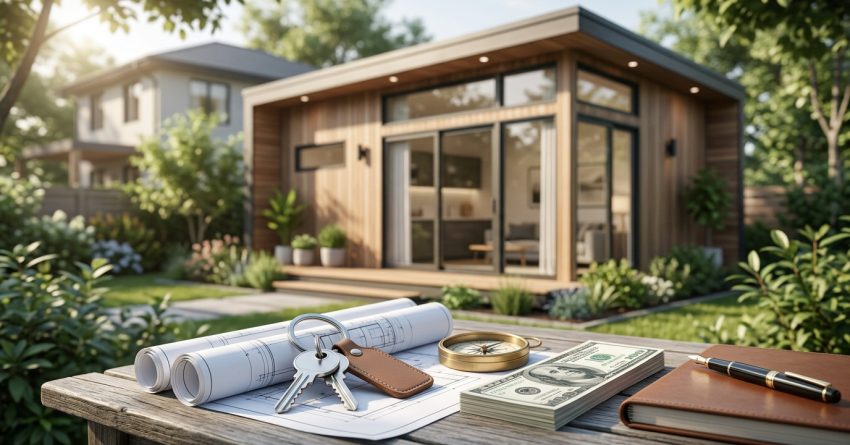
An accessory dwelling unit (ADU) is one of the most practical ways a homeowner can generate consistent rental income, increase property value, and build long-term wealth — all without purchasing a separate investment property. Whether you’re adding a detached backyard cottage, converting a garage, or finishing a basement suite, an ADU puts underused space to work as a revenue-generating asset. This guide covers everything you need to evaluate, build, finance, and manage an ADU as a sound investment.
Understanding the full investment picture — from construction costs to rental returns — helps you make a confident, well-informed decision. This guide breaks down each stage clearly.
You’ll learn what ADUs earn, what they cost, how to finance them, and how to manage them profitably, so you can take the right next step with confidence.
What Makes an ADU a Viable Investment Property
An ADU becomes a viable investment when it generates income that exceeds its carrying costs — including mortgage interest, maintenance, insurance, and property taxes — while also increasing the overall market value of the primary property. Unlike purchasing a separate rental property, an ADU leverages land you already own, which dramatically reduces the barrier to entry and the capital required to get started.
The investment case for ADUs has strengthened significantly as housing demand in most U.S. markets continues to outpace supply. Renters actively seek smaller, private units close to urban centers, and ADUs fill that gap efficiently. For homeowners, this translates into a dual benefit: monthly cash flow from rent and a measurable increase in appraised property value.
Understanding ADU investment potential is one piece of a larger financial picture — our real estate investment guide covers the full framework for evaluating residential income properties, from acquisition strategy to long-term portfolio growth.
Rental Income Potential from ADU Units
Rental income from an ADU varies by location, unit size, and amenities, but most ADUs in mid-to-large U.S. markets generate between $1,000 and $2,500 per month. In high-demand metros such as Los Angeles, Seattle, and Austin, monthly rents for well-finished ADUs frequently exceed $2,000. Even in smaller markets, a modest ADU can cover a significant portion of a homeowner’s mortgage payment, effectively reducing housing costs while building equity.
Property Value Appreciation with an ADU
Adding an ADU to a property increases its appraised value because it adds livable square footage and income-generating potential — two factors appraisers and buyers weigh heavily. Studies from the urban planning and real estate sectors consistently show that properties with permitted ADUs sell at a premium compared to comparable homes without them. The value added typically ranges from 20% to 35% of the ADU’s construction cost, though this varies by market conditions and unit quality.
Types of ADUs and Their Investment Returns
Not all ADUs deliver the same return on investment. The type of ADU you build — and how it fits your property — directly affects construction cost, rental income potential, and the speed at which you recoup your investment.
The four primary ADU types are detached ADUs, attached ADUs, garage conversions, and basement conversions. Each carries a different cost profile and appeals to a different renter profile. Choosing the right type for your property and market is one of the most important investment decisions you’ll make before breaking ground.
Before committing to a specific ADU type, it helps to understand the full scope of design, permitting, and construction decisions involved — our ADU planning guide walks through every stage from site evaluation to final build.
Detached ADUs vs. Attached ADUs
A detached ADU is a fully separate structure built on the same lot as the primary home — typically a backyard cottage or carriage house. It offers the highest rental income potential because tenants value complete privacy and separation. Attached ADUs share a wall with the primary residence and cost less to build because they use existing structural elements. Both types require separate utility connections and their own entrance, but detached units generally command 10%–20% higher rents due to the privacy premium.
Garage Conversions and Basement ADUs
Garage conversions and basement ADUs are the most cost-efficient ADU types because the structural shell already exists. Converting an attached garage typically costs between $30,000 and $80,000 depending on finish level, while a basement conversion ranges from $50,000 to $120,000. These units tend to attract long-term tenants who prioritize affordability, making them reliable income sources with lower vacancy rates. The trade-off is that rental rates are typically 10%–15% lower than a comparable detached unit.
ADU Construction Costs and ROI Breakdown
Construction cost is the single largest variable in any ADU investment analysis. Getting this number right — before you commit — is essential to projecting accurate returns and avoiding budget overruns that erode profitability.
ADU construction costs in the U.S. range from $80,000 for a basic garage conversion to over $300,000 for a high-finish detached unit in a high-cost market. The wide range reflects differences in labor markets, material costs, permit fees, utility connection requirements, and design complexity. Most homeowners planning a mid-range detached ADU should budget between $150,000 and $250,000 for a complete, permitted, move-in-ready unit.
Construction budgets vary significantly based on scope and materials, and the same cost dynamics apply across all major home projects — our remodeling cost guide provides detailed breakdowns by project type to help you plan accurately.
Average Build Costs by ADU Type
| ADU Type | Typical Cost Range | Key Cost Drivers |
| Detached ADU (new build) | $150,000–$300,000+ | Foundation, utilities, full structure |
| Attached ADU | $80,000–$160,000 | Shared wall, separate entrance, utilities |
| Garage Conversion | $30,000–$80,000 | Insulation, HVAC, plumbing, finish |
| Basement Conversion | $50,000–$120,000 | Egress windows, waterproofing, HVAC |
Calculating Your Return on Investment
A straightforward ADU ROI calculation compares annual net rental income to total construction cost. If a detached ADU costs $200,000 to build and generates $2,000 per month in rent, the gross annual income is $24,000. After subtracting estimated expenses — maintenance, insurance, vacancy, and property tax allocation — net annual income typically lands between $18,000 and $21,000. That produces a gross ROI of 9%–12%, which compares favorably to most traditional real estate investments.
Financing an ADU as an Investment Property
Most homeowners finance an ADU using equity they’ve already built in their primary residence. This approach avoids the need for a separate investment property loan and typically offers lower interest rates than unsecured financing options.
The three most common financing paths are a home equity line of credit (HELOC), a cash-out refinance, and a renovation loan such as a Fannie Mae HomeStyle or FHA 203(k). Each has different qualification requirements, draw structures, and repayment terms. Choosing the right option depends on how much equity you have, your current mortgage rate, and your timeline for completing the build.
Tapping into your existing property’s equity is one of the most common ways to fund an ADU build — our resource on home equity financing explains HELOC, cash-out refinance, and renovation loan options in plain terms.
Loan Options and Equity-Based Financing
A HELOC gives you a revolving credit line tied to your home’s equity, which works well for phased construction projects where costs are drawn over time. A cash-out refinance replaces your existing mortgage with a larger loan and delivers the difference as a lump sum — useful when you need full funding upfront. Renovation loans bundle construction costs into a single mortgage and are particularly useful for homeowners with limited existing equity. Each option carries different closing costs, interest rate structures, and approval timelines, so comparing them carefully before committing is essential.
Zoning Laws and Permit Requirements for ADUs
Zoning laws and local permit requirements determine whether you can legally build an ADU on your property — and what restrictions apply to its size, placement, height, and use. These rules vary significantly by state, county, and municipality, and they change frequently as local governments respond to housing demand.
California, Oregon, Washington, and several other states have passed legislation that broadly permits ADUs on single-family lots and limits local governments’ ability to restrict them. Other states leave ADU regulation entirely to local jurisdictions, which means rules can differ dramatically from one city to the next. Before investing in design or construction, confirming your property’s ADU eligibility with your local planning department is a non-negotiable first step.
Zoning rules differ dramatically by city and county, and navigating them correctly is critical before breaking ground — our permit and zoning guide explains how to research local ordinances, apply for permits, and avoid costly compliance mistakes.
How Local Regulations Affect ADU Investment Viability
Local regulations affect ADU investment viability in three primary ways: they determine whether an ADU is permitted at all, they set size and setback limits that affect rental income potential, and they establish owner-occupancy requirements that restrict how the property can be used. Some municipalities require the property owner to live on-site, which limits the ability to rent both the primary home and the ADU simultaneously. Understanding these constraints before purchasing a property or committing to a build is essential to protecting your investment.
Managing an ADU Rental Property
Once an ADU is built and rented, ongoing management determines whether the investment performs as projected. Effective management means maintaining the unit, retaining good tenants, and keeping operating costs predictable — all of which directly affect net income and long-term property value.
Many ADU owners self-manage their rental, particularly when the unit is on the same property as their primary residence. This reduces management costs but requires time, availability, and familiarity with landlord-tenant law. Others hire a property manager, which typically costs 8%–12% of monthly rent but removes the day-to-day burden of tenant communication and maintenance coordination.
Keeping an ADU rental running smoothly requires consistent upkeep and clear tenant communication — our guide on property management tips covers screening tenants, handling maintenance requests, and protecting your investment long-term.
Maintenance and Upkeep Responsibilities
An ADU requires the same routine maintenance as any residential unit: HVAC servicing, plumbing inspections, appliance upkeep, exterior maintenance, and periodic interior refreshes between tenants. Budgeting 1%–2% of the unit’s construction cost annually for maintenance is a standard rule of thumb. Deferred maintenance is the most common reason ADU rental income underperforms projections, so establishing a regular maintenance schedule from day one protects both the asset and the tenant relationship.
Routine maintenance is what keeps an ADU rental profitable and code-compliant — Mr. Local Services provides comprehensive home maintenance services for ADU owners who need reliable professionals to handle everything from HVAC upkeep to plumbing inspections.
Setting Rent and Finding Tenants
Setting rent at the right level requires researching comparable units in your immediate area — not just the broader city. Platforms such as Zillow, Apartments.com, and local rental listings provide current market data. Pricing 5%–10% below the top of the market range typically reduces vacancy and attracts longer-term tenants, which lowers turnover costs and stabilizes income. Tenant screening — including credit checks, income verification, and rental history — is essential to protecting your investment from the start.
Tax Implications of ADU Rental Income
Rental income from an ADU is taxable and must be reported on your federal and state income tax returns. However, ADU landlords are also entitled to deduct a range of expenses that reduce their taxable income, often significantly.
Deductible expenses include mortgage interest allocated to the ADU, property taxes, insurance, repairs and maintenance, utilities paid by the landlord, and depreciation. Depreciation is particularly valuable — it allows you to deduct a portion of the ADU’s construction cost each year over 27.5 years, reducing taxable rental income without any out-of-pocket expense. Working with a tax professional who has experience with rental properties ensures you capture every available deduction.
ADU rental income introduces specific tax obligations and deduction opportunities that most first-time landlords overlook — our rental property tax guide explains how to report income, claim depreciation, and work with a tax professional to maximize your returns.
Deductions and Depreciation for ADU Owners
The most impactful tax benefit for ADU owners is depreciation. If your ADU cost $200,000 to build, you can deduct approximately $7,273 per year in depreciation ($200,000 divided by 27.5 years). Combined with deductions for maintenance, insurance, and allocated mortgage interest, many ADU landlords find that their taxable rental income is substantially lower than their gross rent — sometimes by 30%–50%. Keeping detailed records of all ADU-related expenses from the first day of construction is essential to maximizing these benefits.
Conclusion
An ADU is a proven investment vehicle that generates rental income, increases property value, and builds long-term financial security using land you already own. The key variables — construction cost, rental income, financing structure, and local zoning rules — are all knowable before you commit.
With the right planning, an ADU can deliver 9%–12% gross returns while adding 20%–35% of its build cost to your property’s appraised value. The investment case is strong across most U.S. markets when approached with accurate cost data and realistic income projections.
Mr. Local Services connects ADU owners with skilled professionals for every stage of the process — from initial construction and remodeling to ongoing maintenance and repairs that keep your rental performing at its best.
Frequently Asked Questions
How much rental income can an ADU generate per month?
Most ADUs in U.S. markets generate between $1,000 and $2,500 per month in rent, depending on location, unit size, and finish level. High-demand metros such as Los Angeles and Seattle frequently see ADU rents above $2,000 per month for well-finished units.
What is the average ROI on an ADU investment?
A well-built ADU typically delivers a gross return on investment of 9%–12% annually when rental income is compared to total construction cost. Net ROI after expenses such as maintenance, insurance, and vacancy generally falls between 7% and 10%, which compares favorably to most traditional real estate investments.
Do I need a permit to build an ADU?
Yes. All ADU construction requires local building permits, and most jurisdictions also require zoning approval before construction begins. Permit requirements vary significantly by city and state, so confirming eligibility and requirements with your local planning department before starting any design work is essential.
Can I finance an ADU with a HELOC?
Yes. A home equity line of credit (HELOC) is one of the most common ways to finance an ADU build. It allows you to draw funds as construction progresses, which reduces interest costs compared to taking a lump sum upfront. Qualification depends on your available home equity and creditworthiness.
Does an ADU increase property value?
Yes. A permitted, well-built ADU typically increases a property’s appraised value by 20%–35% of its construction cost. The income-generating potential of the unit is a key factor appraisers and buyers consider, making ADUs a strong value-add in most residential markets.
What are the tax benefits of renting an ADU?
ADU landlords can deduct mortgage interest, property taxes, insurance, maintenance costs, and depreciation from their rental income. Depreciation alone — calculated over 27.5 years — can reduce taxable rental income by thousands of dollars annually, making the after-tax return on an ADU investment significantly stronger than the gross figures suggest.
What type of ADU has the lowest construction cost?
Garage conversions typically have the lowest construction cost, ranging from $30,000 to $80,000, because the structural shell already exists. Basement conversions are the next most cost-efficient option, ranging from $50,000 to $120,000. Both types offer strong ROI relative to their build cost, particularly in markets where rental demand is high.