Home insulation is the material installed in your walls, attic, floors, and foundation to slow the transfer of heat between the inside and outside of a building. Choosing the right insulation type directly affects your energy bills, indoor comfort, moisture control, and the long-term structural health of your property. With six primary insulation materials in common use across U.S. homes, each with distinct performance characteristics, cost profiles, and ideal applications, the decision is rarely straightforward.
This guide matters because the wrong insulation choice costs money twice: once during installation and again through years of higher utility bills and potential moisture damage.
This complete comparison covers every major insulation type, explains where each one belongs in your home, and gives you the information to make a confident, cost-effective decision.
How to Compare Insulation Types: Key Factors to Evaluate First
Before comparing specific materials, you need a clear framework for evaluation. Every insulation type performs differently across four core dimensions: thermal resistance, moisture behavior, fire safety, and installation requirements. Understanding these factors first makes every material comparison that follows far more useful.
Thermal resistance, measured as R-value, is the single most important performance metric. A higher R-value means greater resistance to heat flow. Moisture behavior determines whether a material will absorb water, promote mold growth, or maintain its performance in humid conditions. Fire rating affects building code compliance and occupant safety. Installation requirements determine whether a material is suitable for DIY application or demands professional equipment and training.
Understanding how insulation performance connects to your heating and cooling system is equally important — our HVAC service options explains how proper insulation and HVAC work together to reduce energy costs and maintain year-round comfort.
R-Value and Thermal Resistance Explained
R-value measures how effectively a material resists heat flow. The higher the number, the better the insulation performs. R-values are additive, meaning two layers of R-13 batts produce a combined R-26 assembly. The U.S. Department of Energy publishes minimum R-value recommendations by climate zone, ranging from R-30 in mild southern climates to R-60 in the coldest northern regions for attic applications.
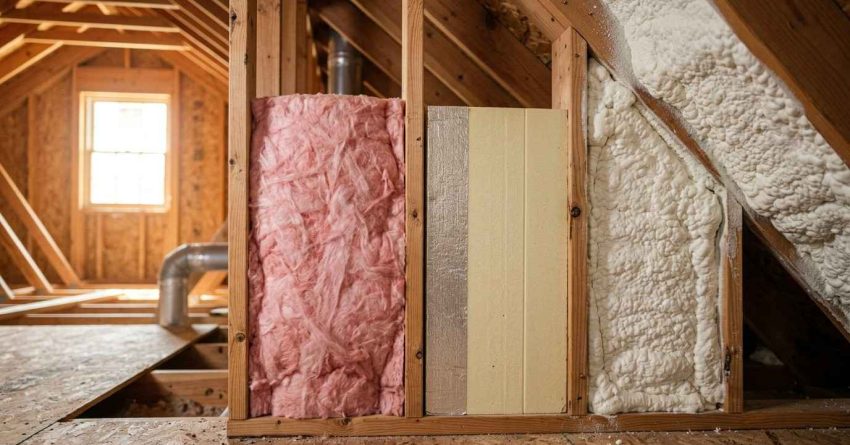
R-value per inch varies significantly by material. Spray foam closed-cell achieves approximately R-6 to R-7 per inch. Rigid foam board ranges from R-3.8 to R-6.5 per inch depending on type. Fiberglass batts deliver R-2.9 to R-3.8 per inch. This difference matters most in walls and spaces where thickness is constrained.
R-value requirements vary significantly by location in your home, and our attic insulation guide covers the specific R-value targets recommended for attic spaces across every U.S. climate zone.
Moisture Resistance and Vapor Control
Moisture is the primary cause of insulation failure. When insulation absorbs water, its R-value drops, and the material becomes a breeding ground for mold and mildew. Closed-cell spray foam and rigid foam board are inherently moisture-resistant. Fiberglass and mineral wool do not absorb water themselves but can trap moisture against adjacent surfaces if vapor control is not managed correctly. Cellulose, while treated with fire retardants, is the most moisture-sensitive of the common insulation types and requires careful vapor barrier management in humid climates.
Vapor barriers and vapor retarders are separate products installed alongside insulation to control condensation. Their placement — interior side, exterior side, or both — depends on your climate zone and the specific wall or roof assembly being insulated.
Fire Rating, Safety Standards, and Building Codes
All insulation materials sold in the U.S. must meet minimum fire safety standards under ASTM E84, which measures flame spread and smoke development. Mineral wool and fiberglass are naturally non-combustible. Spray foam and rigid foam board are combustible and require a thermal barrier — typically drywall — when installed in occupied spaces. Cellulose is treated with borate-based fire retardants to meet code requirements.
Local building codes specify which insulation types are permitted in specific applications, and requirements vary by state and municipality. Fire-rated insulation requirements often apply during renovation projects, and our home remodeling services team ensures all insulation upgrades meet current local building codes and safety standards.
Fiberglass Insulation The Most Common Choice for U.S. Homes
Fiberglass insulation is the most widely installed insulation material in the United States, found in the majority of homes built since the 1950s. It is made from fine strands of glass woven into a wool-like material and is available in two primary forms: pre-cut batts and rolls, and loose-fill. Fiberglass is non-combustible, resistant to moisture absorption, and relatively inexpensive compared to most alternatives.
The material’s widespread adoption comes from its combination of acceptable thermal performance, low cost, and ease of installation in standard framing cavities. It is available at virtually every home improvement retailer and is familiar to most contractors and DIY-capable homeowners.
Fiberglass is one of the most DIY-accessible materials available, but professional installation ensures consistent coverage and correct R-value — our insulation installation guide walks through what the process involves from start to finish.
Batts and Rolls vs. Loose-Fill Fiberglass
Fiberglass batts and rolls are pre-cut or continuous sheets sized to fit standard 16-inch and 24-inch stud spacing. They are the easiest form of fiberglass to install in open wall cavities, floor joists, and attic bays during new construction or gut renovations. Batts deliver R-11 to R-38 depending on thickness and are available with or without a kraft paper or foil facing that acts as a vapor retarder.
Loose-fill fiberglass is blown into place using specialized equipment, making it the preferred choice for attic floors, irregularly shaped spaces, and retrofit applications where walls are already closed. It settles slightly over time, which can reduce its effective R-value, and requires a higher initial installation depth to account for settling.
Where Fiberglass Works Best and Where It Falls Short
Fiberglass performs best in standard framed wall cavities, attic floors, and floor assemblies over unconditioned spaces. It is cost-effective, widely available, and easy to replace or supplement. Its limitations include air permeability — fiberglass does not stop air movement, only slows heat transfer — and susceptibility to performance loss when compressed or installed with gaps. In climates with extreme temperature swings or high humidity, fiberglass alone may be insufficient without additional air sealing measures.
Spray Foam Insulation Maximum Air Sealing Performance
Spray foam insulation is a two-component liquid that expands on contact to fill cavities, seal gaps, and create a continuous thermal and air barrier. It is the only insulation type that simultaneously insulates and air-seals in a single application, making it the highest-performing option for energy efficiency in most residential applications. Spray foam is applied by trained professionals using specialized equipment and is not a DIY material.
The material’s ability to conform to irregular surfaces and penetrate small gaps makes it particularly effective around pipes, wiring, and structural connections where other insulation types leave thermal bridges and air leakage paths.
Spray foam installation requires specialized equipment and training, making it one of the few insulation types that should always be handled by a professional — our handyman services team connects you with qualified installers for projects of any size.
Open-Cell vs. Closed-Cell Spray Foam
Open-cell spray foam expands to a soft, spongy consistency with an R-value of approximately R-3.5 to R-3.7 per inch. It is vapor-permeable, meaning moisture can pass through it, and is best suited for interior applications where vapor permeability is acceptable or desired. Open-cell foam is less expensive than closed-cell and is commonly used in interior walls and attic roof decks in mixed-humid climates.
Closed-cell spray foam expands to a rigid, dense consistency with an R-value of R-6 to R-7 per inch — the highest of any commonly used insulation material. It is a Class II vapor retarder, meaning it significantly restricts moisture movement. Closed-cell foam adds structural rigidity to wall assemblies and is the preferred choice for exterior applications, below-grade walls, crawl spaces, and any location where moisture intrusion is a concern.
Best Applications for Spray Foam in Residential Properties
Closed-cell spray foam is the preferred choice for rim joists, crawl space walls, basement walls, and roof decks in unvented attic assemblies. Open-cell foam is commonly used in interior wall cavities and vented attic roof decks where vapor permeability is acceptable. Both types are used to seal around penetrations, electrical boxes, and structural connections where air leakage is a primary concern. Spray foam is rarely cost-effective as the sole insulation in large open areas like attic floors, where blown-in materials deliver comparable thermal performance at a fraction of the cost.
Cellulose Insulation The Eco-Friendly Blown-In Option
Cellulose insulation is made from recycled paper products — primarily newsprint — treated with borate-based fire retardants and pest deterrents. It is the most environmentally sustainable of the common insulation materials, with recycled content typically exceeding 80%. Cellulose is installed as loose-fill blown into attic floors, wall cavities, and floor assemblies using pneumatic equipment.
Its high recycled content, competitive cost, and good thermal performance make cellulose a popular choice for both new construction and retrofit applications, particularly among homeowners prioritizing environmental impact alongside performance.
Blown-in cellulose can settle around utility penetrations over time, which is why it’s worth scheduling regular dryer vent cleaning and utility inspections to confirm airflow paths remain clear and insulation hasn’t shifted into venting areas.
How Cellulose Is Made and Installed
Cellulose is produced by shredding and milling recycled paper into a fine, fibrous material, then treating it with borate compounds that provide fire resistance, mold resistance, and pest deterrence. The finished product is packaged in compressed bags and installed using a blowing machine that breaks up the compressed material and propels it through a flexible hose.
In attic applications, cellulose is blown loosely over the attic floor to the required depth. In wall cavities, it is either dense-packed under pressure to prevent settling or wet-sprayed with a small amount of water to help it adhere to surfaces during new construction before drywall is installed.
Cellulose vs. Fiberglass: Which Performs Better?
Cellulose and fiberglass are the two most common blown-in insulation materials, and their performance is comparable in most applications. Cellulose delivers R-3.2 to R-3.8 per inch, similar to loose-fill fiberglass. Cellulose has a slight advantage in air resistance due to its denser fiber structure, which reduces convective heat loss within the insulation layer. Fiberglass has a slight advantage in moisture resistance, as it does not absorb water. In humid climates, fiberglass loose-fill is generally preferred for attic applications. In dry climates and interior wall applications, cellulose is a competitive and often more affordable alternative.
Rigid Foam Board Insulation High R-Value in Thin Profiles
Rigid foam board insulation is a manufactured panel product available in thicknesses from half an inch to four inches. It delivers higher R-values per inch than fiberglass or cellulose and is the only common insulation type that can be installed on the exterior of a building’s structural frame, eliminating thermal bridging through studs and joists. Rigid foam board is used in walls, roofs, foundations, and under concrete slabs.
Its dimensional stability, moisture resistance, and high R-value per inch make it a preferred choice in applications where space is limited and maximum thermal performance is required.
Rigid foam board is frequently installed alongside window and door framing to eliminate thermal bridging at openings — our window insulation upgrades explains how window replacement and insulation improvements work together to stop heat loss at the most vulnerable points in your walls.
Foam board is also used around door frames to seal gaps that standard cavity insulation cannot reach, and our door weatherproofing service addresses both the insulation and sealing needs around exterior doors in one visit.
EPS, XPS, and Polyisocyanurate: What’s the Difference?
Three types of rigid foam board are in common use. Expanded polystyrene (EPS) is the most affordable, delivers R-3.6 to R-4.2 per inch, and is vapor-permeable, allowing drying in both directions. Extruded polystyrene (XPS) delivers R-5 per inch, is moisture-resistant, and is the most common choice for below-grade and exterior applications. Its R-value can decrease slightly over decades as blowing agents dissipate. Polyisocyanurate (polyiso) delivers the highest R-value of the three at R-5.7 to R-6.5 per inch and is the most common choice for roof assemblies. Its R-value decreases in very cold temperatures, which affects its real-world performance in cold climates.
Where Rigid Foam Board Is Used in Home Construction
Rigid foam board is used on the exterior of wall sheathing to create a continuous insulation layer that eliminates thermal bridging through studs. It is installed under concrete slabs to reduce heat loss to the ground. It is used on the interior of basement walls and crawl space walls as a moisture-resistant thermal barrier. In roof assemblies, polyiso is the standard choice for flat and low-slope commercial roofs and is increasingly used in residential applications where high R-values are required in thin roof profiles.
Mineral Wool (Rockwool) Insulation Fire and Sound Performance
Mineral wool insulation, sold under brand names including Rockwool and Thermafiber, is made from volcanic rock or industrial slag spun into dense fiber batts and boards. It is naturally non-combustible, resisting temperatures above 1,000 degrees Fahrenheit without melting or releasing toxic gases. Mineral wool is denser than fiberglass, which gives it superior acoustic performance and better resistance to air movement within the insulation layer.
Its combination of thermal performance, fire resistance, and sound attenuation makes mineral wool the preferred choice in applications where multiple performance requirements must be met simultaneously.
Mineral wool is a preferred choice in walls and ceilings where both thermal and acoustic performance matter — our drywall and ceiling work team regularly pairs mineral wool installation with drywall finishing to deliver a complete, code-compliant assembly.
Thermal vs. Acoustic Benefits of Mineral Wool
Mineral wool delivers R-3.0 to R-4.2 per inch, comparable to fiberglass. Its thermal advantage over fiberglass comes from its density, which reduces convective heat movement within the batt and improves real-world performance relative to its rated R-value. Its acoustic advantage is more significant: mineral wool batts in interior walls reduce sound transmission by 10 to 15 decibels more than standard fiberglass batts of the same thickness, making it the standard choice for home theaters, bedrooms, and shared walls in multi-family properties.
Mineral Wool vs. Fiberglass: A Direct Comparison
Mineral wool costs approximately 25 to 50 percent more than comparable fiberglass batts. In exchange, it offers better fire resistance, better acoustic performance, better dimensional stability, and slightly better real-world thermal performance due to its density. Fiberglass is lighter, easier to cut, and more widely available. For standard exterior wall insulation in a single-family home, fiberglass remains the cost-effective default. For interior walls, party walls, mechanical rooms, and any application where fire resistance or sound control is a priority, mineral wool justifies its higher cost.
Reflective and Radiant Barrier Insulation Heat Management in Hot Climates
Radiant barriers are reflective foil materials installed in attic spaces to reduce radiant heat gain from the roof deck. Unlike conventional insulation, which slows conductive heat transfer, radiant barriers work by reflecting infrared radiation rather than absorbing and slowing it. They are most effective in hot, sunny climates where solar heat gain through the roof is the dominant cooling load.
Radiant barriers are not a replacement for conventional insulation. They are a supplemental measure that reduces attic temperatures and, by extension, reduces the load on air conditioning systems in climates where cooling is the primary energy concern.
Where Radiant Barriers Work and Where They Don’t
Radiant barriers deliver measurable energy savings in Climate Zones 1 through 3 — the hot and mixed-humid regions of the southern United States including Florida, Texas, Arizona, and the Gulf Coast. In these climates, a properly installed radiant barrier can reduce attic temperatures by 20 to 30 degrees Fahrenheit and reduce cooling energy use by 5 to 10 percent. In Climate Zones 5 through 8 — the cold and very cold northern regions — radiant barriers provide minimal benefit because heating loads dominate and solar heat gain through the roof is not a significant energy factor. In mixed climates (Zones 4 and 5), the benefit is marginal and the investment is better directed toward increasing conventional insulation R-values.
Insulation by Location Which Type Belongs Where in Your Home
Insulation requirements vary by location within a building because each location has different thermal, moisture, and structural conditions. The attic, exterior walls, interior walls, crawl space, basement, and slab each present distinct challenges that favor different materials and installation methods. Matching the right insulation type to each location is as important as selecting the right R-value.
Attic Insulation Options and R-Value Recommendations
The attic floor is the highest-priority insulation location in most U.S. homes because it separates the conditioned living space from the unconditioned attic, which experiences extreme temperature swings. Blown-in cellulose and loose-fill fiberglass are the most common and cost-effective choices for attic floors, delivering the required R-values — typically R-38 to R-60 depending on climate zone — at competitive installed costs. Spray foam is used in unvented attic assemblies where the insulation is applied to the roof deck rather than the attic floor, bringing the attic into the conditioned envelope.
Attic insulation performance is directly tied to the condition of your roof deck and ventilation system — our roofing and attic services team inspects both during every roofing project to confirm insulation is protected from moisture intrusion and air leakage.
Wall Insulation: Interior, Exterior, and Cavity Choices
Exterior walls in new construction are typically insulated with fiberglass or mineral wool batts in the stud cavity, achieving R-13 to R-21 depending on stud depth. Adding continuous rigid foam board on the exterior of the sheathing eliminates thermal bridging through studs and can increase the effective wall R-value by 30 to 50 percent. In retrofit applications where walls are already closed, dense-pack cellulose or blown-in fiberglass are installed through small holes drilled in the exterior or interior cladding. Interior partition walls are insulated with mineral wool batts for acoustic control rather than thermal performance.
Crawl Space, Basement, and Foundation Insulation
Crawl spaces and basements present the most complex insulation decisions because moisture management is as important as thermal performance. In vented crawl spaces, insulation is installed between the floor joists above the crawl space. In encapsulated crawl spaces — the current best practice in most climates — the crawl space walls and floor are sealed with a vapor barrier and the walls are insulated with closed-cell spray foam or rigid foam board. Basement walls are insulated on the interior with rigid foam board or closed-cell spray foam, both of which resist moisture from the concrete.
Crawl space insulation is especially vulnerable to moisture damage, and if water has already entered the space, insulation replacement should follow professional water damage restoration to prevent mold growth behind new materials.
Insulation Cost Comparison Material and Installation Costs by Type
Insulation costs vary by material, coverage area, installation method, and regional labor rates. The table below reflects typical installed cost ranges per square foot for common insulation types in U.S. residential applications as of 2025.
| Insulation Type | R-Value per Inch | Installed Cost (per sq ft) | Best Application |
| Fiberglass Batts | R-2.9 to R-3.8 | $0.40–$1.50 | Walls, attic floors, floors |
| Loose-Fill Fiberglass | R-2.2 to R-2.7 | $0.50–$1.20 | Attic floors, retrofit walls |
| Cellulose (Blown-In) | R-3.2 to R-3.8 | $0.60–$1.80 | Attic floors, retrofit walls |
| Open-Cell Spray Foam | R-3.5 to R-3.7 | $1.00–$2.00 | Interior walls, attic decks |
| Closed-Cell Spray Foam | R-6.0 to R-7.0 | $1.50–$3.50 | Crawl spaces, basements, rim joists |
| Rigid Foam Board (EPS) | R-3.6 to R-4.2 | $0.25–$0.65 per sq ft per inch | Exterior walls, slabs |
| Rigid Foam Board (XPS) | R-5.0 | $0.30–$0.80 per sq ft per inch | Below-grade, exterior |
| Mineral Wool Batts | R-3.0 to R-4.2 | $0.80–$2.00 | Walls, party walls, ceilings |
Insulation costs vary widely depending on material, coverage area, and labor, and our home improvement costs resource breaks down typical price ranges across the most common residential upgrade projects so you can plan your budget accurately.
DIY vs. Professional Insulation Installation
Fiberglass batts and rigid foam board panels are the most accessible materials for DIY installation in open framing cavities. Both require basic tools, are available at retail, and carry manageable safety requirements — primarily eye protection, gloves, and a dust mask for fiberglass. Blown-in cellulose and loose-fill fiberglass require a blowing machine, which can be rented from some retailers, but achieving consistent coverage and correct density without experience is difficult.
Spray foam — both open-cell and closed-cell — is not a DIY material. The two-component chemistry requires precise mixing ratios, specialized application equipment, and proper respiratory protection. Improper installation results in off-ratio foam with significantly reduced R-value and potential off-gassing issues.
For homeowners weighing whether to tackle insulation themselves, the decision often comes down to access, safety, and material type — our professional handyman help outlines which insulation jobs are safe for DIY and which require a licensed installer.
Climate Zone Insulation Guide Matching Insulation to Your U.S. Region
The U.S. Department of Energy divides the country into eight climate zones, each with distinct heating and cooling demands that determine the appropriate insulation strategy. Insulation requirements in Miami (Zone 1) and Minneapolis (Zone 7) are fundamentally different, and applying the wrong strategy wastes money on either over-insulation or under-insulation.
In hot climates (Zones 1–2), the priority is reducing solar heat gain and cooling loads. Radiant barriers, reflective roof materials, and moderate R-values in walls and attics are the primary tools. In mixed climates (Zones 3–4), balanced insulation strategies address both heating and cooling seasons. In cold and very cold climates (Zones 5–7), maximum R-values in attics and walls, continuous exterior insulation to eliminate thermal bridging, and aggressive air sealing are the priorities. In subarctic climates (Zone 8), insulation requirements are the most demanding of any region.
Climate zone insulation requirements are one part of a broader energy efficiency strategy — our home energy efficiency guide covers insulation, air sealing, HVAC upgrades, and other improvements that work together to reduce utility costs year-round.
DOE R-Value Recommendations by Climate Zone
The Department of Energy publishes minimum R-value recommendations for attics, walls, floors, and crawl spaces by climate zone. For attics, recommendations range from R-30 in Zone 1 to R-60 in Zones 7 and 8. For walls, recommendations range from R-13 in Zone 1 to R-20 plus continuous exterior insulation in Zones 6 through 8. For crawl spaces and basement walls, recommendations range from R-5 to R-19 depending on zone. These are minimum recommendations; exceeding them is cost-effective in most climates given current energy prices.
Signs Your Home Needs New or Additional Insulation
Most U.S. homes built before 1980 are under-insulated by current standards, and many homes built through the 1990s fall short of today’s recommended R-values. Identifying the signs of inadequate insulation early prevents energy waste and protects the building from moisture-related damage.
The most common signs include uneven temperatures between rooms, with some areas consistently warmer or cooler than others regardless of thermostat settings. High heating and cooling bills relative to similar homes in the same climate are a strong indicator. Ice dams forming at roof edges in winter indicate heat escaping through the attic and melting snow that refreezes at the cold eaves. Cold floors above crawl spaces or unheated garages indicate missing or degraded floor insulation. Visible moisture, condensation, or mold in attic spaces or on exterior walls indicates both insulation and vapor control problems.
If you’re seeing multiple warning signs at once, a full property walkthrough can help prioritize what needs attention first — our home inspection checklist gives homeowners and property managers a structured way to assess insulation, HVAC, roofing, and other systems in one review.
How to Choose the Right Insulation Type for Your Property
Choosing the right insulation type requires matching material characteristics to the specific conditions of each location in your home, your climate zone, your budget, and your performance priorities. No single insulation type is the best choice for every application.
Start with location. Attic floors favor blown-in materials for coverage and cost. Exterior walls in new construction favor batts or dense-pack. Crawl spaces and basements favor closed-cell spray foam or rigid foam board for moisture resistance. Interior walls favor mineral wool for acoustic performance.
Then consider your climate zone. Cold climates demand maximum R-values and continuous insulation to eliminate thermal bridging. Hot climates benefit from radiant barriers and moderate R-values. Mixed climates require balanced strategies.
Then consider your budget. Fiberglass and cellulose deliver the lowest installed cost per R-value. Spray foam delivers the highest performance but at two to five times the cost of blown-in alternatives. Rigid foam board occupies the middle ground for exterior and below-grade applications.
Finally, consider your timeline and access. Retrofit applications with closed walls require blown-in materials. Open framing during renovation or new construction allows the full range of options. Spray foam requires professional installation regardless of access.
Choosing the right insulation type is often part of a larger renovation decision — our remodeling and renovation services help homeowners plan insulation upgrades alongside structural, mechanical, and finish improvements for a coordinated result.
Professional Insulation Services What to Expect
Professional insulation installation begins with an assessment of your home’s current insulation levels, air sealing condition, and moisture management. A qualified installer will measure existing insulation depth in the attic, check for gaps and bypasses around penetrations, assess vapor control, and identify any moisture damage that needs to be addressed before new insulation is installed.
The installation process varies by material. Blown-in insulation projects in attics typically take two to four hours for an average home. Spray foam projects require the space to be vacated during application and for a curing period of 24 hours before re-occupancy. Batt installation in open framing is the fastest process, often completed in a single day for a full house.
Professional insulation upgrades are most effective when coordinated with heating and cooling system improvements, and our HVAC installation services team works alongside insulation professionals to deliver whole-home energy performance improvements in a single project.
After installation, a professional should provide documentation of the installed R-value, material type, and coverage area. This documentation is required for energy efficiency tax credits and rebates available under current federal programs, and it supports future real estate transactions by demonstrating the property’s energy performance.
Conclusion
Insulation type selection is a decision that connects thermal performance, moisture control, fire safety, and long-term property value into a single material choice. Each insulation type — fiberglass, spray foam, cellulose, rigid foam board, mineral wool, and radiant barriers — serves specific applications where its characteristics deliver the best return.
Matching the right material to each location in your home, calibrated to your climate zone and budget, is the foundation of an effective insulation strategy. The performance gap between a well-insulated and under-insulated home compounds over years of energy costs and maintenance expenses.
At Mr. Local Services, our team connects homeowners and property managers with qualified insulation professionals who assess your property, recommend the right materials for each location, and deliver installations that meet current code requirements and energy performance standards. Contact us today to schedule an insulation assessment.
Frequently Asked Questions
What is the best insulation type for an attic?
Blown-in cellulose and loose-fill fiberglass are the most cost-effective choices for attic floors in most U.S. homes. Both can be installed to the R-38 to R-60 levels recommended by the DOE for most climate zones at a lower installed cost than spray foam or batt alternatives.
What is the difference between open-cell and closed-cell spray foam?
Open-cell spray foam is softer, vapor-permeable, and delivers R-3.5 to R-3.7 per inch at a lower cost. Closed-cell spray foam is rigid, moisture-resistant, and delivers R-6 to R-7 per inch. Closed-cell is the preferred choice for crawl spaces, basements, and any moisture-exposed application.
How do I know what R-value I need for my home?
R-value requirements depend on your climate zone and the location being insulated. The U.S. Department of Energy recommends R-38 to R-60 for attics, R-13 to R-21 for walls, and R-5 to R-19 for crawl spaces and basements, with higher values required in colder climate zones.
Is fiberglass insulation safe to install yourself?
Fiberglass batts are one of the most DIY-accessible insulation materials. Proper personal protective equipment — including gloves, eye protection, long sleeves, and a dust mask — is required during installation. Blown-in fiberglass requires a blowing machine and is more difficult to install correctly without experience.
How long does insulation last?
Fiberglass and mineral wool insulation can last 80 to 100 years when kept dry and undisturbed. Cellulose may settle over time, reducing its effective R-value and requiring top-up applications every 15 to 20 years. Spray foam, when properly installed, is considered a permanent installation with no expected degradation under normal conditions.
Does insulation help with soundproofing?
Conventional thermal insulation provides some acoustic benefit, but mineral wool batts are significantly more effective for sound control than fiberglass of the same thickness. Mineral wool in interior walls can reduce sound transmission by 10 to 15 decibels more than standard fiberglass batts, making it the standard choice for bedrooms, home theaters, and shared walls.
What insulation type is best for a crawl space?
Closed-cell spray foam and rigid foam board are the preferred choices for crawl space walls in encapsulated crawl spaces because both resist moisture from the surrounding soil and concrete. In vented crawl spaces, fiberglass batts installed between floor joists are the traditional approach, though encapsulation with closed-cell foam is the current best practice in most climates.
Can I add insulation on top of existing insulation?
Yes, adding insulation on top of existing attic insulation is one of the most cost-effective home energy improvements available. The existing insulation does not need to be removed unless it is damaged, wet, or contaminated. New blown-in material is installed over the existing layer to bring the total R-value up to current recommendations.