The foundation your home sits on is only as strong as the soil beneath it. Choosing the wrong foundation for your soil type leads to cracking, settling, water intrusion, and costly structural repairs that could have been avoided before construction began. Soil composition, drainage behavior, and load-bearing capacity all directly determine which foundation system will perform reliably over the long term.
For homeowners, landlords, and property managers, understanding this relationship is not optional — it is the difference between a stable property and one that requires constant, expensive intervention.
This guide explains how soil type shapes every foundation decision, which foundation systems match which soil conditions, and what warning signs indicate a mismatch between your foundation and the ground it rests on.
Why Soil Type Determines Your Foundation Choice
Every foundation transfers the weight of a structure into the ground below it. How well that transfer works depends entirely on what the ground is made of. Soil that compresses, expands, shifts, or drains poorly creates uneven pressure on a foundation — and uneven pressure causes damage.
Engineers and geotechnical specialists evaluate soil before recommending any foundation system. They look at three primary factors: bearing capacity (how much weight the soil can support without compressing), moisture behavior (how the soil responds to water), and stability (whether the soil moves seasonally or under load).
A foundation designed for stable, well-draining soil will fail prematurely in expansive clay. A foundation suited for clay will be unnecessarily expensive on solid bedrock. Matching the foundation to the soil is not a preference — it is a structural requirement.
Understanding how soil type shapes your foundation decision is one of the most critical factors in any new build — our custom home investment analysis covers how foundational decisions like this one affect the total cost and long-term value of building versus buying a spec home.
How Soil Composition Affects Load-Bearing Capacity
Load-bearing capacity is measured in pounds per square foot (PSF) and varies dramatically by soil type. Dense gravel and bedrock can support 8,000 PSF or more. Soft clay may support as little as 1,000 PSF. Sandy soils fall in the middle but shift under dynamic loads.
When a foundation is placed on soil with insufficient bearing capacity, the structure settles unevenly. One corner drops while another holds. Walls crack. Doors and windows stop closing properly. Over time, the structural integrity of the entire building is compromised.
Soil Testing: The First Step Before Any Foundation Decision
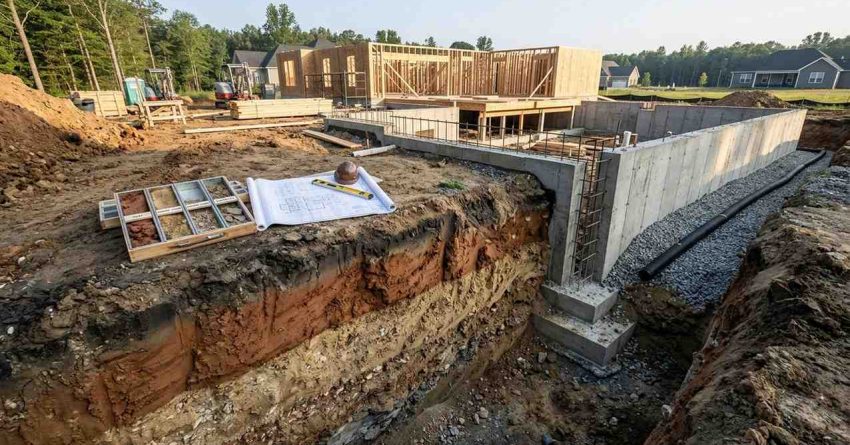
A geotechnical soil investigation — commonly called a soil test or site investigation — is conducted before any foundation is designed. A licensed geotechnical engineer drills bore holes at multiple points across the site, extracts soil samples at varying depths, and analyzes composition, moisture content, and bearing capacity.
The results determine which foundation types are structurally appropriate for the site. Skipping this step is one of the most common and costly mistakes in residential construction. No reputable structural engineer will design a foundation without soil data — and no homeowner should accept a foundation design that was not based on one.
If you are planning a custom build, soil testing for your specific site should be completed before you finalize your land purchase — our soil testing for home construction resource explains the full process, what results mean, and what to do when soil conditions are poor.
Common Soil Types and the Foundations That Work Best
Soil is not uniform. Even within a single property, soil composition can change significantly at different depths and across different areas of the lot. Understanding the dominant soil type on your site is the starting point for every foundation decision.
Clay Soil and Foundation Challenges
Clay soil is the most problematic soil type for residential foundations. Clay expands when wet and contracts when dry — a behavior called shrink-swell. This seasonal movement creates lateral pressure against foundation walls and causes differential settlement when different areas of the foundation experience different moisture levels.
Homes built on clay soil require foundations with deep footings that reach below the active zone — the depth at which clay moisture content changes seasonally. Pier and beam foundations and drilled pier systems are commonly used in high-clay regions because they transfer load to stable soil or bedrock below the active zone.
For a detailed look at how clay soil movement damages home structures over time, our clay soil foundation problems resource covers the full progression from early warning signs to structural failure.
Sandy Soil and Drainage Considerations
Sandy soil drains quickly and does not retain moisture the way clay does. This makes it less prone to expansion and contraction, but it presents a different challenge: sandy soil can shift or erode under load, particularly when water flows through it.
Foundations on sandy soil typically require wider footings to distribute load across a larger surface area. In areas with high water tables or significant rainfall, drainage systems must be incorporated into the foundation design to prevent erosion beneath the footings.
Loamy Soil and Stable Foundation Options
Loamy soil — a balanced mixture of sand, silt, and clay — is the most favorable soil type for residential construction. It drains well, retains enough moisture to remain stable, and provides consistent bearing capacity across seasons.
Most standard foundation types perform reliably on loamy soil. Slab-on-grade, crawl space, and basement foundations are all viable options, with the final choice driven by climate, topography, and budget rather than soil limitations.
Rocky or Bedrock Soil and Deep Foundation Advantages
Bedrock and rocky soil provide the highest bearing capacity of any soil type. Foundations on bedrock are inherently stable — there is no shrink-swell behavior, no erosion risk, and no settlement under load.
The primary challenge with rocky soil is excavation cost. Drilling or blasting through rock to reach the required depth adds significant expense to site preparation. However, once the foundation is set, long-term maintenance costs are typically lower than foundations on problematic soils.
Foundation Types Matched to Soil Conditions
Three primary foundation systems are used in residential construction in the United States. Each performs differently depending on the soil beneath it — our home foundation guide walks through every foundation system in detail, including cost ranges, installation requirements, and the soil conditions each one is designed to handle.
Slab Foundations: Best Soil Conditions
A slab-on-grade foundation is a single concrete pad poured directly on prepared ground. It performs best on stable, well-draining soil with consistent bearing capacity — loamy soil and compacted gravel are ideal.
Slab foundations are not recommended for high-clay soils without significant soil treatment, because clay movement can crack the slab. They are also unsuitable for sites with high water tables unless drainage systems are installed beneath the slab.
Crawl Space Foundations: When Soil Moisture Is a Factor
A crawl space foundation raises the structure above grade on perimeter walls, creating a ventilated space beneath the floor. This design is well-suited to sites with moderate moisture, uneven terrain, or soils that drain slowly.
The elevated design protects floor systems from ground moisture and allows access to plumbing and electrical systems beneath the home. However, crawl spaces require proper vapor barriers and ventilation to prevent moisture accumulation — a particular concern on clay-heavy or high-water-table sites.
Basement Foundations: Soil Depth and Stability Requirements
A basement foundation extends the structure below grade, creating usable living or storage space beneath the home. Basements require soil that can be excavated to the required depth without collapse and that provides adequate lateral support for the foundation walls.
Stable, well-draining soils are best suited for basements. High-clay soils create significant lateral pressure against basement walls, requiring reinforced wall systems and robust waterproofing. In areas with high water tables, basement construction requires active drainage systems and waterproofing membranes.
Signs Your Foundation Was Mismatched to Your Soil Type
Foundation problems caused by soil mismatch rarely appear immediately. They develop over months or years as soil movement accumulates. Recognizing the early warning signs allows homeowners to address problems before they become structural emergencies.
Common indicators of a soil-foundation mismatch include:
- Diagonal cracks running from the corners of doors and windows
- Doors and windows that stick, bind, or no longer close flush
- Visible gaps between walls and ceilings or floors
- Uneven or sloping floors, particularly in older homes
- Cracks in exterior brick or masonry that follow a stair-step pattern
- Water intrusion in basements or crawl spaces after rainfall
- Visible separation between the foundation and the structure above it
When a foundation is installed in the wrong soil conditions, the damage compounds over time — our foundation repair services explains what professional remediation involves, how long repairs take, and what homeowners can expect to pay.
How a Professional Soil Assessment Protects Your Investment
A professional soil assessment is not an optional expense — it is a risk management tool. The cost of a geotechnical investigation for a residential site typically ranges from $500 to $3,000 depending on site complexity, number of bore holes, and laboratory analysis required. That cost is a fraction of what foundation repair or remediation costs after construction.
A professional soil assessment protects your investment in three specific ways. First, it identifies soil conditions that require special foundation designs before construction begins — when changes are inexpensive. Second, it provides documentation that supports insurance claims and resale disclosures. Third, it gives structural engineers the data they need to design a foundation that will perform reliably for the life of the structure.
A professional soil assessment is a pre-construction investment that pays for itself many times over — if you are weighing a custom build against a move-in-ready option, our spec home comparison breaks down exactly how pre-assessed land affects total project cost and risk.
For homeowners purchasing land for a custom build, a soil assessment should be a condition of the purchase agreement — not an afterthought after closing. If the soil assessment reveals conditions that require expensive foundation solutions, that information belongs in your negotiation, not your construction budget.
Foundation Choice by Soil Type: What Homeowners Should Ask
Before any foundation is designed or poured, homeowners and property managers should ask their contractor and structural engineer the following questions:
- Has a geotechnical soil investigation been completed for this specific site?
- What soil types were identified, and at what depths?
- What is the measured bearing capacity of the soil at footing depth?
- Which foundation types are structurally appropriate for these soil conditions?
- What drainage provisions are included in the foundation design?
- What are the long-term maintenance requirements for this foundation type on this soil?
- Is there any soil treatment required before the foundation is poured?
These questions separate contractors who understand soil-foundation relationships from those who apply a one-size-fits-all approach. The answers should be specific, documented, and reflected in the engineering drawings.
How Foundation Problems Affect Home Maintenance and Repairs
A foundation that is mismatched to its soil type does not just create structural problems — it creates a cascade of maintenance issues throughout the home. Water intrusion from a compromised foundation leads to mold growth, wood rot, and damaged insulation. Differential settlement cracks drywall, misaligns door frames, and breaks tile grout lines. Lateral pressure from expansive clay can bow basement walls inward, damaging plumbing and electrical systems routed through the foundation.
For landlords and property managers, foundation-related maintenance issues are particularly costly because they affect multiple systems simultaneously. A single foundation problem can generate repair needs across plumbing, electrical, drywall, flooring, and exterior systems — all traceable to a single root cause that was preventable at the design stage.
Addressing foundation-related damage requires coordinated work across multiple trades. Homeowners dealing with active foundation movement should prioritize stabilization before investing in cosmetic repairs — fixing drywall cracks before the foundation is stabilized means fixing them again after the next seasonal soil movement.
Working With Home Service Professionals on Foundation-Related Issues
Foundation-related repairs and maintenance decisions connect directly to the long-term financial performance of your property — our home investment analysis provides the broader context homeowners and property managers need when evaluating repair costs against property value.
When foundation issues are identified, the repair process typically involves multiple professionals: a structural engineer to assess the damage and design the repair, a foundation specialist to execute the stabilization work, and general contractors or trade specialists to address secondary damage to plumbing, drywall, flooring, and other affected systems.
Mr. Local Services connects homeowners and property managers with skilled professionals across all of these trades. Whether you need a structural assessment, foundation repair coordination, or follow-on repairs to systems damaged by foundation movement, our network of vetted professionals delivers quality workmanship, transparent pricing, and dependable service — keeping your property safe, functional, and well-maintained through every stage of the repair process.
Frequently Asked Questions
What soil type is best for a home foundation?
Loamy soil is the most favorable soil type for residential foundations. It provides consistent bearing capacity, drains well, and remains stable across seasons — making it compatible with slab, crawl space, and basement foundation systems without special engineering requirements.
Can you build a foundation on clay soil?
Yes, but clay soil requires specific foundation designs that account for its shrink-swell behavior. Deep footings, drilled piers, or pier and beam systems that reach below the active moisture zone are commonly used to prevent differential settlement caused by seasonal clay expansion and contraction.
How much does a soil test cost before building a home?
A residential geotechnical soil investigation typically costs between $500 and $3,000 depending on site size, number of bore holes required, and the complexity of laboratory analysis. This cost is a small fraction of what foundation remediation costs after construction if soil conditions are not properly assessed.
What are the signs of a foundation problem caused by soil movement?
Common signs include diagonal cracks at door and window corners, doors and windows that stick or no longer close properly, uneven or sloping floors, stair-step cracks in exterior brick, and water intrusion in basements or crawl spaces after rainfall.
Is a slab foundation good for all soil types?
No. Slab foundations perform best on stable, well-draining soils like compacted gravel or loam. They are not recommended for high-clay soils without soil treatment because clay expansion and contraction can crack the slab and cause uneven settlement beneath it.
What is the difference between a crawl space and a slab foundation for wet soil?
A crawl space foundation raises the structure above grade, reducing direct contact between the floor system and moist soil — making it better suited to sites with slow drainage or moderate moisture. A slab foundation sits directly on prepared ground and requires robust drainage systems beneath it to perform reliably on wet or high-water-table sites.
Do I need a soil test if I am buying a spec home?
If you are purchasing a spec home, the soil assessment and foundation design should already be documented by the builder. Request copies of the geotechnical report and structural engineering drawings before closing. If the builder cannot provide them, treat that as a significant red flag.
Conclusion
Soil type is not a background detail in home construction — it is the primary variable that determines which foundation system will perform reliably and which will fail. Clay, sand, loam, and bedrock each require different engineering responses, and matching the foundation to the soil is a structural requirement, not a preference.
For homeowners and property managers, understanding this relationship reduces the risk of costly repairs and protects long-term property value. A professional soil assessment before construction is the most cost-effective investment you can make in the structural integrity of any building.
Mr. Local Services connects you with skilled professionals across foundation assessment, repair, and related home maintenance trades — contact us today to get dependable, expert support for every stage of your property’s care.