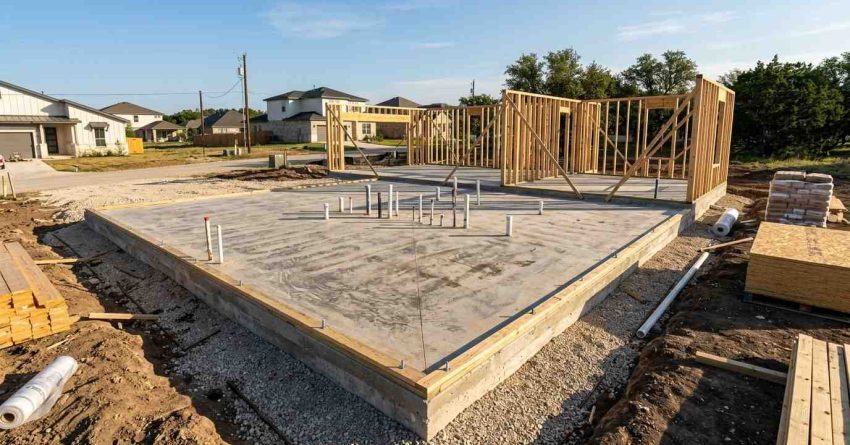
A slab-on-grade foundation is a single layer of concrete poured directly on prepared ground, serving as both the structural base and the floor of a building. It is one of the most widely used foundation systems in the United States, particularly in warm and temperate climates where frost depth is minimal and soil conditions are stable. Understanding how this foundation type works — and how to maintain it — directly affects the safety, value, and longevity of any property built on it.
Foundation problems are among the most expensive repairs a homeowner can face, and catching issues early makes a significant difference in cost and outcome.
This guide covers everything you need to know: how slab foundations are built, the different types available, where they perform best, what they cost, and how to identify and address problems before they escalate.
What Is a Slab-on-Grade Foundation?
A slab-on-grade foundation is a reinforced concrete slab poured at ground level, resting directly on a prepared soil or gravel base. Unlike basement or crawl space foundations, there is no hollow space beneath the living area. The concrete slab acts simultaneously as the structural foundation and the finished floor surface, with plumbing and electrical conduits embedded within or beneath it before the pour.
This foundation type is classified as a shallow foundation system, meaning it transfers the building’s load to the soil near the surface rather than to deeper load-bearing strata. The slab is typically 4 to 6 inches thick at its center, with thickened edges — called grade beams or footings — that extend deeper into the ground to provide additional load-bearing capacity at the perimeter and beneath load-bearing walls.
Reinforcement is embedded within the concrete in the form of steel rebar, welded wire mesh, or post-tensioning cables, depending on the design. This reinforcement prevents the slab from cracking under load and helps it perform as a unified structural element rather than a collection of separate concrete sections.
Understanding how a slab-on-grade compares to other options is easier when you have a clear overview of all foundation types — our foundation types guide breaks down every major category, from crawl space to basement, so you can see exactly where slab construction fits in the broader picture.
How a Slab-on-Grade Foundation Is Built
The construction sequence for a slab-on-grade foundation follows a defined order that directly affects the slab’s long-term performance. The process begins with site clearing and excavation, followed by grading the soil to achieve the correct elevation and slope for drainage. A layer of compacted gravel or crushed stone — typically 4 to 6 inches deep — is placed over the prepared subgrade to improve drainage and provide a stable base.
A vapor barrier, usually a polyethylene sheet, is installed over the gravel layer to prevent ground moisture from migrating upward through the concrete. Rigid foam insulation is added in colder climates to reduce heat loss through the slab. Plumbing rough-in work — including drain lines, supply lines, and any in-slab conduit — is completed at this stage, before any concrete is placed.
Steel reinforcement is then positioned within the slab area, held at the correct height by plastic or metal chairs. Formwork is set at the perimeter to define the slab’s edges and thickness. Concrete is poured, consolidated with vibrators to eliminate air pockets, and screeded to a level surface. Finishing crews then trowel the surface to the specified texture. Curing begins immediately after finishing and continues for a minimum of seven days to allow the concrete to reach its design strength.
Slab-on-Grade vs. Other Foundation Types
The primary alternatives to a slab-on-grade foundation are crawl space foundations and full basement foundations. Each system has distinct structural, cost, and performance characteristics that make it more or less appropriate depending on climate, soil type, topography, and building use.
A slab-on-grade foundation is generally the least expensive option to construct because it requires the least excavation and the fewest materials. It also eliminates the moisture and structural concerns associated with enclosed below-grade spaces. However, it provides no access to plumbing and mechanical systems once the slab is poured, which can make future repairs more disruptive and costly.
Crawl space foundations raise the building above grade on short foundation walls, creating a shallow accessible space beneath the floor. This space allows access to plumbing and electrical systems and provides some insulation benefit in cold climates. Homeowners weighing their options often compare slab construction against raised alternatives — our crawl space foundation resource explains how that system is built, what it costs, and when it makes more sense than a slab.
Basement foundations provide the greatest below-grade depth, offering usable living or storage space and easy access to mechanical systems. They are most common in cold climates where footings must extend below the frost line, making the additional excavation cost relatively minor. Basements add significant square footage and value but require careful waterproofing and drainage management.
Types of Slab-on-Grade Foundations
Not all slab-on-grade foundations are built the same way. The specific type used on a project depends on soil conditions, structural loads, climate, and engineering requirements. Understanding the differences helps homeowners and property managers evaluate what they have and what performance to expect.
Standard Concrete Slab
A standard concrete slab, sometimes called a conventional slab, uses steel rebar or welded wire mesh as its primary reinforcement. The rebar is placed in a grid pattern within the slab thickness, typically at 12 to 18 inch spacing, and tied at intersections to hold position during the pour.
This is the most common slab type for residential construction in stable soil conditions. It performs well when the subgrade is properly prepared and compacted, and when drainage is managed to prevent soil movement beneath the slab. Standard slabs are cost-effective and straightforward to construct, but they are more susceptible to cracking from soil settlement or expansive clay soils than post-tensioned alternatives.
Post-Tension Slab
A post-tension slab uses high-strength steel cables — called tendons — embedded within the concrete. After the concrete reaches sufficient strength, the tendons are tensioned using hydraulic jacks and anchored at the slab’s edges. This process places the concrete in compression, which significantly increases its resistance to cracking and allows the slab to span over weaker or more variable soil conditions.
Post-tensioning is commonly specified in areas with expansive clay soils, such as Texas, Oklahoma, and parts of California, where soil movement from moisture changes is a primary cause of foundation damage. Post-tensioned slabs are thinner and use less concrete than conventionally reinforced slabs of equivalent performance, but they require specialized design, installation, and repair expertise.
Post-tensioning is a specialized reinforcement method that significantly changes how a slab performs under load — our dedicated post-tension slab covers the engineering behind it, its cost implications, and when engineers specify it over standard rebar reinforcement.
Monolithic vs. Stem Wall Slab
Slab-on-grade foundations are also categorized by how the slab and its supporting footings are constructed. A monolithic slab is poured in a single continuous pour, with the thickened edge beams and the interior slab formed and poured together. This approach is faster and less expensive because it eliminates a separate footing pour, but it requires precise forming and is best suited to level sites with stable soil.
A stem wall slab — also called a T-shaped or raised slab — involves a separate footing poured first, followed by stem walls built up to grade, and then the slab poured on top. This approach provides a more robust perimeter support system and is better suited to sloped sites, areas with deeper frost lines, or conditions where the footing must extend below unstable surface soils. Stem wall construction adds cost and time but offers greater design flexibility and structural performance in challenging conditions.
Where Slab-on-Grade Foundations Are Used
Slab-on-grade foundations are not universally appropriate. Their suitability depends on a combination of geographic, climatic, and soil factors that determine whether the system will perform reliably over the life of the building.
Climate and Soil Conditions That Favor Slab Foundations
Slab-on-grade construction is most common in the southern and southwestern United States, where frost depth is minimal or nonexistent. In regions where the ground freezes deeply in winter, footings must extend below the frost line to prevent frost heave — the upward movement of soil caused by freezing water. In northern states, this can mean footings 4 feet or deeper, which makes a full basement or crawl space foundation more economical because the required excavation depth is already close to basement depth.
In warm climates, the frost line is shallow or absent, making a slab-on-grade the most cost-effective foundation option. States like Florida, Texas, Arizona, Georgia, and the Carolinas have high concentrations of slab-on-grade construction for this reason.
Soil type is equally important. Well-draining, stable soils — such as sandy loam or compacted gravel — provide an ideal base for slab construction. Expansive clay soils, which shrink and swell with moisture changes, create significant risk for slab movement and cracking. In clay-heavy regions, post-tensioned slabs or engineered fill programs are used to manage this risk.
The suitability of a slab foundation depends heavily on what lies beneath the surface, and our soil testing guide explains how geotechnical assessments work, what soil reports reveal, and how results directly influence foundation design decisions.
Residential vs. Commercial Applications
Slab-on-grade foundations are used extensively in both residential and commercial construction. In residential applications, they are the standard foundation type for single-family homes, townhomes, and low-rise multifamily buildings in appropriate climates. They are also common in attached garages, workshops, and outbuildings across all regions.
In commercial construction, slab-on-grade is the dominant foundation type for single-story retail buildings, warehouses, industrial facilities, and light commercial structures. Commercial slabs are typically thicker and more heavily reinforced than residential slabs, and they are often designed to accommodate forklift traffic, heavy racking systems, or other concentrated loads.
Property managers overseeing commercial properties should be aware that commercial slab specifications differ significantly from residential standards, and repair or modification work requires contractors with commercial concrete experience.
Slab-on-Grade Foundation Pros and Cons
Every foundation system involves trade-offs. A slab-on-grade foundation offers genuine advantages that make it the right choice for many properties, but it also has limitations that homeowners and property managers should understand before building or buying.
Advantages of a Slab Foundation
The most significant advantage of a slab-on-grade foundation is cost. Because it requires minimal excavation and eliminates the need for below-grade walls, it is typically the least expensive foundation type to construct. This cost advantage is most pronounced in warm climates where frost depth is not a design constraint.
Slab foundations also eliminate the moisture and air quality problems associated with crawl spaces and basements. There is no below-grade enclosed space where humidity can accumulate, mold can grow, or radon can collect. This makes slab-on-grade construction inherently simpler to manage from a moisture control standpoint.
From a structural standpoint, a properly designed and constructed slab provides a stable, level floor surface that is resistant to pest intrusion when properly sealed. Termites and other wood-destroying insects cannot access the structure through a solid concrete floor the way they can through a wood-framed crawl space floor system.
Slab foundations also have a lower profile, which can be advantageous on flat sites where raising the building above grade is not desirable or practical.
Before committing to any foundation type, a professional evaluation of your site conditions is essential — our foundation inspection services outlines what a qualified inspector examines, what the report includes, and how findings shape your construction or purchase decisions.
Disadvantages and Limitations
The primary limitation of a slab-on-grade foundation is the lack of access to embedded systems. Plumbing drain lines, supply lines, and electrical conduits that run beneath or within the slab are inaccessible without cutting through the concrete. When a pipe leaks or a drain line fails beneath a slab, the repair process involves locating the problem, cutting or jackhammering through the concrete, making the repair, and then patching and refinishing the floor. This is significantly more disruptive and expensive than accessing the same systems through a crawl space or basement.
Slab foundations are also more susceptible to damage from soil movement than deeper foundation systems. Expansive soils, poor drainage, tree root intrusion, and erosion beneath the slab can all cause differential settlement — where one part of the slab moves more than another — leading to cracking, sloping floors, and door and window alignment problems.
In cold climates, slab-on-grade construction requires careful insulation detailing to prevent heat loss through the slab edge and to protect embedded plumbing from freezing. Without proper insulation, energy costs can be higher than with a raised floor system that allows insulation to be installed beneath the floor.
Slab-on-Grade Foundation Construction Process
The quality of a slab-on-grade foundation is determined almost entirely by the quality of the work done before and during the pour. Shortcuts in site preparation, reinforcement placement, or curing have consequences that may not appear for years but are difficult and expensive to correct.
Site Preparation and Grading
Site preparation begins with clearing vegetation, removing topsoil, and excavating to the design subgrade elevation. The subgrade must be compacted to a specified density — typically verified by a geotechnical engineer using a nuclear density gauge or other testing method — to ensure it will support the slab without settling.
Grading is critical for drainage. The finished slab surface and the surrounding grade must be sloped away from the building to direct surface water away from the foundation. Inadequate grading is one of the most common causes of moisture problems in slab-on-grade construction.
A layer of compacted granular fill — typically 4 to 6 inches of crushed stone or gravel — is placed over the prepared subgrade. This layer improves drainage, provides a capillary break to reduce moisture migration, and creates a stable working surface for subsequent construction activities.
Formwork, Reinforcement, and Pouring
Formwork defines the perimeter of the slab and establishes its finished elevation. For a monolithic slab, the formwork also shapes the thickened edge beams. Forms must be set accurately and braced securely to prevent movement during the pour.
The vapor barrier is installed over the granular fill layer, with seams overlapped and taped to create a continuous moisture barrier. Rigid insulation is placed at the slab perimeter in climate zones where it is required. Plumbing rough-in work is completed and inspected before reinforcement is placed.
Steel reinforcement — rebar, welded wire mesh, or post-tensioning tendons — is positioned within the slab area at the specified height and spacing. Concrete is then placed, typically by pump or chute, and consolidated with internal vibrators to eliminate voids and ensure complete encapsulation of the reinforcement.
The quality of the pour and finishing work directly determines how long a slab performs without cracking or settling — our concrete flatwork services explains what professional concrete crews do at each stage and what to look for when vetting contractors.
Curing and Finishing
Curing is the process of maintaining adequate moisture and temperature in the freshly placed concrete to allow the cement hydration reaction to proceed fully. Concrete that dries too quickly — particularly in hot, dry, or windy conditions — develops surface shrinkage cracks and does not achieve its design strength.
Curing methods include wet burlap or curing blankets, plastic sheeting, and liquid curing compounds applied to the surface. The minimum curing period for residential slabs is typically seven days, with longer periods specified for higher-strength mixes or critical applications.
Finishing involves screeding the surface to the correct elevation, floating to close surface voids, and troweling to the specified texture. A broom finish provides slip resistance for exterior slabs. A smooth steel trowel finish is used for interior slabs that will receive flooring. Control joints — shallow saw cuts made in the slab surface — are placed at regular intervals to control where shrinkage cracks occur, directing them to predetermined locations where they are less visible and less structurally significant.
Slab-on-Grade Foundation Costs
Foundation costs vary significantly based on project size, location, soil conditions, design complexity, and local labor markets. Understanding the major cost drivers helps homeowners and property managers budget accurately and evaluate contractor proposals.
Factors That Affect Slab Foundation Cost
The primary cost factors for a slab-on-grade foundation include the slab area, thickness, and reinforcement type. A standard 4-inch residential slab with rebar reinforcement costs less per square foot than a 6-inch post-tensioned slab designed for expansive soil conditions. Thickened edge beams, grade beams beneath interior load-bearing walls, and additional reinforcement at concentrated load points all add to the material and labor cost.
Site conditions have a major impact on cost. A level site with stable, well-draining soil requires minimal preparation. A sloped site, a site with poor soil that requires removal and replacement, or a site with high groundwater requires additional work that can significantly increase the total cost.
Geographic location affects both material and labor costs. Concrete prices vary by region based on the availability of aggregate and cement, and labor rates vary considerably between urban and rural markets and between different states.
Permit fees, engineering fees for sites requiring a geotechnical report or structural design, and inspection fees are additional costs that are sometimes overlooked in early budget estimates.
Foundation work rarely happens in isolation — it often connects to broader renovation budgets, and our remodeling cost guide helps homeowners and property managers understand how foundation expenses fit into total project planning and financing.
Cost Comparison with Other Foundation Types
On a per-square-foot basis, a slab-on-grade foundation is consistently the least expensive foundation option in climates where it is appropriate. The cost advantage comes from reduced excavation, no below-grade wall construction, and a simpler construction sequence.
A crawl space foundation adds the cost of perimeter foundation walls, floor framing, and subfloor materials, plus ongoing maintenance costs for moisture management in the crawl space. A full basement adds the cost of deep excavation, waterproofed below-grade walls, and a separate floor slab, but also adds usable square footage that partially offsets the higher construction cost.
When evaluating foundation costs, it is important to consider not just the initial construction cost but also the long-term maintenance and repair costs associated with each system. Slab foundations have lower initial costs but higher repair costs when embedded plumbing or mechanical systems require access.
Common Slab-on-Grade Foundation Problems
Even well-constructed slab foundations can develop problems over time. Soil movement, moisture, poor drainage, and normal concrete behavior all contribute to issues that, if left unaddressed, can escalate from cosmetic concerns to structural problems.
Cracks, Settling, and Heaving
Concrete cracks. This is a fundamental characteristic of the material, not necessarily a sign of failure. Hairline shrinkage cracks that form during curing are common and generally not structurally significant. Control joints are placed specifically to manage where these cracks occur.
The cracks that require attention are those that are wide, actively growing, or accompanied by vertical displacement — where one side of the crack is higher than the other. These are signs of differential settlement, where the soil beneath part of the slab has compressed, eroded, or shifted, causing that section of the slab to move independently of adjacent sections.
Heaving is the opposite problem — where soil beneath the slab expands, pushing the slab upward. This is most common in expansive clay soils that absorb water and swell. Heaving causes the same visible symptoms as settlement — cracking, sloping floors, sticking doors and windows — but requires different repair approaches.
Tree roots growing beneath a slab can cause both settlement and heaving as they displace soil and create voids. Large trees planted close to a structure are a common cause of progressive slab damage that worsens over time.
Moisture, Drainage, and Pest Intrusion
Moisture is the most persistent threat to a slab-on-grade foundation. Water that pools against the foundation, saturates the soil beneath the slab, or migrates upward through the concrete creates conditions that damage flooring materials, promote mold growth, and accelerate concrete deterioration.
Poor grading — where the ground slopes toward the building rather than away from it — is the most common cause of foundation moisture problems. Clogged or improperly sloped gutters and downspouts that discharge water near the foundation compound the problem. Plumbing leaks beneath the slab can saturate the subgrade and cause localized settlement.
Moisture intrusion through or around a slab is one of the most damaging and frequently misdiagnosed problems a property can face — our water damage restoration explains how professionals assess the source, stop the damage, and restore affected areas before structural harm compounds.
Pest intrusion is a related concern. While a solid concrete slab provides a better barrier against termites than a wood-framed crawl space floor, termites can enter through cracks, expansion joints, and the gap between the slab edge and exterior cladding. Slab foundations are not immune to pest intrusion — termites and other insects can enter through cracks and expansion joints, and our pest control services covers how licensed technicians identify entry points, treat active infestations, and protect the structure going forward.
Slab-on-Grade Foundation Repair and Maintenance
Addressing slab foundation problems promptly prevents minor issues from becoming major structural failures. The appropriate repair method depends on the type and severity of the problem, the foundation design, and the underlying cause.
When to Repair vs. When to Replace
Most slab foundation problems can be repaired without replacing the entire slab. The decision between repair and replacement depends on the extent of damage, the cause of the problem, and the cost-effectiveness of each option.
Localized settlement affecting a portion of the slab can often be addressed through slab lifting techniques — mudjacking or polyurethane foam injection — that fill voids beneath the slab and restore it to its original elevation. These methods are significantly less expensive and disruptive than full slab replacement.
Widespread cracking, severe differential settlement across the entire slab, or damage caused by a systemic problem — such as a failed drainage system or severely expansive soil — may require more extensive intervention, including partial or full slab replacement combined with soil stabilization or drainage correction.
The underlying cause must always be addressed before or alongside the repair. Lifting a settled slab without correcting the drainage problem or soil condition that caused the settlement will result in the same problem recurring.
Minor surface cracks and small maintenance tasks around a slab foundation can often be addressed quickly by a skilled generalist — our handyman services outlines the types of repairs a handyman can handle versus the work that requires a licensed structural contractor.
Professional Repair Methods
The most common professional repair methods for slab-on-grade foundations include mudjacking, polyurethane foam injection, piering, and slab replacement.
Mudjacking — also called slabjacking or pressure grouting — involves drilling holes through the slab and pumping a slurry of cement, soil, and water beneath it to fill voids and lift the slab. It is a proven, cost-effective method for lifting settled concrete, though the slurry adds weight and the holes must be patched after the work is complete.
Polyurethane foam injection uses a two-part expanding foam injected through small-diameter holes to fill voids and lift the slab. The foam is lightweight, sets quickly, and is resistant to water and soil erosion. It is increasingly preferred over mudjacking for residential applications because of its speed, minimal disruption, and long-term performance.
Piering — also called underpinning — involves driving steel piers or helical piers through the slab and into stable soil or bedrock below the problematic surface soils. The piers transfer the building’s load to the deeper, stable stratum and can be used to lift and stabilize a settled foundation. Piering is the most robust repair method for severe settlement but is also the most expensive.
Inspecting a Slab-on-Grade Foundation
Regular inspection is the most effective way to catch slab foundation problems early, when they are least expensive to address. Both homeowners and professional inspectors play a role in monitoring foundation condition.
Signs of Foundation Damage Homeowners Should Know
Homeowners do not need specialized equipment to identify early warning signs of slab foundation problems. The most common visible indicators include:
Cracks in interior drywall or plaster, particularly diagonal cracks running from the corners of door and window openings, indicate differential movement in the structure above the slab. Doors and windows that stick, bind, or no longer close properly are another common symptom of slab movement.
Visible cracks in the slab surface — particularly those that are wider than 1/4 inch, show vertical displacement, or are actively growing — warrant professional evaluation. Gaps between the slab and interior walls, or between the exterior foundation and the cladding, indicate movement that should be investigated.
Sloping or uneven floors are a direct sign of differential settlement. A simple way to check is to place a marble or level on the floor in multiple locations. Significant slope — generally more than 1 inch over 10 feet — is a threshold that most foundation engineers consider worth evaluating.
Efflorescence — white mineral deposits on concrete surfaces — indicates water movement through the concrete and is a sign of moisture intrusion that should be addressed.
What a Professional Foundation Inspection Covers
A professional foundation inspection goes well beyond what a homeowner can observe from the surface. A thorough professional evaluation goes far beyond what a homeowner can observe from the surface — our foundation inspection resource details the tools, methods, and reporting standards used by qualified inspectors to assess slab integrity accurately.
A qualified foundation inspector evaluates the slab surface for cracking patterns, displacement, and surface deterioration. They assess the structure above the slab — walls, door and window frames, ceiling lines — for signs of differential movement. They examine the exterior grade and drainage conditions around the foundation perimeter.
In some cases, inspectors use electronic moisture meters, infrared cameras, or ground-penetrating radar to identify subsurface voids, moisture accumulation, or embedded system conditions that are not visible from the surface. The inspection report documents findings, identifies the probable cause of any observed problems, and recommends appropriate next steps — which may include monitoring, targeted repairs, or further engineering evaluation.
Slab-on-Grade Foundation and Home Value
A slab-on-grade foundation in good condition is not a negative factor in a property’s value. In markets where slab construction is the norm — which includes most of the southern and southwestern United States — buyers expect and accept slab foundations without concern.
Foundation problems, however, are among the most significant value-reducing factors a property can have. Visible cracking, documented settlement, or a history of foundation repairs raises buyer concerns and can complicate financing, as lenders may require a structural engineer’s report before approving a mortgage on a property with known foundation issues.
Addressing foundation problems before listing a property for sale is almost always more cost-effective than accepting a reduced sale price or losing a sale entirely. Buyers who discover foundation issues during inspection typically request price reductions that exceed the actual repair cost, or they walk away from the transaction.
For property managers overseeing rental properties, maintaining the foundation in good condition is a legal and practical obligation. Structural deficiencies that affect habitability can expose landlords to liability and regulatory action.
A structurally sound foundation is the baseline for any value-adding renovation, and our remodeling services shows how professional improvement projects build on that foundation to increase property value, functionality, and long-term marketability.
Conclusion
A slab-on-grade foundation is a reliable, cost-effective structural system when it is properly designed, constructed, and maintained for the soil and climate conditions of the site.
Understanding the types of slab foundations, the construction process, and the warning signs of damage gives homeowners and property managers the knowledge to protect one of their most significant investments.
At Mr. Local Services, our network of skilled professionals handles everything from foundation inspections and concrete repair to water damage restoration and pest control — giving you a single, dependable source for every service your property needs.
Frequently Asked Questions
How long does a slab-on-grade foundation last?
A properly constructed slab-on-grade foundation can last 50 years or more with appropriate maintenance. Longevity depends on soil conditions, drainage management, and the quality of the original construction.
Is a slab foundation good or bad for a house?
A slab foundation is a good choice for houses in warm climates with stable soil conditions. It is cost-effective, eliminates crawl space moisture problems, and provides a solid, level floor. Its main limitation is the lack of access to embedded plumbing and mechanical systems.
What causes a slab foundation to crack?
Slab foundations crack due to soil settlement, expansive clay soil movement, poor drainage, tree root intrusion, concrete shrinkage during curing, and overloading. Hairline shrinkage cracks are normal. Wide, displaced, or growing cracks indicate a problem requiring professional evaluation.
How much does it cost to repair a slab foundation?
Slab foundation repair costs vary widely depending on the method and extent of damage. Minor crack injection repairs may cost a few hundred dollars. Mudjacking or foam lifting for a settled section typically ranges from $500 to $3,000. Piering for severe settlement can cost $5,000 to $15,000 or more depending on the number of piers required.
Can you add a basement to a house with a slab foundation?
Adding a basement beneath an existing slab-on-grade foundation is technically possible but extremely expensive and disruptive. It requires lifting or demolishing the existing structure, excavating beneath the slab, constructing below-grade walls, and rebuilding the foundation. In most cases, the cost makes this impractical compared to other options.
How do I know if my slab foundation needs repair?
Signs that a slab foundation needs professional evaluation include diagonal cracks in walls near door and window corners, doors and windows that stick or no longer close properly, visible cracks in the slab surface wider than 1/4 inch, sloping or uneven floors, and gaps between walls and the floor or ceiling.
What is the difference between a monolithic slab and a stem wall slab?
A monolithic slab is poured in a single continuous pour, with the thickened edge beams and the interior slab formed together. A stem wall slab involves a separate footing poured first, followed by stem walls built to grade, and then the slab poured on top. Stem wall construction is more robust and better suited to sloped sites or areas with deeper frost lines.
Do slab foundations have drainage problems?
Slab foundations can experience drainage problems if the surrounding grade slopes toward the building, if gutters and downspouts discharge near the foundation, or if the original drainage design was inadequate. Proper grading and gutter management are the most effective ways to prevent moisture problems in slab-on-grade construction.