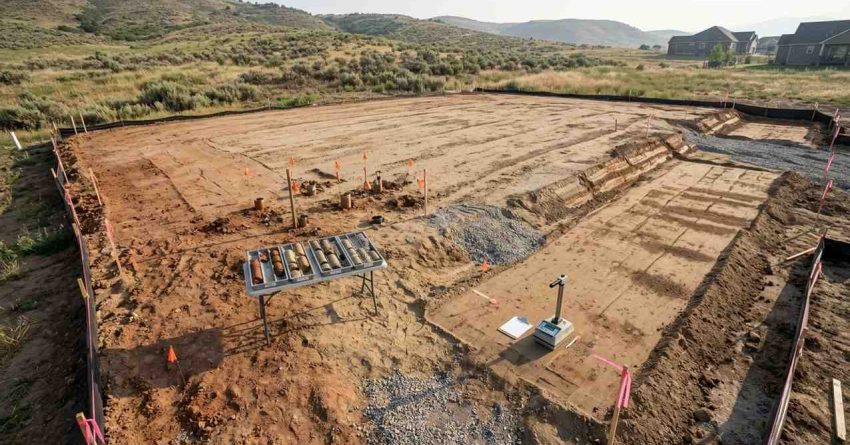
Soil tests determine whether the ground beneath a property can safely support a structure, driveway, retaining wall, or any significant construction work. Two categories matter most for residential and commercial properties: geotechnical testing, which evaluates soil composition and load-bearing capacity, and compaction testing, which confirms that disturbed or filled soil has been compressed to the required density. Together, these tests protect your investment before a single foundation is poured.
Skipping soil testing is one of the most expensive mistakes a property owner can make, often leading to foundation failures, drainage problems, and costly structural repairs years down the line.
This guide explains both test types clearly, covers when each is needed, and helps you understand what results mean so you can make confident decisions about your property.
What Are Soil Tests and Why Do They Matter for Your Property?
A soil test is a structured evaluation of the ground at a specific site. Engineers and technicians collect samples or take field measurements to determine how soil will behave under load, how it drains, and whether it is stable enough for the intended use. Without this information, builders and property owners are making structural decisions blind.
For homeowners and property managers, soil testing is most relevant during new construction, major additions, driveway installation, retaining wall projects, and any work that involves significant excavation or fill placement. The results directly influence foundation design, drainage planning, and the materials your contractor will specify.
Understanding soil conditions is a foundational step in any property investment decision — our custom home investment analysis covers how site conditions, including soil quality, directly affect build costs and long-term property value.
The Difference Between Geotechnical and Compaction Testing
Geotechnical testing focuses on the natural soil already present at a site. It answers questions about soil type, layering, strength, and how the ground will respond to the weight of a structure over time. Compaction testing, by contrast, evaluates soil that has been moved, graded, or filled. It confirms that the disturbed material has been compressed to a density that meets engineering specifications. Both are necessary at different stages of a project, and both serve distinct purposes.
Common Types of Geotechnical Soil Tests
Geotechnical testing encompasses several methods, each designed to reveal specific properties of the soil at a site. The right combination depends on the project type, depth of concern, and local soil conditions.
Boring and Sampling Tests
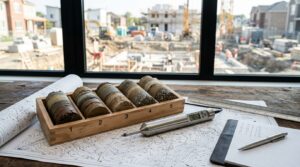
Soil borings involve drilling into the ground at strategic locations across a site to extract samples at various depths. A geotechnical engineer analyzes these samples to identify soil layers, detect groundwater, and assess how conditions change with depth. Borings are standard practice for new home construction, commercial projects, and any site where subsurface conditions are unknown. The number and depth of borings depend on the size of the project and the complexity of the site.
Standard Penetration Test (SPT)
The Standard Penetration Test is one of the most widely used field tests in geotechnical engineering. During a boring, a split-spoon sampler is driven into the soil using a standardized hammer drop. The number of blows required to advance the sampler a set distance — called the N-value — gives engineers a direct measure of soil resistance and density. Higher N-values indicate denser, stronger soil. SPT results guide foundation design and help engineers identify layers that may be too weak or too compressible to support a structure safely.
Soil Classification and Lab Analysis
Samples collected during borings are sent to a laboratory for classification. Technicians measure grain size distribution, plasticity, moisture content, and organic matter. These properties determine how soil will behave under load and how it responds to water. Clay-heavy soils, for example, can expand when wet and shrink when dry, creating movement that damages foundations and slabs. Identifying these characteristics before construction allows engineers to design appropriate solutions.
Compaction Testing Explained
When soil is excavated, graded, or placed as fill, its natural structure is disturbed. Loose, uncompacted fill cannot support loads reliably and will settle unevenly over time. Compaction testing verifies that fill material has been compressed to a specified density, typically expressed as a percentage of the maximum dry density established in a laboratory test.
Proctor Compaction Test
The Proctor test is the laboratory standard for determining the maximum dry density a specific soil can achieve at its optimum moisture content. A technician compacts soil samples at varying moisture levels and measures the resulting density. The peak of the resulting curve — the optimum moisture content — tells field crews the ideal conditions for achieving maximum compaction. This laboratory result becomes the benchmark against which all field compaction measurements are compared. The Standard Proctor test is used for most residential applications, while the Modified Proctor test applies to projects with heavier loads such as roads and commercial pads.
Nuclear Density Gauge and Sand Cone Methods
Field compaction is verified using one of two primary methods. The nuclear density gauge is the faster option: a device placed on the compacted surface emits radiation that measures both density and moisture content in seconds. Results are immediate, allowing crews to identify and correct under-compacted areas before additional fill is placed. The sand cone method is a non-nuclear alternative that involves excavating a small hole, filling it with calibrated sand, and calculating density from the volume and weight of material removed. Both methods are accepted by engineering standards, and the choice depends on project requirements, local regulations, and contractor preference.

When Do Homeowners and Property Managers Need Soil Testing?
Soil testing is not reserved for large commercial projects. Several common residential and property management scenarios call for professional evaluation before work begins.
New home construction on a previously undeveloped lot requires geotechnical investigation to confirm the site can support the planned foundation type. Additions and accessory structures such as garages, workshops, and large decks may need testing if they involve new footings in areas not previously evaluated. Retaining walls taller than a few feet require both geotechnical data to design the wall and compaction testing to verify the backfill behind it. Driveway and parking area construction on fill or graded sites benefits from compaction verification to prevent premature cracking and settling. Properties with a history of drainage problems, slope instability, or visible foundation movement may need geotechnical investigation to identify the underlying cause.
In many jurisdictions, local building departments require a geotechnical report as part of the permit application for new construction. Checking permit requirements early prevents delays.
What Soil Test Results Mean for Your Project
A geotechnical report delivers more than raw data. It includes an engineer’s interpretation of findings and specific recommendations for your project. Key outputs include the allowable bearing capacity of the soil — the maximum load per square foot the ground can safely support — and foundation recommendations specifying whether a slab, spread footings, or deep piles are appropriate. Reports also flag problem conditions such as expansive clay, organic material, high groundwater, or loose fill that requires removal or treatment before construction.
Compaction test results are expressed as a percentage of the maximum dry density from the Proctor test. Most residential specifications require 90 to 95 percent compaction for general fill and 95 percent or higher for areas beneath slabs and pavements. Results below the required percentage mean the contractor must re-compact the material and retest before proceeding.
Understanding these results helps you have informed conversations with your contractor and engineer, verify that work meets specifications, and avoid accepting substandard conditions that could lead to expensive problems later.
How to Choose a Qualified Soil Testing Professional
Geotechnical and compaction testing must be performed by qualified professionals. For geotechnical investigations, look for a licensed geotechnical engineer or a firm with registered engineers on staff. Compaction testing in the field is typically performed by a certified materials testing technician, often working under the supervision of a licensed engineer.
Ask for references from similar projects, confirm that the firm carries professional liability insurance, and verify that their laboratory is accredited for the tests they will perform. A reputable firm will provide a written report with clear findings, engineering recommendations, and the engineer’s stamp and signature.
Before committing to a build or major renovation, reviewing a thorough home investment analysis can help you understand how soil testing fits into the broader financial picture of your project.
When you are ready to connect with qualified professionals for your property, Mr. Local Services can help you find trusted experts who deliver reliable results and clear communication from the first site visit through project completion.
Conclusion
Geotechnical and compaction soil tests give property owners the information they need to build safely and avoid costly structural failures. Understanding what each test measures, when it is required, and how to read the results puts you in control of your project from the ground up.
Soil conditions shape every decision that follows, from foundation design to drainage planning, making early testing one of the highest-value steps in any construction or renovation project.
When you are ready to move forward, Mr. Local Services connects you with skilled professionals who handle soil testing coordination and property improvement projects with the reliability and transparency your property deserves.
Frequently Asked Questions
What is the purpose of a geotechnical soil test?
A geotechnical soil test evaluates the composition, strength, and load-bearing capacity of the soil at a site. Engineers use the results to design foundations and identify conditions that could cause structural problems.
How is compaction testing different from geotechnical testing?
Geotechnical testing examines natural soil to assess its properties before construction. Compaction testing verifies that fill or graded soil has been compressed to the required density after it has been disturbed or placed.
When is a soil test required for a home project?
Soil testing is typically required for new construction, large additions, retaining walls, and any project involving significant fill placement. Many local building departments require a geotechnical report as part of the permit process.
What does a compaction test result percentage mean?
The percentage represents how close the compacted soil is to its maximum possible density, as determined by the Proctor test. Most residential projects require 90 to 95 percent compaction, with higher standards for areas beneath slabs and pavements.
How long does soil testing take?
Field testing for a standard residential site typically takes one to two days. Laboratory analysis of collected samples adds several business days. A complete geotechnical report is usually delivered within one to two weeks of the site visit.
Who performs soil testing for residential projects?
Geotechnical investigations are conducted by licensed geotechnical engineers. Field compaction testing is performed by certified materials testing technicians, typically working under an engineer’s supervision.
Can I skip soil testing if my neighbor’s house has no foundation problems?
No. Soil conditions can vary significantly across short distances due to fill history, drainage patterns, and natural soil variability. Your neighbor’s experience does not predict what lies beneath your specific site.