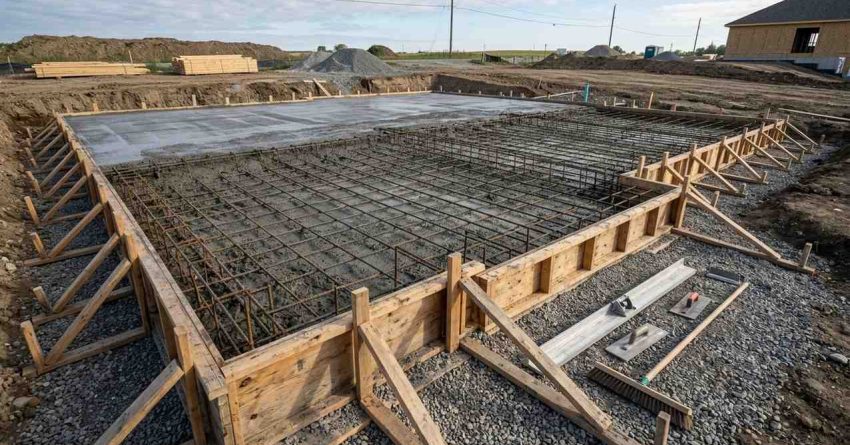
A foundation pour is one of the most critical steps in any construction project — done right, it creates a stable, long-lasting base for everything built above it. Whether you are building a new home, adding a room addition, or replacing a damaged slab, understanding the full process helps you plan effectively, avoid costly errors, and know exactly what to expect from start to finish.
This guide walks through every stage of a foundation pour, from site preparation and formwork to the actual pour, finishing, and curing process.
You will learn what tools and materials are needed, how each step works, what mistakes to watch for, and when the scope of the project calls for professional help.
What Is a Foundation Pour?
A foundation pour is the process of placing and consolidating ready-mix concrete into prepared forms to create the structural base of a building. The poured concrete fills the forms, bonds with embedded reinforcement, and hardens into a solid slab, wall, or footing that supports the entire load of the structure above.
Foundation pours are used in residential construction for slab-on-grade foundations, basement walls, crawl space footings, and garage floors. Each application follows the same core process but varies in depth, reinforcement requirements, and finishing standards.
Understanding what a foundation pour involves is the first step toward a successful build — our concrete foundation services covers the full range of foundation work available for residential and commercial properties, from slab pours to full basement installations.
Types of Foundation Pours Used in Residential Construction
The three most common foundation pour types in residential construction are slab-on-grade, stem wall with footing, and full basement wall systems. A slab-on-grade pour places concrete directly on compacted soil or gravel, creating a flat floor and foundation in a single pour. A stem wall system pours footings first, then builds short concrete walls on top to raise the structure above grade. A full basement system involves pouring continuous walls to full depth, requiring careful form bracing and staged pours. If you need a dedicated comparison of these systems, our guide on slab vs. crawl space vs. basement foundation breaks down the structural, cost, and site-condition differences in full detail.
Tools and Materials You Need Before the Pour
Gathering the right tools and materials before the pour day prevents delays and ensures the concrete is placed correctly before it begins to set. The window for working fresh concrete is narrow, so preparation is everything.
Essential tools:
- Concrete forms (wood or steel panels)
- Form stakes and bracing lumber
- Rebar or wire mesh for reinforcement
- Rebar chairs or dobies to hold reinforcement at correct depth
- Concrete vibrator or rod for consolidation
- Bull float and hand floats for surface finishing
- Screed board or laser screed for leveling
- Edging tool and groover for control joints
- Rubber boots and gloves for safety
Materials needed:
- Ready-mix concrete ordered to the correct PSI specification (typically 3,000–4,000 PSI for residential slabs)
- Vapor barrier (6-mil poly sheeting) for slab-on-grade applications
- Compactable gravel base (4–6 inches minimum)
- Concrete curing compound or plastic sheeting for post-pour curing
If you are missing any of the tools listed here or need help sourcing the right equipment, our handyman tool checklist outlines the professional-grade tools used across common home construction and repair projects.
How to Prepare the Site for a Foundation Pour
Site preparation determines whether the finished foundation performs as designed or develops problems within the first few years. No amount of quality concrete compensates for a poorly prepared base.
Excavation and Grading Requirements
Excavation removes topsoil and organic material down to stable subsoil or engineered fill. The depth depends on the foundation type, local frost depth requirements, and soil bearing capacity. For slab-on-grade foundations in most U.S. regions, excavation reaches 12–18 inches below finished grade to allow for gravel base, vapor barrier, and the slab thickness itself.
After excavation, the subgrade must be compacted using a plate compactor or jumping jack to achieve a firm, uniform surface. Soft spots, tree roots, and organic debris must be removed and replaced with compacted fill. The finished subgrade should not deflect under foot traffic.
Grading the surrounding area to slope away from the foundation at a minimum of 6 inches over 10 feet is a code requirement in most jurisdictions and a critical drainage measure. Proper site grading and prep ensures your property drains correctly and that the ground beneath your foundation is stable before a single yard of concrete is poured.
Setting Up Forms and Reinforcement
Concrete forms define the shape, dimensions, and edges of the finished foundation. Wood forms use 2x lumber staked and braced at regular intervals. Steel panel forms are reusable and preferred for larger pours. All forms must be plumb, square, and braced against the lateral pressure of wet concrete, which can exceed 150 pounds per square foot at the base of a deep pour.
Reinforcement is placed after forms are set. Rebar is positioned on chairs at the specified cover depth — typically 3 inches from the bottom for slabs and 2 inches from the face for walls. Rebar spacing follows the structural engineer’s plan or local code minimums. Wire mesh is an alternative for thinner slabs but provides less crack resistance than rebar in most residential applications. For a detailed breakdown of reinforcement placement, our guide on rebar placement for concrete foundations covers spacing, lap lengths, and tie requirements by foundation type.
The Foundation Pour Process Step by Step
The pour itself is a time-sensitive operation. Once the concrete truck arrives, the clock starts. A standard residential slab pour must be placed, spread, consolidated, and screeded before the concrete reaches initial set — typically within 60–90 minutes of batching, depending on temperature and mix design.
Ordering and Delivering Ready-Mix Concrete
Ready-mix concrete is ordered by the cubic yard from a local batch plant. Calculate the volume of your pour by multiplying length by width by thickness (in feet), then dividing by 27 to convert to cubic yards. Add 5–10% overage to account for waste, spillage, and uneven subgrade.
Specify the correct mix design when ordering. Residential slabs typically require 3,000–4,000 PSI concrete with a 4–5 inch slump for workability. In cold weather, order a heated mix or accelerated mix. In hot weather, request a retarder to extend working time. Confirm the truck’s access route to the pour site before the delivery date — concrete trucks weigh up to 66,000 pounds loaded and require a firm, level approach.
Pouring and Spreading the Concrete
Begin the pour at the far end of the form and work back toward the truck. This prevents the truck from driving over freshly placed concrete. Direct the chute to deposit concrete as close to its final position as possible — moving concrete horizontally with a rake or shovel causes segregation, where the heavier aggregate sinks and the water-cement paste rises.
Use a concrete vibrator to consolidate the mix around rebar and into form corners. Insert the vibrator every 18–24 inches and withdraw slowly to avoid leaving voids. Do not over-vibrate — excessive vibration causes segregation and weakens the finished slab.
Screeding, Floating, and Finishing the Surface
Once the concrete is placed and consolidated, screed the surface to the correct elevation using a straight board or mechanical screed pulled across the form tops. Screeding removes high spots and fills low areas, creating a flat plane.
After screeding, use a bull float to close the surface and embed aggregate slightly below the surface. This step also removes screed marks and begins the finishing process. Allow bleed water to evaporate completely before applying any hand finishing tools. Working the surface while bleed water is present weakens the top layer and causes dusting and scaling over time.
Hand float and trowel the surface to the required finish. A broom finish provides slip resistance for exterior slabs. A smooth trowel finish is used for interior floors. Cut control joints at regular intervals — typically every 10–12 feet in each direction for a 4-inch slab — to direct shrinkage cracking to predictable locations.
A foundation pour is often the first step in larger home remodeling projects, and understanding how the pour integrates with framing, plumbing rough-ins, and structural work helps homeowners plan the full scope of a build or renovation.
Curing the Concrete After the Pour
Curing is the process of maintaining adequate moisture and temperature in freshly placed concrete to allow the cement hydration reaction to proceed fully. Concrete does not dry — it cures through a chemical reaction that requires water. Cutting the curing process short reduces the final strength and durability of the slab significantly.
Apply a curing compound immediately after final finishing, or cover the slab with plastic sheeting weighted at the edges to trap moisture. Wet burlap covered with plastic is an effective alternative for slabs that will receive a surface treatment. Keep the curing cover in place for a minimum of 7 days for standard Type I/II cement mixes.
Improper curing or inadequate drainage around a new foundation can lead to serious moisture and water damage over time, making it critical to follow correct curing procedures and ensure the surrounding grade directs water away from the structure.
How Long Does a Foundation Need to Cure?
Concrete reaches approximately 70% of its design strength in 7 days and 99% of its design strength in 28 days under standard curing conditions. Light foot traffic is generally safe after 24–48 hours. Vehicle traffic should wait a minimum of 7 days. Structural loading — framing, backfill, or heavy equipment — should not be applied until the concrete has reached at least 75% of its design strength, which typically requires 7–10 days of proper curing. Temperature significantly affects curing rate: cold weather slows hydration and may require insulated blankets or heated enclosures to maintain adequate curing temperatures above 50°F.
Common Foundation Pour Mistakes and How to Avoid Them
Even experienced crews encounter problems on pour day. Knowing the most common mistakes in advance allows you to prevent them before they become structural issues.
Adding water to the mix on site. Increasing the water-to-cement ratio beyond the design specification reduces compressive strength and increases shrinkage cracking. If the mix arrives too stiff, contact the batch plant — do not add water at the site.
Pouring on frozen or saturated subgrade. Concrete placed on frozen ground will heave as the ground thaws, causing cracking and settlement. Saturated subgrade compresses under load, leading to uneven settlement. Always verify subgrade conditions before the truck arrives.
Inadequate form bracing. Wet concrete exerts significant lateral pressure. Under-braced forms blow out during the pour, wasting material and creating a safety hazard. Inspect all bracing before the pour begins.
Finishing too early. Working the surface while bleed water is still present traps water in the top layer, weakening it and causing surface scaling within the first winter freeze-thaw cycle.
Skipping control joints. Concrete shrinks as it cures. Without control joints, shrinkage cracks appear randomly across the slab surface. Cutting joints at the correct spacing and depth — one-quarter of the slab thickness — directs cracking to planned locations.
Neglecting curing. Allowing the slab to dry out in the first 7 days is one of the most common and damaging mistakes. A slab that dries too quickly can lose 30–40% of its potential strength.
When to Call a Professional for a Foundation Pour
A foundation pour is manageable as a DIY project for small, simple slabs — a garden shed pad, a small patio, or a utility slab. However, several conditions make professional involvement not just advisable but necessary.
If the pour requires more than 5–6 cubic yards of concrete, the logistics of placement, consolidation, and finishing exceed what a small crew can manage before initial set. If the foundation is structural — supporting a home, addition, or load-bearing wall — local building codes in most U.S. jurisdictions require a permitted pour with inspections at the subgrade, reinforcement, and finished stages. Attempting a structural pour without permits creates liability issues and can complicate future sales or insurance claims.
Soil conditions that require engineered fill, deep footings, or specialized reinforcement also call for professional assessment. Similarly, pours in cold weather (below 40°F) or hot weather (above 90°F) require mix adjustments and protective measures that are difficult to execute without experience.
When the scope of a pour exceeds what a homeowner can safely manage, connecting with a team experienced in professional foundation work ensures the job is done to code, on schedule, and with the structural integrity your property depends on.
Conclusion
A successful foundation pour depends on thorough preparation, precise execution, and disciplined curing — each stage directly affects the strength and longevity of the finished structure. From site grading and formwork to concrete placement and surface finishing, every step in this walkthrough builds on the one before it.
Skipping preparation steps or rushing the finishing and curing process creates problems that are expensive and difficult to correct after the fact. The investment in doing each stage correctly pays dividends for the entire life of the structure above.
At Mr. Local Services, our team handles every phase of foundation work with the precision and experience your project requires — contact us today to schedule an assessment and get your foundation pour done right the first time.
Frequently Asked Questions
How much concrete do I need for a foundation pour?
Calculate cubic yards by multiplying the length, width, and thickness of the slab in feet, then dividing by 27. Always order 5–10% extra to account for waste and uneven subgrade. Most concrete suppliers have online calculators to simplify this step.
What PSI concrete is best for a residential foundation?
Most residential slabs and footings use 3,000–4,000 PSI concrete. Basement walls and foundations in freeze-thaw climates typically require 4,000 PSI or higher for durability. Always confirm the specification with your local building department or structural engineer.
Can I pour a foundation in cold weather?
Yes, but cold weather requires specific precautions. Concrete should not be placed on frozen ground, and the mix temperature must be maintained above 50°F during placement and curing. Insulated blankets, heated enclosures, or accelerated mix designs are typically required for pours below 40°F.
How long before I can frame on a new foundation?
Most residential foundations are ready for framing after 7 days of proper curing, at which point the concrete has reached approximately 70% of its design strength. Full design strength is achieved at 28 days. Always confirm with your structural engineer or building inspector before loading the foundation.
What causes cracks in a newly poured foundation?
The most common causes are shrinkage during curing, inadequate control joints, premature surface finishing while bleed water is present, and subgrade settlement. Minor hairline cracks from shrinkage are normal. Structural cracks — wider than 1/4 inch or accompanied by displacement — require professional evaluation.
Do I need a permit to pour a concrete foundation?
In most U.S. jurisdictions, any structural foundation pour requires a building permit and inspections at the subgrade, reinforcement, and finished stages. Non-structural slabs such as patios or shed pads may not require a permit, but requirements vary by municipality. Always check with your local building department before starting.
How thick should a residential foundation slab be?
Standard residential slabs are 4 inches thick for interior floors and garage slabs. Slabs supporting heavier loads — such as driveways or equipment pads — are typically 5–6 inches. Footings and foundation walls follow structural engineering specifications based on soil bearing capacity and building loads.