Yes, prefab homes are built to code — but the specific standards that apply depend entirely on the type of prefab home you are buying. Manufactured homes follow a federal standard enforced by the U.S. Department of Housing and Urban Development, while modular homes must meet the same local building codes as any site-built house in the same area.
For homeowners and property managers, understanding this distinction is not just a technicality — it directly affects safety, financing, insurance, and long-term property value.
This guide explains which codes apply to each prefab type, how inspections work, what compliance challenges arise after installation, and exactly what to verify before you buy.
What “Built to Code” Means for Prefab Homes
When a home is described as “built to code,” it means the structure was designed, constructed, and inspected to meet specific safety and construction standards set by a recognized governing authority. Those standards cover everything from structural integrity and fire resistance to electrical systems, plumbing, and energy efficiency.
For prefab homes, “built to code” is not a single answer because “prefab” is an umbrella term. It covers manufactured homes, modular homes, panelized homes, and kit homes — each with a different regulatory framework. The two most important categories for code purposes are manufactured homes and modular homes, and they operate under entirely separate systems.
Understanding code compliance starts with knowing what type of prefab structure you own — our guide to prefab home options explains the key differences between manufactured, modular, and panelized homes and how each is classified under U.S. building law.
Which Building Codes Apply to Prefab Homes in the USA
The code that governs a prefab home is determined by how it is classified — not by how it looks or where it is installed. Two distinct regulatory pathways exist in the United States, and knowing which one applies to your home is the foundation of every compliance question that follows.
For buyers who want a direct comparison of these two frameworks before diving into the details, a dedicated breakdown of HUD Code vs. IRC for prefab homes covers the key differences, what each standard requires, and how they affect your purchase decision.
HUD Code for Manufactured Homes
Manufactured homes — commonly called mobile homes when built before 1976 — are regulated by the HUD Code, formally known as the National Manufactured Housing Construction and Safety Standards. This is a federal standard administered by the U.S. Department of Housing and Urban Development, and it applies uniformly across all 50 states.
The HUD Code covers structural design, fire safety, energy efficiency, plumbing, heating, and the home’s ability to withstand transportation. Every manufactured home must be inspected at the factory by a HUD-approved third-party inspection agency before it leaves the production facility. A home that passes receives a HUD label — a small metal plate affixed to the exterior of each section — confirming it was built to federal standards.
One important distinction: the HUD Code is a federal floor, not a ceiling. States and local jurisdictions can impose additional requirements for site preparation, foundation, and utility connections, but they cannot require changes to the home’s factory-built components.
IRC and Local Codes for Modular Homes
Modular homes are treated differently. For code purposes, a modular home is the legal equivalent of a site-built home. It must meet the International Residential Code (IRC) and any local amendments adopted by the state or municipality where it will be installed.
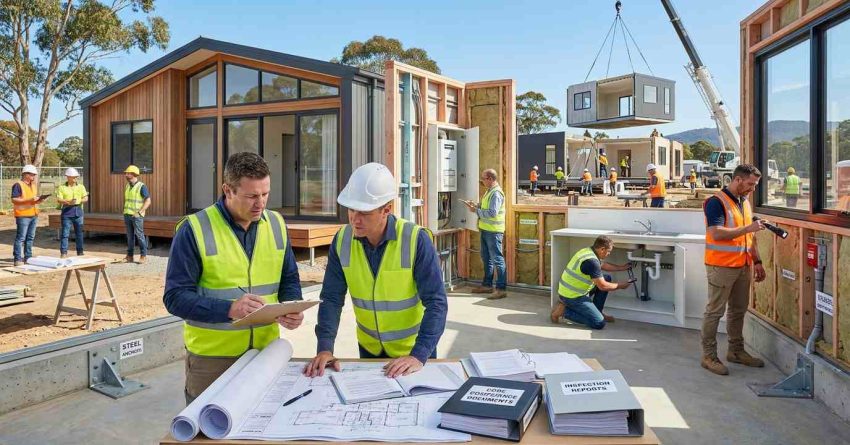
Modular homes are built in a factory under controlled conditions, but the applicable code is the same one a contractor would follow building a traditional house on your street. The factory builds to the IRC, a state-approved inspector reviews the work before the home ships, and the home receives a state approval seal. After delivery and installation, a local building inspector conducts an on-site review before issuing a certificate of occupancy.
This two-stage process — factory certification followed by local on-site approval — is what makes modular homes fully equivalent to site-built construction in the eyes of lenders, insurers, and local governments.
How Prefab Homes Are Inspected and Certified
Prefab home inspections happen in two stages: at the factory and at the installation site. Understanding both stages helps homeowners know what documentation to expect and what to ask for when buying an existing prefab home.
Factory inspection is the first stage. For manufactured homes, a HUD-approved third-party agency inspects the home during production and issues a HUD label upon passing. The home also receives a data plate — an interior document listing the home’s specifications, including its wind zone, thermal zone, and snow load ratings. For modular homes, a state-approved inspector reviews construction at the factory and issues a state approval seal.
On-site inspection is the second stage and applies primarily to modular homes. After the home is delivered and set on its foundation, a local building inspector reviews the installation, utility connections, and any site-built components. A certificate of occupancy is issued when the home passes. A certificate of occupancy is the official document confirming that a structure meets all applicable codes and is legally approved for habitation.
Manufactured homes may also require local permits and inspections for foundation work, utility hookups, and any additions built after installation — but the factory-certified components themselves are not subject to re-inspection under local codes.
If your prefab home requires structural modifications after installation, those changes must also pass local inspection — our home remodeling permits resource covers what permits are required and how the approval process works for existing structures.
Common Code Compliance Challenges with Prefab Homes
Even when a prefab home leaves the factory fully certified, compliance challenges can arise during and after installation. These are the issues homeowners and property managers encounter most often.
Foundation requirements are one of the most common friction points. Many local jurisdictions require a permanent foundation for any home intended as a primary residence, and some manufactured homes are originally installed on non-permanent supports. Upgrading to a permanent foundation requires permits, engineering review, and inspections that are separate from the home’s original HUD certification.
Local code amendments affect modular homes in particular. The IRC is a model code, and local jurisdictions frequently adopt amendments — stricter energy requirements, different electrical standards, or additional fire safety measures. A modular home built to base IRC may still need modifications to comply with local amendments at the installation site.
Utility connection permits are often overlooked. Water, sewer, electrical, and gas hookups require separate local permits that are entirely distinct from the home’s factory certification. Missing permits for utility connections can create title problems, insurance complications, and resale obstacles years after installation.
Zone rating mismatches are a safety issue specific to manufactured homes. Every manufactured home is rated for a specific wind zone, thermal zone, and snow load zone based on its intended installation region. Installing a home outside its rated zone — for example, placing a home rated for a mild climate in a high-wind coastal area — creates both safety risks and code violations.
Homeowners researching permit requirements for their specific state can find detailed guidance in our breakdown of prefab home permit requirements by state, which covers what each state requires for manufactured and modular home installations.
What Homeowners Should Verify Before Buying a Prefab Home
Whether you are purchasing a new prefab home or buying an existing one, these are the five verification points that matter most for code compliance.
- HUD label or state approval seal. For a manufactured home, confirm the HUD label is physically present on the exterior of each section. For a modular home, confirm the state approval seal is in place. A missing label is a serious red flag — it may indicate the home was never properly certified or that the label was removed.
- Data plate. The data plate inside the home lists the manufacturer’s specifications, including wind zone, thermal zone, and snow load ratings. Confirm these ratings match the climate and geography of the installation site.
- Certificate of occupancy. For modular homes and any manufactured home with site-built additions, confirm a certificate of occupancy was issued after installation. Request a copy from the local building department if the seller cannot provide one.
- Local permit records. Pull permit records from the local building department for foundation work, utility connections, and any post-installation modifications. Unpermitted work can create financing, insurance, and resale problems.
- Title status. Confirm whether the home is titled as real property (attached to land) or personal property (titled like a vehicle). Real property status is required for most conventional mortgage financing and affects how the home is taxed, insured, and transferred at sale.
Before finalizing a prefab purchase, a professional walkthrough can catch compliance gaps early — our home repair checklist outlines the key systems and components a skilled handyman can assess to confirm everything meets local standards.
Conclusion
Prefab homes are built to code — the key is knowing which code applies and verifying that every stage of the process, from factory certification to on-site installation, was completed correctly. Manufactured homes follow the federal HUD Code; modular homes follow the IRC and local standards just like any site-built home.
For homeowners and property managers, the compliance questions do not end at purchase. Foundation upgrades, utility permits, and post-installation modifications all carry their own requirements that must be addressed to protect your investment.
At Mr. Local Services, our team helps homeowners and property managers navigate every stage of prefab home maintenance, compliance, and improvement — contact us today to connect with a skilled professional who knows exactly what your property needs.
Frequently Asked Questions
Are manufactured homes and modular homes subject to the same building codes?
No. Manufactured homes follow the federal HUD Code, which is a national standard enforced uniformly across all states. Modular homes must meet the International Residential Code and any local amendments adopted by the jurisdiction where the home is installed, the same standards that apply to site-built homes.
What happens if a manufactured home is missing its HUD label?
A missing HUD label means the home cannot be verified as federally compliant. This can affect financing eligibility, insurance coverage, and resale value. HUD has a process for requesting a letter of label verification for homes where the label was lost or removed, but it requires documentation from the original manufacturer.
Do prefab homes need a certificate of occupancy?
Modular homes require a certificate of occupancy issued by the local building department after on-site installation. Manufactured homes may also require one depending on state and local rules, particularly when installed on a permanent foundation or when site-built additions are involved.
Can a prefab home fail a local inspection after delivery?
Yes. Even if a prefab home left the factory fully certified, it can fail local inspection if the foundation does not meet local requirements, utility connections were not properly permitted, or the installation did not comply with local site preparation standards. Factory certification covers the home itself — not the site work.
Does the HUD Code meet the same standards as local building codes?
The HUD Code is a comprehensive federal standard that covers structural, mechanical, plumbing, electrical, and energy systems. It is generally considered equivalent to or stricter than many local codes in certain areas, but it does not automatically satisfy every local requirement. States and localities can impose additional site-specific requirements beyond what the HUD Code covers.
Can I convert a manufactured home to real property?
Yes. Converting a manufactured home from personal property to real property typically requires permanently affixing the home to a foundation that meets local requirements, retiring the vehicle title, and recording the home as real estate with the county. Requirements vary by state, and the process usually involves the local building department, the DMV or title agency, and the county recorder’s office.
What is a data plate on a manufactured home?
A data plate is a document permanently affixed inside a manufactured home — typically in a kitchen cabinet or electrical panel area — that lists the home’s specifications, including the manufacturer’s name, the date of manufacture, the wind zone, thermal zone, and snow load ratings, and the appliances installed at the factory. It is a required component of HUD Code compliance and should be present in every manufactured home.