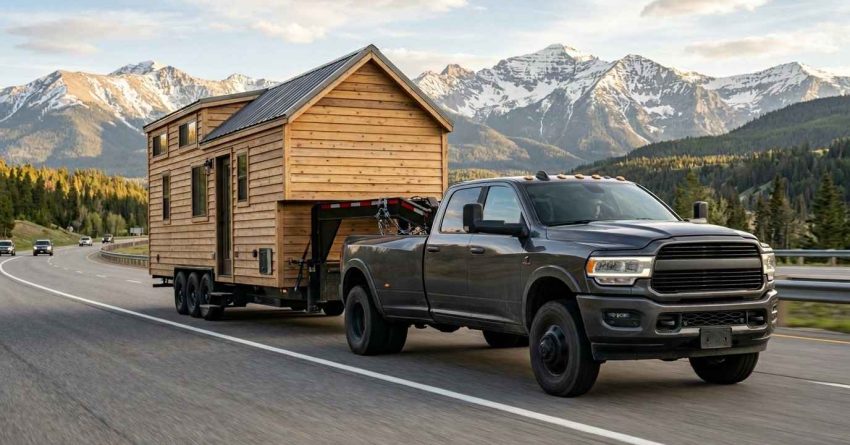
Towing a tiny home on wheels safely requires a vehicle that meets specific weight, mechanical, and legal standards — and most passenger trucks and SUVs fall short without careful verification. A THOW typically weighs between 10,000 and 30,000 pounds fully loaded, which places it firmly in the territory of heavy-duty towing. Choosing the wrong vehicle creates serious safety risks, legal exposure, and mechanical damage that can total both the truck and the home.
This matters because the gap between a vehicle’s advertised tow rating and its real-world safe towing capacity is often significant, and the consequences of getting it wrong on the road are severe.
This guide covers every requirement — from GVWR and hitch class to brake controllers, engine specs, and state licensing rules — so you can match the right vehicle to your THOW with confidence.
What Makes a Vehicle Capable of Towing a Tiny Home on Wheels?
Not every truck rated for towing is rated for towing a THOW. Tiny homes on wheels are heavier, taller, and less aerodynamic than conventional travel trailers, which means the mechanical demands on the tow vehicle are substantially higher. The starting point for any evaluation is understanding the ratings that govern safe towing — not the marketing numbers on a window sticker.
Understanding tow vehicle requirements starts with knowing what a THOW actually is — our tiny homes guide covers the full range of THOW sizes, weights, and build types so you can match your vehicle to your specific home.
Gross Vehicle Weight Rating (GVWR) and Why It Matters
GVWR is the maximum safe operating weight of a vehicle, including its own weight plus passengers, cargo, and any tongue weight transferred from the trailer. Every tow vehicle has a GVWR stamped on the door jamb. When selecting a truck for THOW towing, the combined weight of the loaded truck and the tongue weight of the THOW must stay below this number. Exceeding GVWR voids manufacturer warranties, violates federal safety standards, and creates direct liability in the event of an accident.
Tongue Weight Capacity and Hitch Class Requirements
Tongue weight is the downward force the THOW exerts on the hitch ball or coupler. For most trailer configurations, tongue weight should be 10 to 15 percent of the total trailer weight. A 20,000-pound THOW generates 2,000 to 3,000 pounds of tongue weight — a load that exceeds the capacity of most half-ton and many three-quarter-ton trucks. The tow vehicle’s hitch receiver must be rated to handle this load, and the hitch class must match or exceed the tongue weight requirement.
Tow Rating vs. Payload Capacity — Understanding the Difference
These two numbers are frequently confused, and the confusion leads to dangerous mismatches. Tow rating is the maximum weight a vehicle can pull behind it. Payload capacity is the maximum weight the vehicle can carry in its bed and cab, including passengers, gear, and tongue weight from the trailer. Both limits apply simultaneously, and both can be exceeded independently.
A truck rated to tow 18,000 pounds may have a payload capacity of only 1,800 pounds. If the tongue weight of the THOW is 2,500 pounds, the truck is already over its payload limit before a single person or piece of gear is added. Payload capacity is almost always the binding constraint for THOW towing, not the tow rating.
Payload and tow rating calculations depend entirely on how heavy your tiny home is — the THOW weight requirements breaks down standard weight ranges by build type and material so you can verify your vehicle’s numbers before purchasing.
How Manufacturers Calculate Safe Tow Ratings
Manufacturers calculate tow ratings under controlled conditions — typically with a driver only, no passengers, no cargo, and at sea level. Real-world towing with a loaded THOW at altitude, in heat, or on grades reduces effective capacity meaningfully. The Society of Automotive Engineers (SAE) J2807 standard provides a more consistent testing methodology, and vehicles rated under this standard offer more reliable real-world numbers. Always verify whether a vehicle’s tow rating was calculated under SAE J2807 before relying on it for THOW selection.
Engine, Transmission, and Drivetrain Requirements for THOW Towing
The engine must produce enough torque to move the combined weight of the truck and THOW from a stop, maintain highway speeds on grades, and do so repeatedly without overheating. For most THOWs in the 15,000 to 30,000-pound range, this means a heavy-duty three-quarter-ton or one-ton truck with a high-torque engine. Light-duty trucks and most SUVs are not mechanically suited for this weight class regardless of their stated tow ratings.
Diesel vs. Gas Engines for Long-Distance THOW Hauling
Diesel engines produce significantly more torque at lower RPMs than comparable gasoline engines, which translates to better pulling power on grades and less strain during sustained highway towing. For THOWs over 15,000 pounds, diesel is the practical standard among experienced THOW owners. Gasoline engines in three-quarter-ton and one-ton trucks can handle lighter THOWs, but they run hotter under sustained load and typically require more frequent transmission and coolant service.
Transmission Cooling and Towing Mode Features
Transmission heat is the primary mechanical failure point during heavy towing. Any truck used for THOW towing should have an integrated transmission cooler — either factory-installed or aftermarket. Many modern heavy-duty trucks include a dedicated tow/haul mode that adjusts shift points to reduce heat buildup and improve engine braking on descents. This feature is not optional for THOW towing — it is a baseline requirement for protecting the drivetrain over the life of the vehicle.
Brake Systems and Trailer Brake Controllers
A THOW at 20,000 pounds cannot be stopped by the tow vehicle’s brakes alone. Federal regulations require trailer brakes on any trailer with a gross weight over 3,000 pounds in most states, and THOWs exceed this threshold by a wide margin. The tow vehicle must be equipped with a brake controller — either integrated into the truck’s electronics or installed as an aftermarket unit — that activates the trailer’s electric brakes in proportion to the tow vehicle’s deceleration.
Brake controllers are just one part of a broader legal and safety framework — the THOW safety regulations covers all federally and state-mandated equipment requirements for towing a tiny home on public roads.
Electric Brake Controllers — When They Are Required
Electric brake controllers are required any time the trailer is equipped with electric brakes, which is standard on THOWs. Proportional brake controllers are the preferred type — they measure actual deceleration and apply trailer brakes accordingly, producing smoother stops and less brake wear than time-delayed controllers. Most states require trailer brakes on trailers over 3,000 pounds gross weight, and some states set the threshold as low as 1,500 pounds. Verify the specific threshold for every state on your planned route before towing.
Hitch Types and Weight Distribution Systems for THOWs
The hitch system connects the tow vehicle to the THOW and transfers load between them. Choosing the wrong hitch type for the THOW’s weight and configuration is one of the most common and dangerous mistakes in THOW setup. The three primary hitch configurations used with THOWs are conventional ball hitches, fifth-wheel hitches, and gooseneck hitches — each with distinct weight capacities, stability characteristics, and vehicle compatibility requirements.
Selecting the right hitch class is only the first step — the hitch and towing setup walks through proper installation, load distribution, and sway control configuration for every major hitch type used with THOWs.
Fifth-Wheel vs. Gooseneck vs. Conventional Hitch
Fifth-wheel hitches mount in the truck bed over the rear axle and connect to a kingpin on the THOW. This configuration provides exceptional stability and is rated for 16,000 to 30,000 pounds or more depending on the hitch model. Gooseneck hitches also mount in the truck bed and use a ball-and-coupler connection, offering similar weight capacity with a lower profile. Conventional ball hitches mount to the rear receiver and are generally limited to 10,000 to 12,000 pounds — adequate for lighter THOWs but insufficient for most full-size builds.
Weight Distribution Hitches and Sway Control
For conventional hitch setups, a weight distribution hitch redistributes tongue weight across all axles of the tow vehicle and trailer, restoring steering and braking performance that tongue weight would otherwise compromise. Sway control devices — either friction-based or electronic — reduce trailer oscillation caused by wind, passing vehicles, or road irregularities. Both are strongly recommended for any THOW towed on a conventional hitch and are required by some hitch manufacturers to maintain warranty coverage.
Mirrors, Lighting, and Safety Equipment Requirements
Federal Motor Vehicle Safety Standards require that the driver maintain a clear view of the road behind and beside the trailer at all times. Standard side mirrors on most trucks do not provide adequate visibility alongside a THOW’s width. Extended tow mirrors — either factory-installed or clip-on — are required for legal and safe operation. Most states mandate that trailer lighting match the tow vehicle’s signals, including brake lights, turn signals, running lights, and clearance lights. Safety chains rated to the trailer’s gross weight are required in all 50 states and must be crossed under the coupler to catch the tongue if the hitch fails.
Legal Requirements — Registration, Licensing, and State Regulations
THOWs occupy a complex legal category that varies by state. Most states classify them as recreational vehicles or travel trailers for registration purposes, but weight thresholds, titling requirements, and road use rules differ significantly. Before towing a THOW across state lines, the owner must verify registration status, insurance requirements, and any route-specific restrictions such as length, height, or weight limits on specific roads or bridges.
Licensing and registration rules vary significantly by state — the THOW registration requirements maps out state-by-state rules for titling, plating, and operating a tiny home on wheels legally.
CDL Requirements and Gross Combined Weight Rating (GCWR)
A commercial driver’s license (CDL) is required when the gross combined weight rating (GCWR) — the combined weight of the tow vehicle and the loaded THOW — exceeds 26,001 pounds and the vehicle is used in commerce. For private, non-commercial use, most states do not require a CDL regardless of GCWR. However, some states impose additional endorsement requirements for combinations over specific weight thresholds. Confirming the rules in every state on the planned route is essential before the first trip.
Choosing the Right Tow Vehicle for Your THOW
Matching a tow vehicle to a THOW requires working backward from the THOW’s actual loaded weight — not its dry weight or its estimated weight. Weigh the THOW fully loaded at a certified scale before finalizing any vehicle purchase. From that number, calculate tongue weight, verify it against the truck’s payload capacity, confirm the tow rating exceeds the THOW’s gross weight by a meaningful margin, and verify the hitch class supports the required tongue weight.
Choosing a tow vehicle is one of the most consequential decisions in the THOW journey — our tiny home living guide provides the broader context around lifestyle, mobility, and setup that shapes which vehicle type fits your situation best.
Top Tow Vehicle Categories That Meet THOW Requirements
Heavy-duty three-quarter-ton trucks — such as the Ford F-250, Ram 2500, and Chevrolet Silverado 2500HD — are the minimum practical platform for most THOWs in the 10,000 to 18,000-pound range. One-ton trucks — the F-350, Ram 3500, and Silverado 3500HD — are the standard for THOWs over 18,000 pounds and offer significantly higher payload ratings that provide the margin most THOW owners need. Dually configurations on one-ton trucks add rear axle stability and increase payload capacity further, making them the preferred choice for the heaviest THOW builds.
Common Mistakes When Selecting a Tow Vehicle for a THOW
The most frequent mistake is relying on the THOW’s dry weight rather than its actual loaded weight. Dry weight does not include water, furniture, personal belongings, or any modifications made after the build — and the difference between dry and loaded weight is often 3,000 to 6,000 pounds. A truck that appears adequate on paper becomes dangerously overloaded in practice.
The second most common mistake is ignoring payload capacity in favor of tow rating. As noted above, payload is almost always the binding constraint. A truck with a 20,000-pound tow rating and a 1,900-pound payload capacity cannot safely tow a THOW with 2,400 pounds of tongue weight — regardless of what the tow rating says.
Most tow vehicle mistakes trace back to underestimating the actual loaded weight of the THOW — reviewing THOW size and weight data before finalizing any vehicle purchase prevents the most common and costly errors.
Skipping a pre-purchase scale check, selecting a hitch class below the tongue weight requirement, and failing to verify brake controller compatibility are the remaining errors that most frequently result in unsafe towing conditions or failed roadside inspections.
Conclusion
Tow vehicle selection for a THOW is a mechanical, legal, and safety decision that requires verified numbers — not estimates. GVWR, payload capacity, tow rating, tongue weight, hitch class, and brake system compatibility must all align before the first mile.
Getting these numbers right protects the THOW, the tow vehicle, and everyone sharing the road. The margin for error at highway speeds with 20,000 pounds behind a truck is effectively zero.
At Mr. Local Services, our team connects THOW owners with the professionals and resources needed to set up, inspect, and maintain their tiny home systems — reach out today to make sure your setup meets every requirement before you hit the road.
Frequently Asked Questions
What is the minimum tow rating needed for a THOW?
The minimum tow rating depends on the THOW’s actual loaded weight. As a general rule, the tow vehicle’s rated capacity should exceed the THOW’s gross weight by at least 10 to 15 percent to provide a safe operating margin. Most THOWs require a tow rating of at least 14,000 to 20,000 pounds.
Can a half-ton truck tow a tiny home on wheels?
Most half-ton trucks cannot safely tow a full-size THOW. Their payload capacities — typically 1,500 to 2,200 pounds — are insufficient to handle the tongue weight of a THOW over 12,000 pounds. Lighter, smaller THOWs under 10,000 pounds may be within range, but a certified scale check is required before any attempt.
Do I need a special license to tow a THOW?
For private, non-commercial use, most states do not require a CDL to tow a THOW regardless of combined weight. However, some states impose endorsement requirements for combinations over specific GCWR thresholds. Verify the rules in every state on your planned route before towing.
What hitch class is required for towing a THOW?
Most THOWs require a Class IV or Class V hitch at minimum, with fifth-wheel or gooseneck configurations preferred for builds over 15,000 pounds. The hitch class must match or exceed the tongue weight of the fully loaded THOW — not just the trailer’s dry weight.
How does tongue weight affect tow vehicle selection?
Tongue weight — typically 10 to 15 percent of the trailer’s gross weight — is applied directly to the tow vehicle’s payload capacity. A THOW with a 2,500-pound tongue weight consumes 2,500 pounds of the truck’s payload rating before any passengers or cargo are added. Payload capacity, not tow rating, is usually the binding constraint.
Is a diesel engine better than gas for towing a THOW?
For THOWs over 15,000 pounds, diesel engines are the practical standard. They produce more torque at lower RPMs, run cooler under sustained load, and typically offer better fuel economy during heavy towing. Gasoline engines in three-quarter-ton and one-ton trucks can handle lighter THOWs but require more careful thermal management.
What safety equipment is legally required when towing a THOW?
At minimum, federal and state regulations require trailer brakes with a functioning brake controller, safety chains rated to the trailer’s gross weight, full trailer lighting matching the tow vehicle’s signals, and extended mirrors providing clear rearward visibility. Many states impose additional requirements — verify the rules for every state on your route.