Tiny homes on wheels are legal in most U.S. states — but the rules vary significantly depending on where you want to park, live, and register your THOW. Some states have clear, welcoming frameworks. Others impose strict zoning restrictions, permit requirements, or outright bans on full-time residential use. Knowing your state’s position before you buy or build can save you thousands of dollars and months of frustration.
Understanding these regulations matters now more than ever, as THOW ownership has grown rapidly and local governments are actively updating their codes.
This guide breaks down THOW legal status by state, covering fully legal states, conditional acceptance, common restrictions, zoning rules, and how to verify your local regulations before committing.
What Is a THOW and Why Does Legal Status Matter?
A tiny home on wheels (THOW) is a small, self-contained dwelling built on a trailer chassis, designed to be movable while still functioning as a full-time or part-time residence. Unlike a traditional tiny home built on a permanent foundation, a THOW occupies a legal gray area in most states because it shares characteristics with both recreational vehicles (RVs) and residential structures.
Legal status matters because it determines where you can park your THOW, whether you can live in it full-time, what permits you need, and how your home is taxed and insured. Without understanding your state’s classification, you risk fines, forced relocation, or being denied utility hookups.
Understanding THOW legal status starts with knowing what a tiny home on wheels actually is — our tiny home guide covers the full definition, construction standards, and ownership considerations that shape how states regulate these structures.
How States Classify Tiny Homes on Wheels
States classify THOWs in one of three ways: as recreational vehicles (RVs), as manufactured housing, or as accessory dwelling units (ADUs). The classification determines which building codes apply, which agencies oversee permits, and where the THOW can legally be placed.
Most states default to the RV classification because THOWs are built on trailers and can be moved. However, this classification often prevents full-time residential use, since RV parks typically limit stays to 30–180 days. A growing number of states are creating dedicated THOW classifications that allow permanent or semi-permanent residency under specific conditions.
States Where THOWs Are Fully Legal and Regulated
Several states have established clear legal frameworks that explicitly permit THOWs as residential dwellings. These states have updated their building codes, zoning ordinances, and permit processes to accommodate tiny home on wheels ownership.
States with the most THOW-friendly regulations as of 2025–2026 include:
- Texas — Counties outside city limits have minimal zoning restrictions, making rural Texas one of the most accessible states for THOW placement.
- Oregon — Oregon allows THOWs as ADUs in many jurisdictions and has specific provisions for THOW communities.
- Colorado — Several Colorado counties permit THOWs on residential land with utility hookups and proper permits.
- North Carolina — The state allows THOWs in designated areas and has active tiny home communities operating legally.
- Tennessee — Rural counties in Tennessee have minimal restrictions, and the state has seen significant growth in THOW communities.
Full legality in these states typically means you can apply for a residential address, connect to utilities, and live in your THOW year-round without violating local ordinances.
What Full Legality Means for THOW Owners
In states with full legal frameworks, THOW owners can register their home as a primary residence, access standard utility connections, and in some cases qualify for homestead exemptions. Full legality also simplifies insurance and financing, since lenders and insurers have clearer guidelines for structures with recognized residential status.
Each state’s approach to full legality is rooted in its zoning framework — our detailed breakdown of THOW zoning laws explains exactly how local ordinances determine where and how you can place a tiny home on wheels.
States With Partial or Conditional THOW Acceptance
The majority of U.S. states fall into a middle category: they do not explicitly ban THOWs, but they impose conditions that must be met before a THOW can be used as a residence. These conditions vary widely by county and municipality, even within the same state.
States with conditional THOW acceptance include:
- California — State law has expanded ADU allowances, but THOW placement on residential lots requires local approval and varies significantly by city and county.
- Florida — THOWs are permitted in many areas but must comply with hurricane tie-down requirements and local flood zone regulations.
- Arizona — Rural counties are generally permissive, but urban areas like Phoenix and Tucson have stricter zoning that limits THOW placement.
- Washington — The state allows THOWs in some jurisdictions as ADUs, but local approval processes can be lengthy and inconsistent.
- New York — Upstate rural counties are more permissive than downstate areas, where zoning restrictions are significantly tighter.
Common Conditions That Affect THOW Placement
The most common conditions states and counties impose include minimum lot size requirements, mandatory utility connections (water, sewer, and electricity), proof of THOW certification (typically RVIA or state-equivalent), setback requirements from property lines, and limits on the number of THOWs per parcel.
Conditional acceptance often hinges on meeting specific site and utility standards — our on THOW placement requirements walks through the most common conditions states impose before approving a tiny home on wheels for residential use.
States Where THOWs Face the Most Restrictions
Some states maintain strict regulations that make full-time THOW living difficult or legally risky. These states either classify all THOWs as RVs (limiting residency duration), prohibit THOWs from connecting to permanent utilities on residential land, or have not updated their codes to address THOWs at all.
States with the most restrictive environments include:
- Massachusetts — Dense zoning and strict building codes make THOW placement on residential land extremely difficult in most municipalities.
- New Jersey — High population density and rigid zoning ordinances leave very few legal options for THOW placement outside of licensed RV parks.
- Illinois — Outside of rural areas, Illinois municipalities generally do not permit THOWs as permanent residences.
- Michigan — While rural areas offer some flexibility, the state lacks a unified THOW framework, creating significant county-to-county inconsistency.
Why Some States Restrict THOWs More Than Others
Restrictive states typically cite concerns about infrastructure capacity, neighborhood character, property tax equity, and building safety standards. Dense urban states face additional pressure from housing advocacy groups who argue that THOW communities can displace traditional affordable housing development.
Understanding these political and regulatory dynamics helps THOW owners anticipate resistance and prepare stronger permit applications when approaching local planning departments.
Zoning Laws and THOW Placement Rules by State
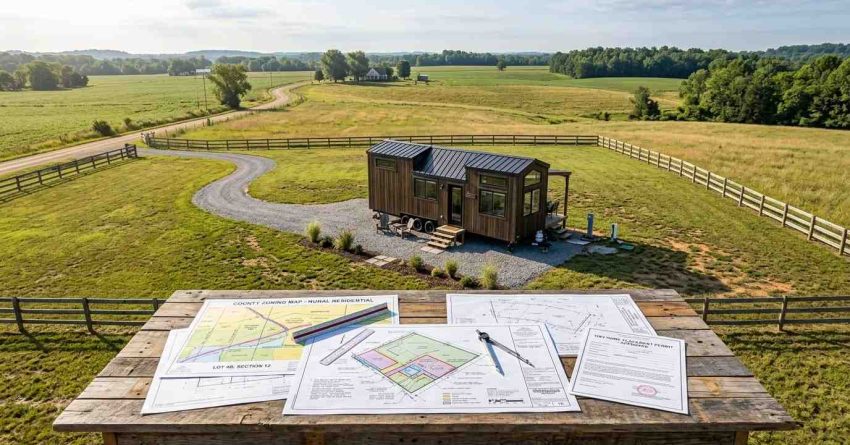
Zoning is the single most important factor in determining whether you can legally place a THOW on a specific piece of land. Even in THOW-friendly states, individual counties and municipalities control zoning, which means two neighboring counties can have completely different rules.
The most relevant zoning categories for THOW placement are:
- Residential (R1, R2, R3) — Single-family and multi-family zones. THOWs are rarely permitted here without specific ADU provisions.
- Agricultural (A1, A2) — Rural agricultural zones are the most permissive for THOW placement in most states.
- Mixed-Use — Some mixed-use zones allow THOWs, particularly in states with progressive housing policies.
- RV/Mobile Home Park Zones — Designated zones for movable dwellings. THOWs are generally permitted here but subject to park rules.
Rural vs. Urban Zoning Differences for THOWs
Rural counties operate under far less restrictive zoning frameworks than urban municipalities. In agricultural zones, many counties do not require building permits for structures under a certain square footage, and THOWs often fall below that threshold. Urban areas, by contrast, apply full residential building codes, setback requirements, and utility connection mandates that THOWs frequently cannot meet without significant modification.
Rural counties frequently operate under different land-use frameworks than cities — our resource on rural zoning rules explains how agricultural and low-density designations affect THOW placement across different states.
RV Park vs. Residential Land: Where Can You Park a THOW?
The two most common legal placement options for a THOW are licensed RV parks and privately owned residential or agricultural land. Each option comes with distinct advantages and limitations.
RV Parks offer immediate legal placement, existing utility hookups, and community infrastructure. However, most RV parks limit stays to 30–180 days per year, which prevents full-time residency in many jurisdictions. Monthly fees can range from $400 to $1,200 depending on location and amenities.
Residential or Agricultural Land offers the possibility of full-time residency and greater autonomy, but requires navigating local zoning, obtaining permits, and installing or connecting to utilities independently. Land ownership also provides long-term stability that RV parks cannot guarantee.
Choosing between an RV park and private residential land involves more than just cost — our RV park living resource outlines the rules, hookup requirements, and long-term residency considerations that THOW owners need to evaluate before committing to a location. Some THOW owners also explore land-sharing arrangements, where they rent space on a private property owner’s land. These arrangements are legal in many states but require a written agreement and, in some jurisdictions, a formal land-use permit.
How to Check THOW Legal Status in Your State
Verifying THOW legal status in your specific state and county requires checking multiple sources, since state law and local ordinances often differ significantly.
Follow these steps to confirm your legal standing before purchasing or placing a THOW:
- Contact your county planning and zoning department — Ask specifically whether THOWs are permitted as primary residences in your target zone and what permits are required.
- Review your state’s building code — Look for references to “tiny homes,” “recreational vehicles,” “manufactured housing,” and “accessory dwelling units” to understand how your state classifies THOWs.
- Check your state’s DMV or DOT — THOWs must be registered as vehicles in most states. Confirm registration requirements and any weight or dimension limits.
- Consult a local real estate attorney — For complex situations involving land purchase or lease agreements, legal counsel familiar with local zoning is essential.
- Connect with local THOW communities — Owners already living legally in your target area are often the most current and practical source of information about what actually works on the ground.
For a broader understanding of how tiny home regulations connect to construction, financing, and ownership decisions, our tiny homes overview provides the full context you need before taking action in your state.
Conclusion
THOW legal status varies significantly across the United States, shaped by state classification systems, local zoning ordinances, and evolving housing policy. Understanding where your state stands is the essential first step in any THOW ownership journey.
The gap between THOW-friendly and restrictive states continues to narrow as more jurisdictions update their codes to reflect growing demand for alternative housing. Staying current with local regulations protects your investment and your right to live where you choose.
At Mr. Local Services, we connect property owners and THOW enthusiasts with trusted professionals who understand local regulations, site preparation, and property improvement — reach out today to get reliable guidance for your specific location and situation.
Frequently Asked Questions
Are tiny homes on wheels legal in all 50 states?
THOWs are not explicitly illegal in any U.S. state, but they are not fully legal for full-time residential use in all states either. Most states classify THOWs as RVs, which limits where and how long you can live in them.
What is the difference between a THOW and a manufactured home?
A THOW is built on a trailer chassis and is designed to be movable, while a manufactured home is built on a permanent steel chassis and is typically placed on a fixed foundation. Different building codes and zoning rules apply to each type.
Can I park a THOW on my own land?
In many states and rural counties, yes — but you must verify local zoning rules first. Agricultural and rural zones are generally the most permissive, while residential zones in cities and suburbs often prohibit THOW placement without specific ADU approval.
Do I need a permit to live in a THOW full-time?
Permit requirements vary by state and county. Some jurisdictions require a land-use permit, a building permit, or both. Others require no permit at all in rural agricultural zones. Always check with your local planning department before placing a THOW.
How is a THOW registered and titled?
Most states require THOWs to be registered as recreational vehicles through the state DMV or DOT. Some states have created separate THOW registration categories. The trailer must meet state weight and dimension requirements to be legally towed on public roads.
Can I get a permanent address in a THOW?
In states with full THOW legality frameworks, you can register a THOW as a primary residence and obtain a permanent address. In states that classify THOWs only as RVs, obtaining a permanent residential address is more difficult and may require using a mail forwarding service.
What happens if I place a THOW in a zone where it is not permitted?
Placing a THOW in a non-permitted zone can result in fines, a notice to vacate, forced removal of the structure, and legal liability. Always confirm zoning compliance before placement to avoid costly enforcement actions.