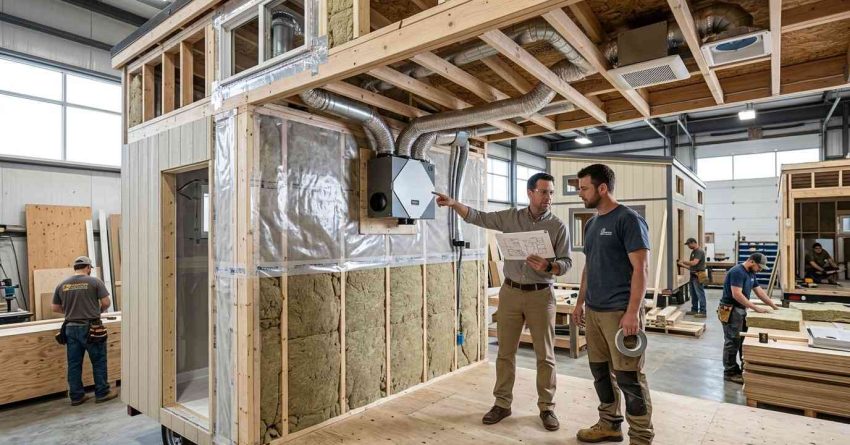
Proper ventilation and moisture control in a tiny house on wheels directly determine whether your living space stays healthy, structurally sound, and comfortable year-round. Without the right systems in place, condensation, mold, and wood rot can develop quickly in the compact, tightly sealed environment of a THOW — often before visible damage appears.
Moisture buildup in small spaces moves fast, and the consequences for your walls, insulation, and subfloor can be costly if left unaddressed for even one season.
This guide explains how ventilation works in a THOW, what causes moisture problems, which systems and materials perform best, and when to bring in a professional for help.
What Is Ventilation in a Tiny House on Wheels?
Ventilation in a THOW is the process of moving fresh air into the living space while pushing stale, humid air out. In a standard home, the larger volume of air and more porous construction naturally allow some air exchange. In a tiny house on wheels, the space is small, the walls are often tightly insulated, and the structure is built to travel — which means air movement must be intentional and well-designed.
Good ventilation serves three functions in a THOW. It removes excess humidity generated by cooking, showering, and breathing. It prevents carbon dioxide from accumulating in an enclosed space. And it regulates temperature by allowing hot or cold air to escape before it creates comfort or structural problems.
Without adequate airflow, a THOW becomes a sealed container where moisture has nowhere to go. That moisture then condenses on cold surfaces — windows, walls, and metal framing — and begins the cycle of damage that leads to mold, rot, and deterioration of insulation.
Understanding ventilation starts with knowing how a THOW is built — our tiny home systems guide covers the full structural and mechanical overview every owner needs before making any upgrade decisions.
Why Air Circulation Matters in a Small Space
The smaller the space, the faster air quality degrades. A single person exhales roughly one liter of water vapor per hour during normal activity. In a 200-square-foot THOW, that moisture has very little room to dilute before it reaches surfaces and condenses. Add cooking steam, a hot shower, or wet clothing drying indoors, and humidity levels can spike dramatically within minutes.
Consistent air circulation prevents that buildup from reaching the dew point — the temperature at which moisture in the air turns to liquid on surfaces. Keeping air moving, even at low rates, is the single most effective way to prevent condensation before it starts.
Common Moisture Problems in THOWs
Moisture problems in a tiny house on wheels fall into two categories: surface condensation and structural infiltration. Surface condensation is visible — water droplets on windows, damp walls, or a clammy feeling in the air. Structural infiltration is hidden — moisture that has worked its way into wall cavities, subfloor panels, or roof decking without any obvious sign on the interior surface.
Both types cause damage, but structural infiltration is far more serious because it often goes undetected until the damage is extensive. Wood framing that stays damp for extended periods loses structural integrity. Insulation that absorbs moisture loses its R-value and becomes a breeding ground for mold. Metal fasteners and connectors corrode, weakening the connections that hold the THOW together during travel.
How Condensation Builds Up Inside a Tiny Home
Condensation forms when warm, humid air contacts a surface that is cooler than the dew point of that air. In a THOW, this happens most often on windows, exterior walls, and any metal components that conduct cold from outside. The process accelerates in winter when the temperature difference between inside and outside is greatest.
The primary sources of moisture inside a THOW are occupant respiration, cooking without ventilation, showering, and any wet materials brought inside. A single pot of boiling water can raise interior humidity by several percentage points in a small space. Without a working exhaust system or open window, that moisture stays in the air until it finds a cold surface to settle on.
Ventilation Systems for Tiny Homes on Wheels
Effective ventilation in a THOW typically combines passive and mechanical systems. Relying on one approach alone rarely provides sufficient air exchange across all seasons and weather conditions. The right combination depends on your climate, how often you move, and how tightly your THOW is built.
Choosing the right ventilation setup often connects directly to your heating and cooling strategy — explore our THOW HVAC options to see how ventilation and climate control work together in a tiny home.
Passive Ventilation Options
Passive ventilation uses natural air pressure differences and wind to move air through the THOW without mechanical assistance. The most common passive options include operable windows positioned on opposite walls to create cross-ventilation, roof vents that allow hot air to rise and escape, and ridge vents along the roofline that work continuously as long as there is any wind or temperature differential.
Passive systems are low-cost, require no electricity, and have no moving parts to maintain. Their limitation is that they depend on outdoor conditions. On still, humid days — exactly when moisture control is most critical — passive ventilation may not provide enough air exchange on its own.
For a dedicated resource on installing roof vents in your THOW, see our guide on THOW roof vent installation, which walks through placement, sizing, and weatherproofing for mobile structures.
Mechanical Ventilation and Exhaust Fans
Mechanical ventilation uses powered fans to force air exchange regardless of outdoor conditions. In a THOW, the most important mechanical ventilation points are the kitchen range hood and the bathroom exhaust fan. These two areas generate the highest concentrations of moisture and must have direct exhaust paths to the outside — not just recirculating filters.
Energy recovery ventilators (ERVs) are an increasingly popular option for THOWs in climates with extreme temperatures. An ERV exchanges stale indoor air for fresh outdoor air while transferring heat between the two streams, so you lose minimal heating or cooling energy during the exchange. For a tightly built, well-insulated THOW, an ERV can provide continuous fresh air without the energy penalty of simply opening a window in winter.
Ceiling fans and small oscillating fans also contribute to air circulation within the space, reducing the likelihood of stagnant pockets of humid air forming in corners or near the floor.
How to Control Moisture in a THOW
Moisture control in a tiny house on wheels requires a layered approach. Ventilation removes moisture from the air. Insulation and vapor barriers prevent moisture from entering the wall assembly. Dehumidifiers manage residual humidity when ventilation alone is not sufficient. Each layer addresses a different pathway through which moisture can cause damage.
Moisture control depends heavily on how well your walls and floor are insulated — our resource on THOW insulation types explains which materials perform best in small, mobile living spaces.
Vapor Barriers and Insulation Choices
A vapor barrier is a material installed within the wall assembly that slows or stops the movement of water vapor from the warm interior into the cooler wall cavity. Without a vapor barrier, warm humid air from inside the THOW migrates into the wall, cools as it approaches the exterior, and condenses inside the insulation — causing exactly the kind of hidden structural moisture that is hardest to detect and most damaging over time.
In most USA climates, the vapor barrier belongs on the warm side of the insulation — the interior face of the wall. Common materials include polyethylene sheeting, vapor-retarding paint, and closed-cell spray foam, which acts as both insulation and vapor barrier in a single layer.
Insulation choice matters significantly for moisture performance. Closed-cell spray foam has the highest R-value per inch and the lowest vapor permeability, making it the strongest moisture barrier available for THOW walls. Open-cell spray foam and fiberglass batts allow more vapor movement and require a separate vapor barrier to perform correctly. Rigid foam board is a strong middle-ground option that is easy to cut and install in the irregular cavities common in THOW framing.
For a complete breakdown of vapor barrier installation in tiny homes, our guide on THOW vapor barriers covers material selection, placement, and common installation mistakes to avoid.
Dehumidifiers and Moisture-Absorbing Solutions
When ventilation and vapor barriers are in place but humidity still runs high — common in humid climates or during rainy seasons — a dehumidifier provides active moisture removal from the air. For a THOW, a compact portable dehumidifier rated for 30 to 50 pints per day is typically sufficient for the square footage involved.
Placement matters. Position the dehumidifier in the area with the highest moisture load — usually near the kitchen or bathroom — and ensure the drainage hose or collection tank is managed consistently. Running a dehumidifier without emptying the tank defeats its purpose.
Passive moisture absorbers, such as desiccant containers, are useful in enclosed spaces like storage compartments, closets, and under-bed areas where a powered dehumidifier cannot reach. They do not replace active ventilation or a dehumidifier for the main living area but add a useful layer of protection in confined spots.
For guidance on selecting the right dehumidifier size for your specific THOW layout, see our resource on choosing a THOW dehumidifier.
Signs Your THOW Has a Ventilation or Moisture Problem
Recognizing a moisture or ventilation problem early is the difference between a simple fix and a costly structural repair. The most common warning signs include persistent condensation on windows even after the interior warms up, a musty or earthy smell that does not clear with airing out, visible mold or mildew on walls, ceilings, or around window frames, and soft or spongy spots in the subfloor or wall panels.
Less obvious signs include paint or wallboard that bubbles, peels, or stains without an obvious water source, wood trim that warps or gaps at joints, and metal hardware that shows rust or corrosion faster than expected. Fogged or permanently clouded windows in a double-pane unit indicate seal failure caused by moisture infiltration.
If you notice any of these signs, address them immediately. Moisture damage compounds quickly in a small structure. If moisture has already reached your walls or framing, the damage may go beyond a DIY fix — our water damage repair team can assess the extent of the problem and restore affected areas safely.
Ventilation and Moisture Control During Seasonal Changes
The demands on your THOW ventilation system change significantly with the seasons, and a strategy that works well in summer may be inadequate in winter — or vice versa.
In summer, the priority is removing heat and humidity. Cross-ventilation through open windows, roof vents, and ceiling fans handles most of the load. A dehumidifier may be needed in high-humidity regions. Cooking and showering should always be accompanied by active exhaust to prevent moisture spikes.
In winter, the challenge reverses. Tightly sealing the THOW to retain heat reduces natural air exchange, which causes humidity to build up rapidly from occupant activity. This is when mechanical ventilation becomes most critical. Running bathroom and kitchen exhaust fans consistently, using an ERV if installed, and monitoring interior humidity with a hygrometer helps maintain safe levels — typically between 30 and 50 percent relative humidity.
During shoulder seasons — spring and fall — temperature swings create the most condensation risk. Warm days followed by cold nights mean surfaces inside the THOW can drop below the dew point overnight even when daytime conditions seem comfortable. Keeping ventilation active through these transitions prevents the condensation cycles that cause the most cumulative damage.
For a complete seasonal approach to protecting your THOW structure, our THOW winterization checklist covers the specific steps to take before cold weather arrives.
When to Call a Professional for THOW Ventilation Help
Most basic ventilation improvements — adding a window vent, replacing an exhaust fan, or installing a dehumidifier — are within reach of a capable DIYer. But some situations call for professional assessment and repair.
Call a professional when you find visible mold covering more than a small surface area, when the subfloor or wall framing feels soft or shows signs of rot, when your existing ventilation system is not reducing humidity despite running consistently, or when you are planning a significant upgrade like adding an ERV or reconfiguring your insulation assembly.
For smaller ventilation upgrades like fan installation, vent cover replacement, or sealing gaps, a skilled handyman can handle the work efficiently — see how our handyman for THOWs service covers these targeted repairs.
When ventilation or moisture issues go beyond basic fixes, working with professionals who understand the unique demands of tiny home living makes all the difference — visit our tiny home maintenance to learn how we support THOW owners across the USA.
Conclusion
Ventilation and moisture control are foundational to the long-term health of any tiny house on wheels. The combination of a small interior volume, tight construction, and mobile use creates conditions where moisture accumulates faster and causes damage more quickly than in a conventional home.
Addressing ventilation with both passive and mechanical systems, pairing them with the right insulation and vapor barrier strategy, and monitoring humidity through seasonal changes gives your THOW the best protection against condensation, mold, and structural deterioration.
At Mr. Local Services, we connect THOW owners with skilled professionals who understand the specific demands of tiny home maintenance — reach out today to get the right help for your ventilation and moisture control needs.
Frequently Asked Questions
How much ventilation does a tiny house on wheels need?
A THOW needs enough ventilation to exchange the full volume of interior air at least four to six times per hour. For a 200-square-foot tiny home with an 8-foot ceiling, that means moving roughly 1,000 to 1,500 cubic feet of air per hour through a combination of passive and mechanical systems.
What causes condensation inside a THOW?
Condensation forms when warm, humid interior air contacts a surface cooler than its dew point. In a THOW, the primary causes are cooking, showering, and normal respiration in a tightly sealed space without sufficient exhaust ventilation to remove the moisture before it settles on walls and windows.
Can I use a regular dehumidifier in a tiny home?
Yes, a standard portable dehumidifier works well in a THOW. Choose a unit rated for 30 to 50 pints per day, which is appropriately sized for the square footage of most tiny homes. Position it near the highest-moisture area and manage drainage consistently to keep it operating effectively.
What is the best insulation for moisture control in a THOW?
Closed-cell spray foam is the top-performing insulation for moisture control in a THOW. It provides a high R-value per inch and acts as its own vapor barrier, preventing moisture from migrating into the wall cavity. Rigid foam board is a strong alternative that is easier to install in existing structures.
How do I prevent mold in a tiny house on wheels?
Preventing mold requires keeping interior relative humidity below 50 percent, running exhaust fans during and after cooking and showering, ensuring all wall assemblies include a vapor barrier, and inspecting window frames, corners, and the subfloor regularly for early signs of moisture accumulation.
Do THOWs need a vapor barrier?
Yes. A vapor barrier is essential in a THOW to prevent warm interior air from migrating into the wall cavity and condensing on cooler surfaces inside the insulation. Without it, hidden moisture accumulates in the wall assembly and causes rot, mold, and insulation failure over time.
When should I upgrade my THOW ventilation system?
Upgrade your ventilation system when interior humidity consistently exceeds 55 percent despite running existing fans, when condensation appears regularly on walls or windows, when you notice musty odors that do not clear with airing out, or when you are adding occupants or changing how you use the space in ways that increase moisture load.