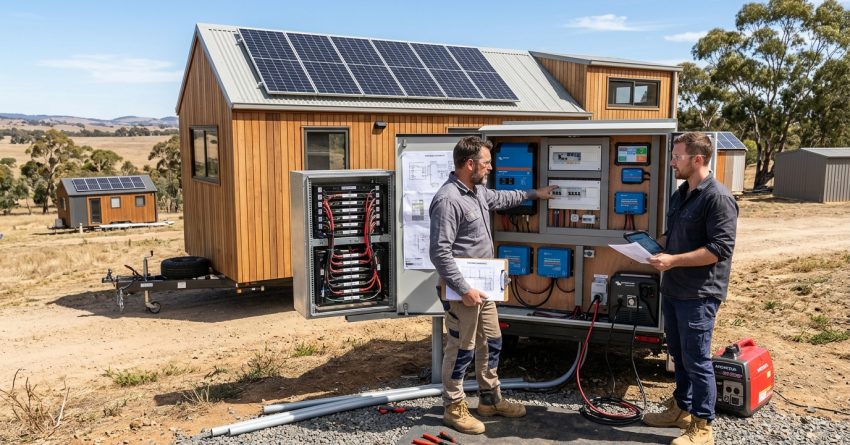
Setting up solar power on a tiny home on wheels requires careful planning across four core areas: energy load calculation, component selection, physical installation, and ongoing system management. Done correctly, a THOW solar setup gives you reliable, independent power whether you are parked at a campsite, on rural land, or moving between locations.
Most THOW owners underestimate how much planning goes into a solar system before a single panel is mounted. Getting the sizing wrong costs money, reduces reliability, and can create safety hazards in a small living space.
This guide walks through every stage of a THOW solar setup — from understanding your power needs to completing the installation and keeping the system running efficiently long term.
What Is a THOW Solar System and Why It Matters
A THOW solar system is a self-contained off-grid power setup built specifically for a tiny home on wheels. Unlike a standard residential solar installation, a THOW system must account for trailer weight limits, roof surface area, mobile use conditions, and the need to operate independently from the utility grid.
The system typically includes solar panels, a charge controller, a battery bank, an inverter, and a load panel. Each component plays a specific role in capturing sunlight, storing energy, converting it to usable power, and distributing it safely throughout the home.
Understanding how solar integrates into a THOW starts with knowing how these structures are built and regulated — our tiny home guide covers everything from trailer specifications to building codes that affect your electrical planning.
Key Components of a THOW Solar Setup
Every functional THOW solar system includes these core components:
- Solar panels — capture sunlight and convert it to DC electricity
- Charge controller — regulates the flow of power from panels to batteries, preventing overcharge
- Battery bank — stores energy for use when sunlight is unavailable
- Inverter — converts stored DC power to AC power for standard appliances
- AC load panel — distributes power to circuits throughout the home
- Wiring and fusing — connects all components safely and protects against shorts and overloads
How Solar Power Differs in a Tiny Home on Wheels
A THOW solar system faces constraints that a fixed residential system does not. Roof space is limited, often to 150–300 square feet, which caps total panel capacity. Trailer tongue weight and axle ratings restrict how much battery weight you can carry. The system must also tolerate road vibration, temperature swings, and variable sun exposure as the home moves between locations.
These constraints make component selection and system sizing more critical in a THOW than in any other solar application.
How to Calculate Your Power Needs Before You Buy
Sizing a THOW solar system starts with an honest accounting of how much electricity you actually use. Buying panels and batteries before completing this step is one of the most common and costly mistakes THOW owners make.
Estimating Daily Energy Consumption
List every electrical device you plan to use and estimate how many hours per day each will run. Multiply each device’s wattage by its daily run time to get watt-hours. Add all figures together for your total daily consumption.
A typical THOW with LED lighting, a laptop, phone charging, a small refrigerator, and a fan uses between 800 and 1,500 watt-hours per day. Adding an electric cooktop, air conditioning, or an electric water heater can push that figure to 3,000 watt-hours or more — which may exceed what a roof-mounted system can realistically supply.
Accurately sizing your system requires a professional-grade understanding of electrical loads — our electrical load assessment explains how licensed electricians evaluate consumption and capacity for residential and off-grid setups.
Sizing Your Battery Bank and Inverter
Once you know your daily consumption, size your battery bank to cover at least two to three days of use without solar input. This buffer accounts for cloudy days and periods of low sun angle.
For a system consuming 1,200 watt-hours per day, a battery bank of 200–300 amp-hours at 12 volts (or 100–150 amp-hours at 24 volts) provides adequate reserve. Lithium iron phosphate (LiFePO4) batteries are the preferred choice for THOW applications because they are lighter, have a longer cycle life, and can be discharged more deeply than lead-acid alternatives.
Your inverter should be sized to handle the peak wattage of all devices you might run simultaneously, not just your average load. A 2,000-watt pure sine wave inverter handles most THOW loads comfortably. If you plan to run high-draw appliances, size up to 3,000 watts.
A dedicated resource covering battery bank sizing in full detail is available here: THOW battery bank sizing
Choosing the Right Solar Panels for Your THOW
Panel selection for a THOW involves balancing efficiency, weight, durability, and cost within the physical constraints of your trailer roof.
Monocrystalline vs. Polycrystalline Panels
Monocrystalline panels are the standard choice for THOW installations. They produce more power per square foot than polycrystalline panels, which matters when roof space is limited. They also perform better in low-light and high-temperature conditions — both common in mobile living scenarios.
Polycrystalline panels cost less upfront but require more surface area to produce the same output. In most THOW applications, the roof space premium makes monocrystalline the practical choice despite the higher cost.
A detailed comparison of panel types for small structures is available here: solar panel types for tiny homes
Roof Space Limitations and Weight Considerations
Most THOW roofs can accommodate between two and six standard 400-watt panels, depending on roof pitch, obstructions like vents and skylights, and trailer weight ratings. A single 400-watt monocrystalline panel weighs approximately 40–50 pounds. Four panels add 160–200 pounds to your roof load — a figure that must be factored into your trailer’s gross vehicle weight rating (GVWR).
Always verify your trailer’s roof load capacity before purchasing panels. Exceeding structural limits creates safety risks during transport and can void your trailer warranty.
Structural considerations specific to THOW roofs are covered in detail here: THOW roof weight limits
Step-by-Step THOW Solar Installation Process
With your components selected and sized, installation follows a logical sequence. Completing each stage in order prevents wiring errors and ensures the system operates safely from the first day.
Mounting Solar Panels Safely on a Trailer Roof
Begin by marking panel positions on the roof before drilling any holes. Use a stud finder or consult your trailer’s structural drawings to locate roof rafters. Mount panels to rafters wherever possible — never to roof decking alone.
Use Z-brackets or tilt-mount racking designed for low-profile trailer roofs. Apply butyl tape or self-leveling lap sealant around every penetration point before tightening hardware. Unsealed roof penetrations are a leading cause of water intrusion in THOWs.
Run conduit or cable raceways from the panel junction boxes to the roof entry point. Use a waterproof cable entry gland rated for outdoor use. Label all wiring at both ends before routing it into the interior.
For homeowners who prefer professional support during the physical mounting and wiring stages, our handyman installation help connects you with skilled technicians experienced in small-structure builds and off-grid systems.
Wiring the Charge Controller and Battery Bank
Connect the battery bank first, before connecting any panels. This sequence prevents voltage spikes that can damage the charge controller during initial setup.
Use appropriately sized wire for each run. The wire between your battery bank and inverter carries the highest current in the system and typically requires 2/0 or 4/0 AWG cable for runs under six feet. Use a fuse or circuit breaker within 18 inches of the positive battery terminal on every high-current run.
Connect the charge controller to the battery bank according to the manufacturer’s wiring diagram. Set the battery type (lithium, AGM, or flooded lead-acid) in the controller before connecting the panels. Incorrect battery type settings cause chronic undercharging or overcharging, both of which shorten battery life significantly.
Once the controller is configured, connect the solar panel array. Most MPPT charge controllers accept panel strings wired in series, in parallel, or in a series-parallel combination depending on your voltage and current targets.
Connecting the Inverter and AC Load Panel
Mount the inverter as close to the battery bank as practical to minimize voltage drop on the high-current DC cables. Connect the inverter’s DC input directly to the battery bank using appropriately sized cable and a fuse sized to the inverter’s maximum input current.
Connect the inverter’s AC output to your load panel. If your THOW will also connect to shore power at campgrounds or properties, install a transfer switch to prevent backfeed between the inverter and shore power source. Backfeed is a serious safety hazard and is prohibited by electrical codes in all US jurisdictions.
A complete guide to inverter selection for off-grid systems is available here: off-grid inverter selection
Managing and Monitoring Your THOW Solar System
A properly installed system still requires regular attention to perform reliably over time. Monitoring your system’s state of charge and output helps you catch problems early and extend the life of every component.
Charge Controller Settings and Optimization
Review your charge controller’s absorption voltage, float voltage, and equalization settings after installation. These parameters vary by battery chemistry and manufacturer specification. Using default settings without verification is a common cause of premature battery failure in THOW systems.
Most modern MPPT controllers include Bluetooth connectivity or a display port for a remote monitor. Connecting a monitoring display inside the home lets you track panel output, battery state of charge, and daily energy harvest without going outside to check the controller.
Keeping your solar-powered appliances running efficiently is just as important as the system itself — our appliance efficiency tips outlines how routine appliance servicing reduces energy draw and extends battery life.
Battery Maintenance and State of Charge Monitoring
LiFePO4 batteries require minimal maintenance compared to lead-acid alternatives, but they still benefit from periodic inspection of terminal connections, cell balance checks (for DIY battery packs), and temperature monitoring in extreme climates.
Never discharge LiFePO4 batteries below 20% state of charge on a regular basis. Chronic deep discharge accelerates capacity loss and shortens the battery’s usable life. Set your inverter’s low-voltage cutoff to disconnect loads before the battery reaches this threshold.
For lead-acid batteries, check electrolyte levels monthly and equalize the bank every 30–60 days according to the manufacturer’s schedule.
Common THOW Solar Setup Mistakes and How to Avoid Them
Even experienced builders make avoidable errors during THOW solar installations. These are the most frequent problems and how to prevent them.
Undersizing the battery bank. Most first-time THOW builders underestimate how much storage they need. Build in at least 20–30% more capacity than your calculated daily consumption to account for inefficiencies and cloudy periods.
Using undersized wire. Voltage drop across undersized wire wastes energy and generates heat. Use a wire sizing calculator for every run and always round up to the next larger gauge when in doubt.
Skipping roof sealant. Every roof penetration is a potential leak point. Apply sealant before and after mounting hardware, not just around the edges after the fact.
Mixing battery chemistries. Never connect lithium and lead-acid batteries in the same bank. Different charge profiles make them incompatible and can cause dangerous charging conditions.
Forgetting to fuse every circuit. Every positive conductor leaving the battery bank needs a fuse or breaker sized to protect the wire, not the device. Unfused wiring is a fire hazard.
When to Call a Professional for THOW Solar Work
Most of the DC wiring in a THOW solar system falls within the capability of a careful, informed DIY builder. The AC side of the system — inverter output wiring, load panel connections, and shore power integration — is a different matter.
AC wiring in a THOW is subject to the same electrical codes that govern residential construction in most US states. Improper AC wiring creates shock and fire hazards that affect not just the owner but anyone who connects to or works near the home.
When your THOW solar system involves AC wiring, inverter connections, or load panel work, a licensed electrician is essential — explore our licensed electrical services to find qualified professionals who handle off-grid and residential electrical systems safely.
This section also connects back to the broader context of THOW ownership and off-grid living — our tiny home systems provides the full picture of what goes into building, powering, and maintaining a compliant tiny home on wheels.
Electrical code compliance requirements specific to THOWs vary by state and jurisdiction. A dedicated resource covering this topic is available here: THOW electrical code requirements
Conclusion
A well-planned THOW solar setup delivers reliable, independent power that supports comfortable off-grid living across every season and location. The key is working through each stage — load calculation, component sizing, installation, and monitoring — in the correct sequence.
Skipping steps or underestimating complexity leads to systems that underperform, fail prematurely, or create safety risks in a small living space. Getting the sizing and wiring right from the start protects your investment and your home.
At Mr. Local Services, our network of licensed electricians and skilled handyman professionals is ready to support your THOW solar project — from load assessment and panel mounting to AC wiring and system commissioning. Contact us today to connect with a qualified professional in your area.
Frequently Asked Questions
How many solar panels does a THOW typically need?
Most THOWs need between two and four 400-watt solar panels to meet average daily energy needs. The exact number depends on your daily consumption, roof space, and how many days of battery reserve you want to maintain.
What type of battery is best for a THOW solar system?
Lithium iron phosphate (LiFePO4) batteries are the best choice for most THOW applications. They are lighter than lead-acid alternatives, last significantly longer, and can be discharged more deeply without damage — all critical advantages in a mobile, weight-sensitive setup.
Can I install a THOW solar system myself?
The DC components — panels, charge controller, and battery bank — are within reach for a careful DIY builder with basic electrical knowledge. The AC wiring, inverter output connections, and load panel work should be handled by a licensed electrician to meet code requirements and ensure safety.
How long does a THOW solar battery bank last?
A quality LiFePO4 battery bank typically lasts 10 or more years with proper care, including avoiding chronic deep discharge and keeping connections clean and tight. Lead-acid batteries in the same application typically last three to five years.
What size inverter do I need for a THOW?
A 2,000-watt pure sine wave inverter handles most standard THOW loads comfortably. If you plan to run high-draw appliances like an electric cooktop or air conditioner, size up to 3,000 watts to handle peak demand without overloading the inverter.
Do I need a permit to install solar on a THOW?
Permit requirements vary by state and jurisdiction. DC-only systems are often unregulated, but any AC wiring connected to a load panel or shore power transfer switch typically requires a permit and licensed electrical work. Check with your local building department before beginning installation.
How do I know if my THOW solar system is working correctly?
A monitoring display connected to your charge controller shows real-time panel output, battery state of charge, and daily energy harvest. If your battery is not reaching full charge on sunny days or is depleting faster than expected, check panel connections, controller settings, and battery health before assuming a component has failed.