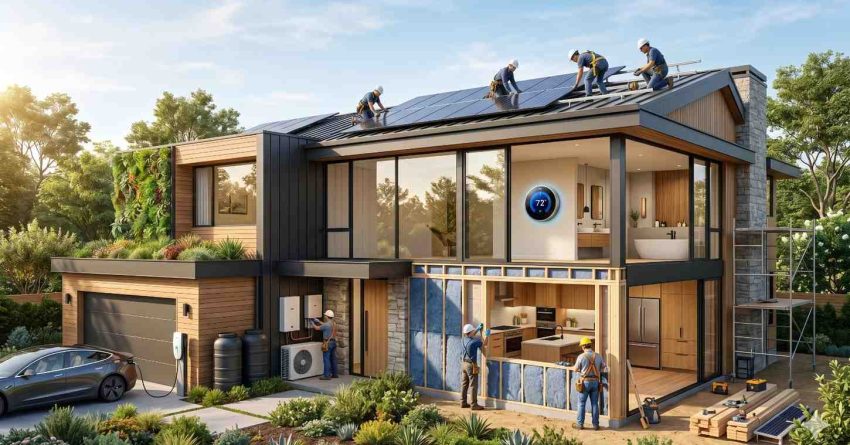
Green and energy-efficient remodeling is the practice of upgrading a home’s envelope, mechanical systems, materials, and energy sources to reduce utility costs, cut carbon emissions, and improve comfort, health, and resilience while preserving long-term property value. This guide gives homeowners, landlords, and property managers a complete roadmap.
With energy prices volatile and federal incentives at historic levels, postponing efficiency upgrades means paying more every month, missing tax credits, and accepting a less comfortable, less marketable home in 2025.
Inside, you will learn energy audits, envelope upgrades, electrification, solar and battery, rebates and tax credits, green materials, water conservation, and proven ROI strategies for every U.S. climate zone.
Start With an Energy Audit
Every successful green remodel begins with measurement, not assumptions. A professional energy audit identifies where your home is losing heat, leaking air, wasting electricity, and underperforming compared to its potential — turning a vague “we want to be more efficient” goal into a ranked list of specific, fixable problems with known payback periods.
What a Home Energy Audit Measures
A standard audit evaluates the building envelope (walls, attic, foundation, windows), the HVAC system and ductwork, water heating efficiency, lighting and appliance loads, ventilation, and combustion safety. The auditor produces a written report with a HERS (Home Energy Rating System) Index score or a DOE Home Energy Score, allowing you to benchmark your home against new construction.
Blower Door Tests and Thermal Imaging
The two diagnostic tests that change conversations are the blower door test, which measures air leakage in ACH50 (air changes per hour at 50 pascals), and infrared thermal imaging, which visualizes missing insulation and thermal bridging. According to ENERGY STAR, a typical U.S. home loses 20–30% of conditioned air through unintended leaks — a number most homeowners find shocking once they see the imaging.
A professional diagnostic gives you the data to prioritize spending intelligently, and our complete home energy audit guide walks through what each test measures, what it costs, and how to read the results before any contractor quotes a project.
Upgrade the Building Envelope First
Before replacing HVAC equipment, installing solar, or specifying new appliances, fix the building envelope. The envelope — air barrier, insulation, windows, doors, and roof — determines how much energy your systems must produce in the first place. Right-sizing equipment to a leaky, under-insulated house guarantees oversized systems, short cycling, and disappointing comfort.
Air Sealing as the Highest-Value First Step
Air sealing typically delivers the fastest payback of any energy upgrade, often 3 to 7 years, because it costs less than insulation or windows and addresses leakage that no other measure can fix. Common targets include attic penetrations, rim joists, recessed lights, and the basement-to-living-space boundary. Because air sealing returns more comfort and savings per dollar than almost any other upgrade, our deep dive on whole-house air sealing methods explains every technique, target leakage rate, and combustion-safety check homeowners need to know.
Insulation by Climate Zone
The U.S. Department of Energy publishes recommended R-values by climate zone, and these numbers should drive your specification. Climate Zone 5 attics, for example, want R-49 to R-60, while warm Zone 2 attics need R-38 to R-49. Wall retrofits, basement insulation, and crawl space encapsulation each have distinct best practices that depend on moisture conditions and existing construction.
Windows, Doors, and Cool Roofs
Replacement windows are popular but rarely the highest-ROI envelope upgrade. Focus on U-factor (insulation value) and SHGC (solar heat gain) numbers appropriate for your climate. In hot regions, cool roofs with high solar reflectance can cut cooling loads measurably. Once leaks are sealed, insulation actually performs as designed — and our attic insulation upgrade guide breaks down R-value targets, material choices, and the venting details that prevent moisture problems down the line.
Electrify Your Home Systems
Electrification means replacing fossil-fuel-burning appliances — gas furnaces, gas water heaters, gas ranges — with high-efficiency electric equivalents that can be powered by clean grids or on-site solar. With heat pump technology now mature and rebates aggressive, electrification has shifted from environmental statement to economic strategy for most U.S. homes.
Heat Pumps for Heating, Cooling, Water
Modern cold-climate air-source heat pumps deliver coefficients of performance (COP) between 2.5 and 4.0, meaning they produce 2.5 to 4 units of heat per unit of electricity. Heat pump water heaters cut water-heating energy use by roughly 60% versus standard electric resistance tanks. Heat pump selection sits inside a larger mechanical strategy, and our complete guide to HVAC in remodeling covers sizing, ductwork, and controls across every system type for context beyond electrification alone.
Induction Cooking and Panel Capacity
Induction cooktops outperform gas and electric resistance on speed, precision, and indoor air quality — a growing concern after recent studies linked gas combustion byproducts to elevated indoor NO₂ levels. Before adding electric heat, an EV charger, and induction together, check your service capacity. Many older homes need a 200-amp upgrade or a smart panel that manages loads dynamically.
Sequencing matters because panel upgrades, appliance retirements, and rebate windows all interact, and our home electrification roadmap maps every step in the right order so you avoid stranded equipment and missed credits.
Add Solar PV and Battery Storage
Solar photovoltaic systems become dramatically more cost-effective once envelope and electrification work is complete, because you size the array to a smaller, more predictable load. According to the Lawrence Berkeley National Laboratory’s Tracking the Sun report, median residential solar prices in 2024 ran around $4.10 per watt installed before incentives.
Sizing Solar to Reduced Loads
A right-sized system covers actual annual electricity use without massive overproduction. Oversizing wastes capital because most utilities credit excess generation at less-than-retail rates under modern net metering rules. After envelope and electrification upgrades, total household electricity needs often drop by 30–50%, meaning you need a smaller array than the pre-retrofit calculation would suggest.
Batteries, Microinverters, Net Metering
Battery storage adds resilience during outages and lets you self-consume more of your solar production where net metering rules have weakened. Microinverters or DC optimizers handle partial shading better than string inverters at the cost of higher upfront pricing. Net metering policies vary dramatically by state and utility, and they directly drive solar payback math.
Timing solar with roofing, framing, and electrical work cuts soft costs significantly, and our guide on solar PV during a remodel covers sizing, roof readiness, and inverter choices in homeowner-friendly language.
Stack Federal, State, and Utility Incentives
The Inflation Reduction Act unlocked the largest federal energy incentive package in U.S. history, and most homeowners are leaving money on the table by not stacking it with state and utility programs.
IRA Rebates: HEEHRA and HOMES
The Home Electrification and Appliance Rebate Act (HEEHRA) provides up to $14,000 per household for low- and moderate-income families covering heat pumps, heat pump water heaters, panel upgrades, and insulation. The HOMES program offers performance-based rebates tied to measured or modeled energy reductions, available to all income levels. State energy offices administer both, with rollout timing varying by state.
25C and 25D Tax Credits
The 25C Energy Efficient Home Improvement Credit pays 30% of qualifying envelope, HVAC, and audit costs up to $3,200 annually, and it resets every year — meaning a multi-year phased project can capture credits repeatedly. The 25D Residential Clean Energy Credit covers 30% of solar PV, battery storage, and geothermal installation costs with no annual cap through 2032. Utility rebates for heat pumps, smart thermostats, and weatherization typically stack on top.
Federal programs alone can cover thousands per project when stacked correctly, and our reference on IRA home energy rebates explained shows exactly which households qualify, how HEEHRA and HOMES differ, and what paperwork you will need.
Choose Green Materials and Building Methods
Green remodeling extends beyond energy to material selection, indoor air quality, durability, and embodied carbon — the emissions baked into a product before it ever reaches your job site.
Embodied Carbon and Low-VOC Finishes
Concrete, steel, and spray foam insulation carry high embodied carbon footprints, while wood-fiber insulation, cellulose, and reclaimed materials carry low or negative footprints. Paints, adhesives, sealants, and engineered wood products specified as low-VOC or no-VOC dramatically improve indoor air quality, particularly in tighter, better-sealed homes where pollutants no longer leak out as easily.
Passive House and LEED Frameworks
Two frameworks provide proven specifications. LEED for Homes covers a broad sustainability checklist including energy, water, materials, and site impact. Passive House targets ultra-low energy demand through extreme envelope performance, mechanical ventilation with heat recovery, and elimination of thermal bridges. Even partial Passive House principles — sometimes called “Pretty Good House” — measurably improve any remodel.
When you want a framework that ties envelope, ventilation, and energy choices into one performance target, our overview of passive house principles applied to remodels explains how the standard scales down for real-world retrofit budgets.
Cut Water Use Without Sacrificing Performance
Water efficiency belongs in every green remodel both because freshwater is increasingly stressed in many U.S. regions and because hot water represents a substantial share of household energy use.
WaterSense-labeled fixtures — toilets, showerheads, and faucets — meet EPA performance criteria while using significantly less water than standard models. A WaterSense showerhead uses 2.0 gallons per minute or less versus 2.5 for standard, a difference that compounds across thousands of showers per year. Hot water distribution efficiency matters as much as fixture flow rates: long, uninsulated supply runs waste both water and energy waiting for hot water to arrive. Recirculation systems with on-demand controls eliminate this waste.
Lower flow rates also mean less water to heat, which is why our breakdown of WaterSense fixtures explained pairs flow specs with hot water savings so you can compare fixtures on total cost of ownership.
Plan for ROI, Comfort, and Climate Realities
Sustainable remodeling has to make financial and lifestyle sense, or projects stall mid-stream. The good news: with current incentives, falling equipment costs, and rising utility prices, ROI math has shifted favorably for nearly every major upgrade.
ROI Ranking by Upgrade Type
Air sealing, attic insulation, and smart thermostats typically pay back fastest — often under 5 years. Heat pumps pay back in 6 to 12 years depending on fuel prices displaced and rebates captured. Solar PV in good-sun markets with strong net metering pays back in 7 to 11 years, then produces nearly free electricity for another 15-plus years. Replacement windows usually rank lowest on pure energy ROI but contribute meaningfully to comfort, noise reduction, and resale appeal. Not every upgrade pays back at the same rate, and our energy upgrade ROI ranking compares projects head-to-head with payback periods, comfort impact, and resale value lift so you can sequence spending by return.
Cold-Climate Heat Pumps and Deep Retrofits
The myth that heat pumps fail in cold weather persists despite strong field data, which is why our deep look at heat pumps in cold climates covers cold-climate models, backup strategies, and real performance numbers from northern installations.
Deep energy retrofits — projects that cut total energy use by 50% or more — require coordinated planning across envelope, mechanicals, ventilation, and sometimes solar. They cost more upfront but deliver near-net-zero performance, dramatically lower operating costs, and the most resilient long-term outcome.
Conclusion
Audit, envelope, electrification, solar, incentives, materials, water, and ROI — these eight dimensions form the complete green remodeling system every property needs.
Sequencing matters as much as scope; load reduction precedes equipment sizing, and incentive timing can shift project economics dramatically across regions and tax years.
We at Mr. Local Services connect you with vetted local professionals to plan, finance, and execute every stage of your energy-efficient remodel.
Frequently Asked Questions
What’s the difference between green remodeling and energy-efficient remodeling?
Energy-efficient remodeling focuses on reducing energy consumption. Green remodeling is broader, covering energy, water, materials, indoor air quality, durability, and embodied carbon. Most modern projects pursue both together.
Do I need an energy audit before remodeling?
An audit is strongly recommended for any project larger than cosmetic. It identifies high-ROI priorities, prevents oversized equipment, and qualifies you for performance-based rebates that require pre and post measurement.
Which energy upgrades have the highest ROI?
Air sealing, attic insulation, smart thermostats, and heat pump water heaters generally deliver the fastest paybacks, often under five years when stacked with available federal and utility incentives.
Can I qualify for tax credits and rebates at the same time?
Yes, in most cases. The 25C and 25D federal tax credits stack with utility rebates and many state programs. HEEHRA and HOMES rebates may reduce the basis for tax credits, so coordinate timing.
Is electrification worth it if I have cheap natural gas?
Usually yes. Heat pumps run efficiently enough that electric operating costs often match or beat gas, and you eliminate combustion safety risks, gas line maintenance, and exposure to volatile fuel prices.
How much can a deep energy retrofit reduce my utility bills?
A well-executed deep retrofit can cut total energy use by 50% to 80%, depending on the starting condition of the home. Combined with solar, net-zero operating cost is achievable in many climates.
Should I add solar before or after envelope upgrades?
Almost always after. Envelope and electrification work reduces your electricity demand, letting you install a smaller, less expensive solar array that still covers your needs.